
Catalogue Search | MBRL


Are you sure you want to remove the book from the shelf?

{{itemTitle}}
497
result(s) for
"Nelson, Brian C"
Sort by:

The best horror of the year. Volume ten
A group of mountain climbers, caught in the dark, fights to survive their descent; An American band finds more than they bargained for in Mexico while scouting remote locations for a photo shoot; A young student's exploration into the origins of a mysterious song leads him on a winding, dangerous path through the US's deep south; A group of kids scaring each other with ghost stories discovers alarming consequences. The Best Horror of the Year showcases the previous year's best offerings in horror short fiction. This edition includes award-winning and critically acclaimed authors Mark Morris, Kaaron Warren, John Langan, Carole Johnstone, Brian Hodge, and others. For more than three decades, award-winning editor and anthologist Ellen Datlow has had her finger on the pulse of the latest and most terrifying in horror writing. Night Shade Books is proud to present the tenth volume in this annual series, a new collection of stories to keep you up at night.
BOOK

Presence and Middle School Students' Participation in a Virtual Game Environment to Assess Science Inquiry
Technology offers many opportunities for educators to support teaching, learning and assessment. This paper introduces a project to design and implement a virtual environment (SAVE Science) intended to assess (not teach) middle school students' knowledge and use of scientific inquiry through two modules developed around curriculum taught in middle schools in Pennsylvania, U.S.A. We explore how the concept of 'presence' supports these efforts, as well as how Piaget's theory of developmental stages can be used as a lens to understand whether these students achieved presence in the modules. Findings are presented from a study looking at 154 middle school students' perceived sense of presence in a virtual world developed for the SAVE Science research project as demonstrated through a post module survey and a post module discussion with their teacher. Age and gender differences are explored. In addition we use content analysis, as described by Slater and Usoh (1993), of student talk in the post module discussion transcripts to identify levels of "presence." In the end, participating seventh grade students demonstrated achieving some level of presence, while the sixth grade students did not.
Journal Article

Exploring the Use of Individualized, Reflective Guidance in an Educational Multi-User Virtual Environment
This study examines the patterns of use and potential impact of individualized, reflective guidance in an educational Multi-User Virtual Environment (MUVE). A guidance system embedded within a MUVE- based scientific inquiry curriculum was implemented with a sample of middle school students in an exploratory study investigating (a) whether access to the guidance system was associated with improved learning, (b) whether students viewing more guidance messages saw greater improvement on content tests than those viewing less, and (c) whether there were any differences in guidance use among boys and girls. Initial experimental findings showed that basic access to individualized guidance used with a MUVE had no measurable impact on learning. However, post-hoc exploratory analyses indicated that increased use of the system among those with access to it was positively associated with content test score gains. In addition, differences were found in overall learning outcomes by gender and in patterns of guidance use by boys and girls, with girls outperforming boys across a spectrum of guidance system use. Based on these exploratory findings, the paper suggests design guidelines for the development of guidance systems embedded in MUVEs and outlines directions for further research.
Journal Article

Understanding museum visitors’ question-asking through a mobile app
Question-asking is essential for reasoning, understanding, and investigating scientific problems within and beyond traditional classrooms. Nevertheless, questions generated in formal and informal learning environments can be infrequent and unsophisticated. This study explores museum visitors’ question-asking quality by considering their interactions with two different modes of a question-asking mobile app (Ask or Game Mode) in two different museum environments (linear non-interactive or non-linear interactive exhibits). Results showed that visitors’ question-asking quality was influenced by app modes and by museum environments. Specifically, we found that visitors’ question-asking quality was significantly higher when using the gamified version of the app (Game Mode) compared to a non-gamified version (Ask Mode) in a linear non-interactive exhibit. Findings also revealed that question-asking performance could be significantly influenced by instrumental factors (such as app performance in answering questions) and socio-contextual factors (such as visitor group inquiry frequency). The study provides fundamental and comprehensive insights for designing active learning environments by considering the influential factors of question-asking.
Journal Article
Ask Dr. Discovery: the impact of a casual mobile game on visitor engagement with science museum content
This study examines the impact of a mobile game app on science museum visitors’ level of engagement with exhibit content, compared to a non game-based version of the same app. Ask Dr. Discovery (Dr. D) is a question-asking app containing two versions: a Game Mode employing casual game mechanics and an Ask Mode providing a baseline version. We implemented both versions of Dr. D at two science museums located in the Southwestern United States with 1539 participants. In both conditions, participants could type or speak questions to receive vetted answers about museum content, but only Game Mode embedded question-asking within a simple game. Participants’ level of engagement was represented by the number of questions asked about exhibit content in Dr. D. Additionally, we explored the relationship between app engagement and participants’ self-reported level of interest in science. All participants completed pre- and post-questionnaires with questions related to science interest, impressions of the Dr. D app, and demographic information. Results in both museums indicated that users of Game Mode asked nearly twice as many questions on average as participants using Ask Mode. Science interest predicted engagement at one of two sites. Demographic variables, including gender, age, and race/ethnicity were not found to influence the rate of question asking in either mode. These results indicate that employing simple game mechanics in apps for museum visitors may lead to strong positive impacts on visitor engagement with museum content.
Journal Article

Scientific Inquiry in Educational Multi-user Virtual Environments
In this paper, we present a review of research into the problems of implementing authentic scientific inquiry curricula in schools and the emerging use of educational Multi-User Virtual Environments (MUVEs) to support interactive scientific inquiry practices. Our analysis of existing literature in this growing area of study reveals three recurrent themes: (1) with careful design and inclusion of virtual inquiry tools, MUVE-based curricula can successfully support real-world inquiry practices based on authentic interactivity with simulated worlds and tools, (2) Educational MUVEs can support inquiry that is equally compelling for girls and boys, and (3) research on student engagement in MUVE-based curricula is uneven. Based on these themes, we suggest that future large-scale research should investigate (1) the extent to which MUVE-based inquiry learning can be a viable substitute for the activities involved in realworld inquiry; (2) the impact of MUVEs on learning and engagement for currently underserved students, and (3) the impact on engagement and learning of individual aspects of MUVE environments, particularly virtual experimentation tools designed to scaffold student inquiry processes and maintain engagement. Additionally, we note that two identified issues with integrating scientific inquiry into the classroom are currently not addressed by MUVE research. We urge researchers to investigate whether (1) MUVE-based curriculum can help teachers meet state and national standards with inquiry curricula; and (2) scientific inquiry curricula embedded in MUVE environments can help teachers learn how to integrate interactive scientific inquiry into their classroom.
Journal Article

The impact of a gamified mobile question-asking app on museum visitor group interactions: an ICAP framing
Mobile devices and apps have become a standard for the museum experience. Many studies have begun to explore the impact mobile apps may have on user experience and informal learning. However, there has been relatively little research on how visitor groups interact collaboratively while using these devices in computer-supported collaborative learning (CSCL) environments. In this paper, we explore the impact of a mobile question-asking app on museum visitor group interactions using the Interactive-Constructive-Active–Passive (ICAP) framework, a hierarchical taxonomy that differentiates modes of cognitive engagement. In a post-hoc analysis of survey findings from a study conducted at two large museums in the American southwest, we found that our app encouraged sharing of information among group members. In addition, users of a gamified version of the app were significantly more likely to report engaging in a group discussion during question-asking than groups using a non-game version of the app. We also found that group collaboration levels depended on the group-designated primary user of the app. Whenever a child or the group collaboratively asked the most questions, group discussion frequency was significantly higher. The study’s findings support mobile question-asking apps’ viability as a means to better understanding of museum visitor groups’ interactions with exhibit content and provide evidence that game-based mobile apps, designed to foster question-asking by visitors, may bolster collaborative group interactions and informal learning.
Journal Article
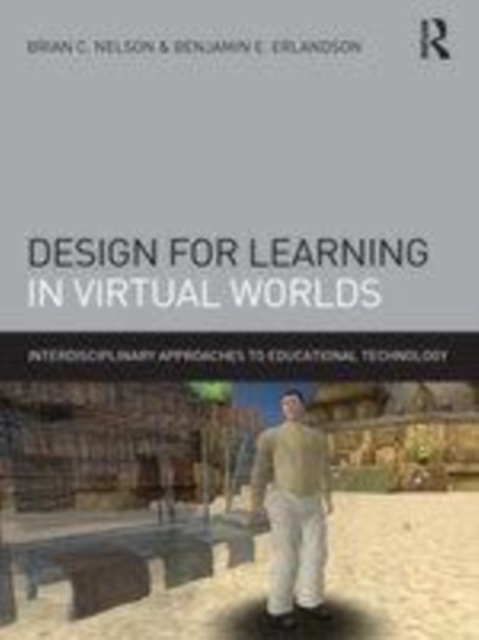
Design for Learning in Virtual Worlds
Design for Learning in Virtual Worlds, the first book focused specifically on how to design virtual worlds for educational purposes, explores:
the history and evolution of virtual worlds
the theories behind the use of virtual worlds for learning
the design of curricula in virtual worlds
design guidelines for elements experienced in virtual worlds that support learning
design guidelines for learning quests and activities in virtual worlds.
The authors also examine the theories and associated design principles used to create embedded assessments in virtual worlds. Finally, a framework and methodology is provided to assist professionals in evaluating \"off-the-shelf\" virtual worlds for use in educational and training settings. Design for Learning in Virtual Worlds will be invaluable both as a professional resource and as a textbook for courses within Educational Technology, Learning Sciences, and Library Media programs that focus on gaming or online learning environments.
eBook

Designing for Data with Ask Dr. Discovery: Design Approaches for Facilitating Museum Evaluation with Real-Time Data Mining
Ask Dr. Discovery is an NSF-funded study addressing the need for ongoing, large-scale museum evaluation while investigating new ways to encourage museum visitors to engage deeply with museum content. To realize these aims, we are developing and implementing a mobile app with two parts: (1) a front-end virtual scientist called Dr. Discovery (Dr. D) for use by museum visitors that doubles as an unobtrusive data-gatherer and (2) a back-end analytics portal to be mined by museum staff, evaluators, and researchers. With the aid of our museum partners, we are developing this app to function as a platform for STEM informal education, research, and data-driven decision-making by museum staff. The Dr. D app has been designed to engage museum visitors, while connecting with an analytic system to make sense, in real time, of the large amounts of data produced by visitors’ use of the app. The analytic system helps museum staff access and interpret ongoing evaluation data, regardless of experience or museum resources, informing the practice of professionals at the front lines of informal STEM education in diverse communities. The design of the Dr. D app incorporates open-source analytic tools that make the gathering and interpretation of contextual information from visitors’ app use accessible to museum staff and educators, building their capacity for using data in their day-to-day work. The same tools are being used by our research team to probe questions about informal learning and motivation, effective application of large datasets for museum evaluation, and ways to encourage and understand use of mobile virtual experiences. In this paper, we describe our theory-based design of the Dr. D app and data analytics and describe findings from initial user testing with our museum partners.
Journal Article
Collaboration modality, cognitive load, and science inquiry learning in virtual inquiry environments
Educational multi-user virtual environments (MUVEs) have been shown to be effective platforms for situated science inquiry curricula. While researchers find MUVEs to be supportive of collaborative scientific inquiry processes, the complex mix of multi-modal messages present in MUVEs can lead to cognitive overload, with learners unable to effectively process the rich information encountered in virtual space. In this study, we investigated the effect of communication modality on cognitive load and science inquiry learning in students completing a science inquiry curriculum in an educational MUVE. Seventy-eight undergraduate education majors from a large southwestern university participated in this control-treatment study. Significant positive results were found for reducing cognitive load for participants communicating through voice-based chat, although this reduction was not found to influence learning outcomes. We conclude that use of voice-based communication can successfully reduce cognitive load in MUVE-based inquiry curricula.
Journal Article