
Catalogue Search | MBRL


Are you sure you want to remove the book from the shelf?

{{itemTitle}}
150
result(s) for
"Nelson, Janice"
Sort by:

Production and characterization of attosecond electron bunch trains
We report the production of optically spaced attosecond electron microbunches produced by the inverse free-electron-laser (IFEL) process. The IFEL is driven by a Ti:sapphire laser synchronized with the electron beam. The IFEL is followed by a magnetic chicane that converts the energy modulation into the longitudinal microbunch structure. The microbunch train is characterized by observing coherent optical transition radiation (COTR) at multiple harmonics of the bunching. Experimental results are compared with 1D analytic theory showing good agreement. Estimates of the bunching factors are given and correspond to a microbunch length of 410 attosec FWHM. The formation of stable attosecond electron pulse trains marks an important step towards direct laser acceleration.
Journal Article

The Thing. Project Pegasus
\"Project Pegasus hired the blue-eyed Thing as its security guard - but what's the point if the base is already filled with super villains? It's the classic saga, featuring all yoru favorites - including Hercules and Thundra, Deathlok and Doctor Strange, Captain America and Marvel, Man-Thing and ... Classic Thing? Watch as bashful Benjy faces action in Olympus and the Nexus, and from Hollywood to Yancy Street! Gasp as three heroes debut new identities and thrill to all the fun of super heroes poler night! Plus: will lending a hand protecting the facility from the Lava Men earn Spider-Man a spot on the Avengers? Or will a super villain riot lead to pandemonium at Project Pegasus?\"--Page 4 of cover.
Book
Phase stable net acceleration of electrons from a two-stage optical accelerator
In this article we demonstrate the net acceleration of relativistic electrons using a direct, in-vacuum interaction with a laser. In the experiment, an electron beam from a conventional accelerator is first energy modulated at optical frequencies in an inverse-free-electron-laser and bunched in a chicane. This is followed by a second stage optical accelerator to obtain net acceleration. The optical phase between accelerator stages is monitored and controlled in order to scan the accelerating phase and observe net acceleration and deceleration. Phase jitter measurements indicate control of the phase to ∼13° allowing for stable net acceleration of electrons with lasers.
Journal Article

Ensuring Timely Completion of Type and Screen Testing and the Verification of ABO/Rh Status for Elective Surgical Patients
Context.—A blood bank can provide compatible blood for an elective surgical procedure, provided a blood sample is received by the laboratory with sufficient time to allow pretransfusion testing and acquire enough compatible red blood cell units. With the push for same-day admission surgical procedures, a patient's pretransfusion blood sample is often collected the morning of surgery. However, if blood is needed, compatible units might not be immediately available. Objective.—To define and improve the process of completing presurgical/preadmission type and screen testing and verifying the ABO/Rh status of scheduled surgical patients before they receive a transfusion. Study Design.—A list of surgical procedures that might necessitate blood transfusion was created. A checklist was used to ensure that the preoperative clinic nurse collects a baseline pretransfusion blood sample for type and screen testing from patients scheduled for a listed procedure. A new pretransfusion specimen was received on the day of surgery, if needed, so that a current specimen would be available for compatibility testing and to verify the accuracy of the patient's ABO/Rh status in case blood was requested. Results.—During the 1-year study period, 666 patients qualified for baseline type and screen testing. Cholecystectomy was the most commonly scheduled surgery. In 99% of cases, a baseline type and screen specimen was received in the laboratory at least 1 day before surgery. The interval between the preoperative clinic visit and date of surgery varied from same day (6 patients) to 3 months. Conclusion.—Timely receipt of a presurgical specimen for type and screen testing and verification of a patient's ABO/Rh status can be ensured when clinical services collaborate and when the hospital blood utilization committee provides oversight to improve compliance.
Journal Article
High-power multimode X-band rf pulse compression system for future linear colliders
We present a multimode X -band rf pulse compression system suitable for a TeV-scale electron-positron linear collider such as the Next Linear Collider (NLC). The NLC main linac operating frequency is 11.424 GHz. A single NLC rf unit is required to produce 400 ns pulses with 475 MW of peak power. Each rf unit should power approximately 5 m of accelerator structures. The rf unit design consists of two 75 MW klystrons and a dual-moded resonant-delay-line pulse compression system that produces a flat output pulse. The pulse compression system components are all overmoded, and most components are designed to operate with two modes. This approach allows high-power-handling capability while maintaining a compact, inexpensive system. We detail the design of this system and present experimental cold test results. We describe the design and performance of various components. The high-power testing of the system is verified using four 50 MW solenoid-focused klystrons run off a common 400 kV solid-state modulator. The system has produced 400 ns rf pulses of greater than 500 MW. We present the layout of our system, which includes a dual-moded transmission waveguide system and a dual-moded resonant line (SLED-II) pulse compression system. We also present data on the processing and operation of this system, which has set high-power records in coherent and phase controlled pulsed rf.
Journal Article

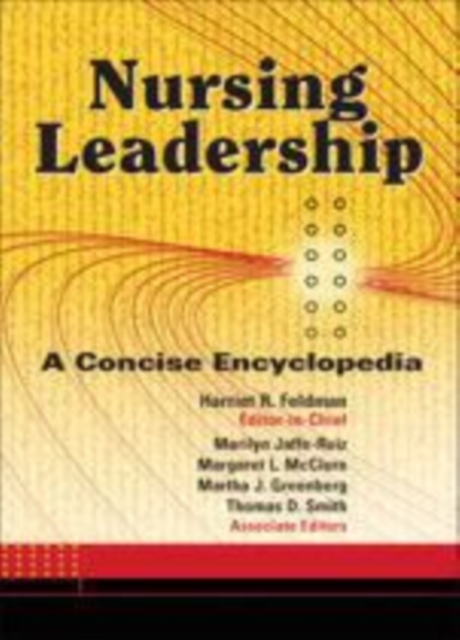
Nursing leadership
''We are delighted to introduce this book to a new generation of readers. The challenges in nursing, as well as in health care, have never been greater. The need for resources such as this text is profound.''. --from the foreword by Joanne Disch, PhD, RN, FAAN, Professor and Lillehei Chair in Nursing Leadership and Director, Katharine J. Densford International Center for Nursing Leadership, School of Nursing, University of Minnesota, and Kathleen Dracup, DNSc, FNP, RN, FAAN, Dean and Chair of Nursing Education, School of Nursing, University of California, San Francisco. The Concise Encyclopedia of Nursing Leadership is a manageable, one-volume reference that describes and defines the field of nursing leadership. The Encyclopedia will provide students, faculty, nurse managers, executives, and others with a comprehensive resource for information about the range of knowledge and roles encompassed by the term ''nursing leadership.'' It details the contributions of key nursing leaders, the knowledge base and traits of leadership, skills and models on which leadership is based, the regulatory environment of health care, the range of practice settings and roles, and the design of quality outcomes. Nine themes have been developed around which the entries are organized:. Management and Executive Skills. Theories and Models of Management and Leadership. Major Leaders and History of Management and Leadership in Nursing. Professional Standards. Health Care Delivery Standards and Health Policy. Characteristics of Leaders. Leadership in Practice, Education, and Research. Quality Outcomes. Informatics and Technology. The editors and contributors to this essential reference comprise some of the best-known and influence leaders in the nursing field. This book will be a cherished resource for leaders and future leaders in health care.
eBook
Safe Handling and Administration of Blood Components: Review of Practical Concepts
Context. —The more advanced we become, the more evident are the infectious and noninfectious risks of the blood supply. Infectious risks are somewhat straightforward and are addressed by implementing stricter donor criteria and testing. The noninfectious risks, however, are more complicated. Each step in the transfusion process, beginning with the physician who orders a transfusion to the actual transfusion of the component, is subject to adverse outcomes and increases the noninfectious risks of transfusion. The challenges to provide the safest blood possible with zero risk have resulted in the implementation of stringent standards from both the American Association of Blood Banks and the Joint Commission on Accreditation of Healthcare Organizations. Objective. —A series of case scenarios serve as the basis for discussion of the risks, which affect the safety and administration of blood components, inherent in the transfusion process. Data Sources. —Journals, textbooks, Internet. Conclusions. —The transfusion process is a complex multistep process with inherent risks. Infectious risks of transfusion are being adequately addressed such that the noninfectious risks of transfusion are becoming much more evident. Patient safety can be compromised if each step of the transfusion process is not completed according to established policies and procedures at each individual institution.
Journal Article
Improving MMR coverage in Birmingham
Achieving herd immunity in an ethnically mixed deprived area is a realistic goal. 1 Between 2004 and 2006, the Heart of Birmingham primary care trust increased measles, mumps, and rubella (MMR) vaccination coverage from 82% to 94% and maintained similar levels for seven years. The elements of our intervention are similar-creating a database of apparently unvaccinated children, list cleansing, contacting parents by phone or letter, scheduling an appointment with the child's GP, and home visiting. 2 3 4 The differences between the models are that we do not incentivise practices-the trust's public health department works collaboratively with practices; our database uses data held by the Birmingham child health system not by general practices; and our home visiting team comprises lay staff, not health visitors.
Journal Article