
Catalogue Search | MBRL


Are you sure you want to remove the book from the shelf?

{{itemTitle}}
5,802
result(s) for
"New, Mark"
Sort by:


Temperature and precipitation extremes under current, 1.5 °C and 2.0 °C global warming above pre-industrial levels over Botswana, and implications for climate change vulnerability
Climate extremes are widely projected to become more severe as the global climate continues to warm due to anthropogenic greenhouse gas emissions. These extremes often cause the most severe impacts on society. Therefore, the extent to which the extremes might change at regional level as the global climate warms from current levels to proposed policy targets of 1.5 and 2.0 °C above preindustrial levels need to be understood to allow for better preparedness and informed policy formulation. This paper analysed projected changes in temperature and precipitation extremes at 1.0, 1.5 and 2.0 °C warming over Botswana, a country highly vulnerable to the impacts of climate change. Projected changes in temperature extremes are significantly different from each other at the three levels of global warming, across three main climatic zones in the country. Specifically, at 2.0 °C global warming relative to preindustrial, for the ensemble median: (a) country average warm spell duration index increases by 80, 65, 62 days per year across different climatic zones, approximately three (and two) times the change at 1.0 (1.5) °C; (b) cold night (TN10P) and cold day (TX10P) frequencies decrease by 12 and 9 days per year across all regions, respectively, while hot nights (TN90P) and hot days (TX90P) both increase by 8-9 days across all regions. Projected changes in drought-related indices are also distinct at different warming levels. Specifically: (a) projected mean annual precipitation decreases across the country by 5%-12% at 2 °C, 3%-8% at 1.5 °C and 2%-7% at 1.0 °C; (b) dry spell length (ALTCDD) increases by 15-19 days across the three climatic zones at 2.0 °C, about three (and two) times as much as the increase at 1.0 (1.5) °C. Ensemble mean projections indicate increases in heavy rainfall indices, but the inter-model spread is large, with no consistent direction of change, and so changes are not statistically significant. The implications of these changes in extreme temperature and precipitation for key socio-economic sectors are explored, and reveal progressively severe impacts, and consequent adaptation challenges for Botswana as the global climate warms from its present temperature of 1.0 °C above preindustrial levels to 1.5 °C, and then 2.0 °C.
Journal Article
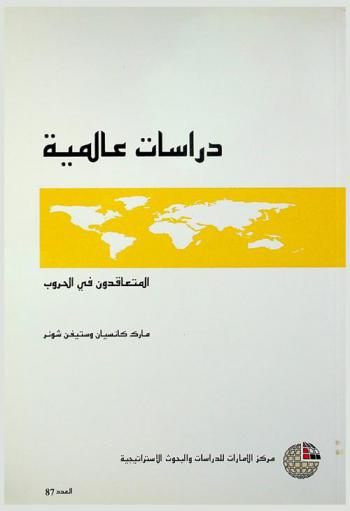
المتعاقدون في الحروب
\"المتعاقدون في الحروب\" أرتبطت عمليتا الحرية الدائمة في أفغانستان وحرية العراق بظاهرة الاستخدام المفرط للمتعاقدين في جبهتي القتال وهي الظاهرة التي أثارت نقاشا واسعا وجدلا حادا متمخضة عن عدد كبير من الأدبيات والآراء التي تنتقد في معظمها هذا التوجه الجديد لـ \"لخصخصة الحرب\" ولكن ما الذي دفع الولايات المتحدة الأمريكية إلى اللجوء إلى المتعاقدين في الحرب ؟ وما طبيعة الأعمال والوظائف التي يقوم بها هؤلاء المتعاقدون ؟ وهل استخدامهم أمر طارئ أو هو متصل بالبنية الجديدة للقوة العسكرية في القرن الحادي والعشرين؟ ولماذا تعتم الحكومة الأمريكية على أعداد القتلى والجرحى في صفوف المتعاقدين ؟ ولم يتجاهل الرأي العام خسائرهم البشرية ؟ هذه الأسئلة وغيرها يحاول هذا الكتاب الإجابة عليها من خلال دراستين الأولى بعنوان \"المتعاقدون : العنصر الجديد في بنية القوة العسكرية\" لمارك كانسيان والثانية بعنوان \"أهمية التركيز على القتلى من المتعاقدين\" لستيفن شونر.
Book

Tracking sustainable development with a national barometer for South Africa using a downscaled “safe and just space” framework
Significance We have downscaled planetary boundaries and applied the “safe and just space for humanity” framework at the national scale, for the first time, creating a “barometer” for inclusive sustainable development for South Africa. The barometer presents the state and trajectory of a broad but manageable set of indicators for environmental and social priorities, and highlights the country’s proximity to environmental boundaries and the distance from eradication of social deprivation. This creates a monitoring and communication tool for national government for thinking in an integrated manner about environmental and social-development issues. Our case study provides insight into the challenges and complexities of developing indicators and targets for the proposed global Sustainable Development Goals that that are globally, regionally, and nationally relevant.
Nations in the 21st century face a complex mix of environmental and social challenges, as highlighted by the on-going Sustainable Development Goals process. The “planetary boundaries” concept [Rockstrüöm J, et al. (2009) Nature 461(7263):472–475], and its extension through the addition of social well-being indicators to create a framework for “safe and just” inclusive sustainable development [Raworth K (2012) Nature Climate Change 2(4):225–226], have received considerable attention in science and policy circles. As the chief aim of this framework is to influence public policy, and this happens largely at the national level, we assess whether it can be used at the national scale, using South Africa as a test case. We developed a decision-based methodology for downscaling the framework and created a national “barometer” for South Africa, combining 20 indicators and boundaries for environmental stress and social deprivation. We find that it is possible to maintain the original design and concept of the framework while making it meaningful in the national context, raising new questions and identifying priority areas for action. Our results show that South Africa has exceeded its environmental boundaries for biodiversity loss, marine harvesting, freshwater use, and climate change, and social deprivation is most severe in the areas of safety, income, and employment. Trends since 1994 show improvement in nearly all social indicators, but progression toward or over boundaries for most environmental indicators. The barometer shows that achieving inclusive sustainable development in South Africa requires national and global action on multiple fronts, and careful consideration of the interplay between different environmental domains and development strategies.
Journal Article


Observed and modelled trends in rainfall and temperature for South Africa: 1960-2010
Observed trends in seasonal and annual total rainfall, number of rain days and daily maximum and minimum temperature were calculated for a number of stations in South Africa for the period 1960-2010. Statistically significant decreases in rainfall and the number of rain days are shown over the central and northeastern parts of the country in the autumn months and significant increases in the number of rain days around the southern Drakensberg are evident in spring and summer. Maximum temperatures have increased significantly throughout the country for all seasons and increases in minimum temperatures are shown for most of the country. A notable exception is the central interior, where minimum temperatures have decreased significantly. Regionally aggregated trends for six water management zones covering the entire country are not evident for total rainfall, but there are some significant trends for the number of rain days. Temperature in these zones has increased significantly for most seasons, with the exception of the central interior. Comparison of the observed trends with statistically downscaled global climate model simulations reveals that the models do not represent the observed rainfall changes nor the cooling trend of minimum temperature in the central interior. Although this result does not rule out the possibility of attributing observed local changes in rainfall to anthropogenically forced global change, it does have major implications for attribution studies. It also raises the question of whether an alternative statistical downscaling method or dynamical downscaling through the use of a regional climate model might better represent regional and local climatic processes and their links to global change. KEYWORDS: rainfall; temperature; historical trends; station observations; climate models
Journal Article


The impact of ENSO on Southern African rainfall in CMIP5 ocean atmosphere coupled climate models
We study the ability of 24 ocean atmosphere global coupled models from the Coupled Model Intercomparison Project 5 (CMIP5) to reproduce the teleconnections between El Niño Southern Oscillation (ENSO) and Southern African rainfall in austral summer using historical forced simulations, with a focus on the atmospheric dynamic associated with El Niño. Overestimations of summer rainfall occur over Southern Africa in all CMIP5 models. Abnormal westward extensions of ENSO patterns are a common feature of all CMIP5 models, while the warming of the Indian Ocean that happens during El Niño is not correctly reproduced. This could impact the teleconnection between ENSO and Southern African rainfall which is represented with mixed success in CMIP5 models. Large-scale anomalies of suppressed deep-convection over the tropical maritime continent and enhanced convection from the central to eastern Pacific are correctly simulated. However, regional biases occur above Africa and the Indian Ocean, particularly in the position of the deep convection anomalies associated with El Niño, which can lead to the wrong sign in rainfall anomalies in the northwest part of South Africa. From the near-surface to mid-troposphere, CMIP5 models underestimate the observed anomalous pattern of pressure occurring over Southern Africa that leads to dry conditions during El Niño years.
Journal Article

Beyond the light : identity and place in nineteenth-century Danish art
\"Denmark in the nineteenth century experienced the disastrous fallout of the Napoleonic Wars, the devastating bombardment of Copenhagen, bankruptcy, and mounting antagonism with Germany. Yet, this sociopolitical and economic tumult also gave rise to a vibrant cultural and philosophical environment for nineteenth-century Danish artists. Beyond the Light places the drawings, oil sketches, and paintings created by these artists firmly in this period, one that witnessed the transformation of a once-powerful Denmark into a small, somewhat marginalized country at the edge of Europe. Danish artists forged a close-knit community during this time, and the artworks they created explore notions of place, identity and belonging, and what it means to travel and return home. The exhibition features approximately 100 works from The Met collection, SMK - The National Gallery of Denmark, and several American collections, and highlights such artists as Christoffer Wilhelm Eckersberg, Christen Købke, Constantin Hansen, Martinus Rørbye, and Vilhelm Hammershøi as well as lesser-known figures like Anton Melbye, Johan Thomas Lundbye, Peter Christian Skovgaard, and Heinrich Gustav Ferdinand Holm, among others. Five thematic essays by leading scholars in Denmark and the United States explore the way Danish artists manifested the pride, traditions, and anxieties of their nation; the sea's ever-changing role as a marker of Danish identity; the evolving nature of portraiture; nostalgia for the Danish landscape and folk traditions; and the influence on Danish artists of their travels throughout Europe.\" -- Metropolitan Museum of Art website (viewed November 30, 2022) https://www.metmuseum.org/exhibitions/listings/2023/beyond-the-light
Book
influence of interpolation and station network density on the distributions and trends of climate variables in gridded daily data
We study the influence of station network density on the distributions and trends in indices of area-average daily precipitation and temperature in the E-OBS high resolution gridded dataset of daily climate over Europe, which was produced with the primary purpose of Regional Climate Model evaluation. Area averages can only be determined with reasonable accuracy from a sufficiently large number of stations within a grid-box. However, the station network on which E-OBS is based comprises only 2,316 stations, spread unevenly across approximately 18,000 0.22° grid-boxes. Consequently, grid-box data in E-OBS are derived through interpolation of stations up to 500 km distant, with the distance of stations that contribute significantly to any grid-box value increasing in areas with lower station density. Since more dispersed stations have less shared variance, the resultant interpolated values are likely to be over-smoothed, and extreme daily values even more so. We perform an experiment over five E-OBS grid boxes for precipitation and temperature that have a sufficiently dense local station network to enable a reasonable estimate of the area-average. We then create a series of randomly selected station sub-networks ranging in size from four to all stations within the E-OBS interpolation search radii. For each sub-network realisation, we estimate the grid-box average applying the same interpolation methodology as used for E-OBS, and then evaluate the effect of network density on the distribution of daily values, as well as trends in extremes indices. The results show that when fewer stations have been used for the interpolation, both precipitation and temperature are over-smoothed, leading to a strong tendency for interpolated daily values to be reduced relative to the “true” area-average. The smoothing is greatest for higher percentiles, and therefore has a disproportionate effect on extremes and any derived extremes indices. For many regions of the E-OBS dataset, the station density is sufficiently low to expect this smoothing effect to be significant and this should be borne in mind by any users of the E-OBS dataset.
Journal Article