
Catalogue Search | MBRL


Are you sure you want to remove the book from the shelf?

{{itemTitle}}
3,958
result(s) for
"Newman, Peter"
Sort by:

The malice
In the south, the Breach stirs. Gamma's sword, the Malice, wakes, calling to be taken to battle once more. But the Vagrant has found a home now, made a life and so he turns his back, ignoring its call. The sword cries out, frustrated, until another answers. Her name is Vesper.
Book
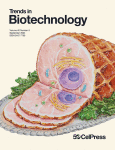
Enhancing the palatability of cultivated meat
Select cultivated meat (CM) products have been approved for sale and consumption in Singapore, the USA, and Israel.Palatability, a term encompassing the taste, texture, and aroma of foods, plays a central role in the appeal of foods.Currently, the consumer appeal of CM is relatively low, including low perceptions of palatability and a variable willingness to try.The palatability of meat arises from the unique chemistry and structure of its cellular constituents: muscle, fat, and stroma.Natural post-mortem processes, deliberate post-processing modifications, and various cooking methods are crucial in determining the palatability of agricultural meat (AM); replicating these processes could improve the palatability of CM.
Cultivated meat (CM) has transitioned from a futuristic concept to a present reality, with select products approved for consumption and sale in Singapore, Israel, and the USA. This evolution has emphasized scalable, cost-effective, and sustainable production, as well as navigation of regulatory pathways. As CM develops, a crucial challenge lies in delivering products that are highly appealing to consumers. Central to this will be refining CM palatability, a term encompassing food’s taste, aroma, texture, tenderness, juiciness, and color. We explore the scientific and engineering approaches to producing palatable CM, including cell-line selection, cell differentiation, and post-processing techniques. This includes a discussion of the structural and compositional properties of meat that are intrinsically coupled to palatability.
Cultivated meat (CM) has transitioned from a futuristic concept to a present reality, with select products approved for consumption and sale in Singapore, Israel, and the USA. This evolution has emphasized scalable, cost-effective, and sustainable production, as well as navigation of regulatory pathways. As CM develops, a crucial challenge lies in delivering products that are highly appealing to consumers. Central to this will be refining CM palatability, a term encompassing food’s taste, aroma, texture, tenderness, juiciness, and color. We explore the scientific and engineering approaches to producing palatable CM, including cell-line selection, cell differentiation, and post-processing techniques. This includes a discussion of the structural and compositional properties of meat that are intrinsically coupled to palatability.
Journal Article

Hostages to fortune : the United Empire Loyalists and the making of Canada
\"In 1776, tensions in the British colonies in North America were reaching a fever pitch. The citizenry was divided between those who wished to establish a new republic and those who remained steadfast in their dedication ot the British Empire. As the pressure inevitably boiled over into violence, people were forced to choose sides. Neighbours turned against each other. Families divided. Borders were redrawn. The conflict was long and bloody, and no side emerged unscathed. When the smoke from the battles dissipated, tens of thousands of individuals who had remained loyal to the Crown found themselves without a home. Destitute, distraught, and persecuted, these Loyalists turned to the only place they had left to go: north. The open land of British North America presented the Loyalist with an opportunity to estabish a new nation distinct from both the American republic and the British empire. But the journey to their new home was far from easy. Beset by starvation, natural disasters, and armed conflict, the Loyalists migrated towards the promise of a new future. Their sacrifices set the groundwork for a country that would be completely unlike any other. And as the War of 1812 dawned, they proved they were willing to defend it with their very lives. In Hostages to Fortune, Peter C. Newman not only recounts the expulsion and migration of these brave Loyalists but also, in his inimitable style, shines a light on the people, places, and events that set the stage for modern Canada.\"--Inside flap.
Book

PECAM-1: regulator of endothelial junctional integrity
PECAM-1 (also known as CD31) is a cellular adhesion and signaling receptor comprising six extracellular immunoglobulin (Ig)-like homology domains, a short transmembrane domain and a 118 amino acid cytoplasmic domain that becomes serine and tyrosine phosphorylated upon cellular activation. PECAM-1 expression is restricted to blood and vascular cells. In circulating platelets and leukocytes, PECAM-1 functions largely as an inhibitory receptor that, via regulated sequential phosphorylation of its cytoplasmic domain, limits cellular activation responses. PECAM-1 is also highly expressed at endothelial cell intercellular junctions, where it functions as a mechanosensor, as a regulator of leukocyte trafficking and in the maintenance of endothelial cell junctional integrity. In this review, we will describe (1) the functional domains of PECAM-1 and how they contribute to its barrier-enhancing properties, (2) how the physical properties of PECAM-1 influence its subcellular localization and its ability to influence endothelial cell barrier function, (3) various stimuli that initiate PECAM-1 signaling and/or function at the endothelial junction and (4) cross-talk of PECAM-1 with other junctional molecules, which can influence endothelial cell function.
Journal Article


Ethical Considerations for Qualitative Research Methods During the COVID-19 Pandemic and Other Emergency Situations: Navigating the Virtual Field
Qualitative research is integral to the pandemic response. Qualitative methods are ideally suited to generating evidence to inform tailored, culturally appropriate approaches to COVID-19, and to meaningfully engaging diverse individuals and communities in response to the pandemic. In this paper, we discuss core ethical and methodological considerations in the design and implementation of qualitative research in the COVID-19 era, and in pivoting to virtual methods—online interviews and focus groups; internet-based archival research and netnography, including social media; participatory video methods, including photo elicitation and digital storytelling; collaborative autoethnography; and community-based participatory research. We identify, describe, and critically evaluate measures to address core ethical challenges around informed consent, privacy and confidentiality, compensation, online access to research participation, and access to resources during a pandemic. Online methods need not be considered unilaterally riskier than in-person data collection; however, they are clearly not the same as in-person engagement and require thoughtful, reflexive, and deliberative approaches in order to identify and mitigate potential and dynamically evolving risks. Ensuring the ethical conduct of research with marginalized and vulnerable populations is foundational to building evidence and developing culturally competent and structurally informed approaches to promote equity, health, and well-being during and after the pandemic. Our analysis offers methodological, ethical, and practical guidance in the COVID-19 pandemic and considerations for research conducted amid future pandemics and emergency situations.
Journal Article

The boy who cried fabulous
A young boy's fascination with everything he sees around him causes him to be late and upsets his parents, until they come to realize his special gift.
Book

Net Zero in the Maelstrom: Professional Practice for Net Zero in a Time of Turbulent Change
The net zero transition is examined as a process of technical change that has rapidly accelerated and now faces social, economic and political transformations that can enable this rapid transition. The illustration of a maelstrom, with barrels that can enable survival, is used to show that professional practice during the turbulent period of change needs new net zero standards reflected in new processes and regulations for business accounting, energy, urban and transport planning, as well as new approaches for the just transition and Indigenous/local engagement. Australian examples are provided to show the beginning of such a maelstrom process to illustrate the significance of this agenda in 2023.
Journal Article


Platelets release pathogenic serotonin and return to circulation after immune complex-mediated sequestration
There is a growing appreciation for the contribution of platelets to immunity; however, our knowledge mostly relies on platelet functions associated with vascular injury and the prevention of bleeding. Circulating immune complexes (ICs) contribute to both chronic and acute inflammation in a multitude of clinical conditions. Herein, we scrutinized platelet responses to systemic ICs in the absence of tissue and endothelial wall injury. Platelet activation by circulating ICs through a mechanism requiring expression of platelet Fcγ receptor IIA resulted in the induction of systemic shock. IC-driven shock was dependent on release of serotonin from platelet-dense granules secondary to platelet outside-in signaling by αIIbβ3 and its ligand fibrinogen. While activated platelets sequestered in the lungs and leaky vasculature of the blood–brain barrier, platelets also sequestered in the absence of shock in mice lacking peripheral serotonin. Unexpectedly, platelets returned to the blood circulation with emptied granules and were thereby ineffective at promoting subsequent systemic shock, although they still underwent sequestration. We propose that in response to circulating ICs, platelets are a crucial mediator of the inflammatory response highly relevant to sepsis, viremia, and anaphylaxis. In addition, platelets recirculate after degranulation and sequestration, demonstrating that in adaptive immunity implicating antibody responses, activated platelets are longer lived than anticipated and may explain platelet count fluctuations in IC-driven diseases.
Journal Article