
Catalogue Search | MBRL


Are you sure you want to remove the book from the shelf?

{{itemTitle}}
4
result(s) for
"Nonini, Donald Macon, author"
Sort by:

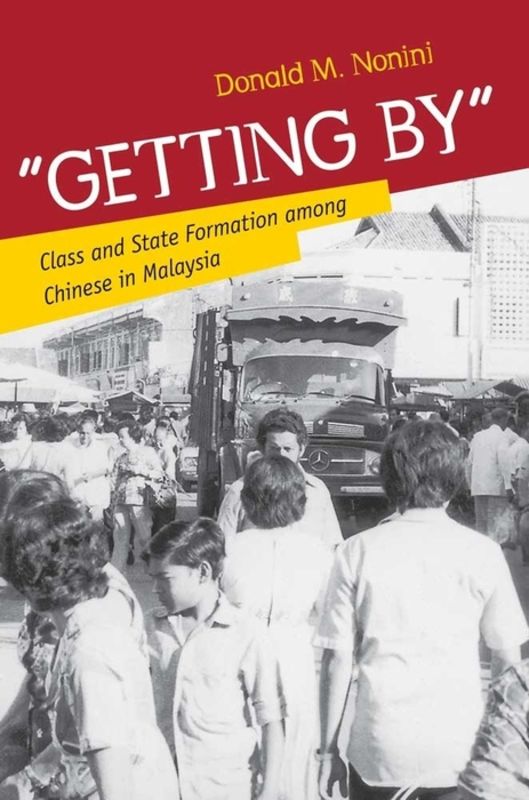
\Getting By\
How do class, ethnicity, gender, and politics interact? In what ways do they constitute everyday life among ethnic minorities? In\"Getting By,\"Donald M. Nonini draws on three decades of research in the region of Penang state in northern West Malaysia, mainly in the city of Bukit Mertajam, to provide an ethnographic and historical account of the cultural politics of class conflict and state formation among Malaysians of Chinese descent.
Countering triumphalist accounts of the capitalist Chinese diaspora in Southeast Asia, Nonini shows that the Chinese of Penang (as elsewhere) are riven by deep class divisions and that class issues and identities are omnipresent in everyday life. Nor are the common features of \"Chinese culture\" in Malaysia manifestations of some unchanging cultural essence. Rather, his long immersion in the city shows, they are the results of an interaction between Chinese-Malaysian practices in daily life and the processes of state formation-in particular, the ways in which Kuala Lumpur has defined different categories of citizens. Nonini's ethnography is based on semistructured interviews; participant observation of events, informal gatherings, and meetings; a commercial census; intensive reading of Chinese-language and English-language newspapers; the study of local Chinese-language sources; contemporary government archives; and numerous exchanges with residents.
How do class, ethnicity, gender, and politics interact? In what ways do they constitute everyday life among ethnic minorities? In\"Getting By,\"Donald M. Nonini draws on three decades of research in the region of Penang state in northern West Malaysia, mainly in the city of Bukit Mertajam, to provide an ethnographic and historical account of the cultural politics of class conflict and state formation among Malaysians of Chinese descent. Countering triumphalist accounts of the capitalist Chinese diaspora in Southeast Asia, Nonini shows that the Chinese of Penang (as elsewhere) are riven by deep class divisions and that class issues and identities are omnipresent in everyday life. Nor are the common features of \"Chinese culture\" in Malaysia manifestations of some unchanging cultural essence. Rather, his long immersion in the city shows, they are the results of an interaction between Chinese-Malaysian practices in daily life and the processes of state formation-in particular, the ways in which Kuala Lumpur has defined different categories of citizens. Nonini's ethnography is based on semistructured interviews; participant observation of events, informal gatherings, and meetings; a commercial census; intensive reading of Chinese-language and English-language newspapers; the study of local Chinese-language sources; contemporary government archives; and numerous exchanges with residents.
eBook

The Global Idea of 'The Commons'
During the last three decades, corporations allied with scientists and universities, national and regional governments, and international financial institutions have, through a variety of mechanisms associated with neo-liberal globalization, acted to dispossess large proportions of the world’s population of their commons’ resources and enclose them for profit making. In response, throughout the global South and in the cities of the global North, large numbers of people have formed movements to defend the commons in all their variety. The idea of the commons has thus emerged as a global idea, and commons have emerged as sites of conflict around the world. The essays in this forum assess strategically the situations of selected commons in a variety of diagnostic sites where they exist, the ways in which they are being transformed by the incursions of capital and state, and the ways in which they are becoming the locus of struggle for those who depend on them to survive.
eBook
Ungrounded Empires
In the last two decades, Chinese transnationalism has become a distinctive domain within the new \"flexible\" capitalism emerging in the Asia-Pacific region. Ungrounded Empires maps this domain as the intersection of cultural politics and global capitalism, drawing on recent ethnographic research to critique the impact of late capitalism's institutions--flexibility, travel, subcontracting, multiculturalism, and mass media--upon transnational Chinese subjectives. Interweaving anthropology and cultural studies with interpretive political economy, these essays offer a wide range of perspectives on \"overseas Chinese\" and their unique location in the global arena.
Aihwa Ong is an Associate Professor of Anthropology at the University of California, Berkeley. Donald Nonini is an Associate Professor of Anthropology at the University of North Carolina, Chapel Hill.
eBook