
Catalogue Search | MBRL


Are you sure you want to remove the book from the shelf?

{{itemTitle}}
75
result(s) for
"Noonan, Jeff"
Sort by:


Academic Freedom as an Institutional Right
Academic freedom seems to be under assault from all political angles. Opposed sides invoke academic freedom when it serves their purposes but ignore it when doing so serves the purposes of attacking their political enemies. Most at risk in the midst of these on-going battles is the future of the university as a space for free inquiry, debate, criticism, and the extension of human knowledge in all fields of intellectual inquiry. As a step towards safeguarding the future of the university as a space for open inquiry, the meaning and value of academic freedom needs to be clarified. While it is often (and understandably) identified with the constitutional right to free speech, it is in fact different in significant respects. Academic freedom is both a broad principle of free inquiry and argument upon which the university as an intellectual institution rests and a narrow collective agreement right. In both dimensions it is subject to limitations to which the right to free speech is not subject (curricular decisions, for example, must pass the test of relevance to the subject matter, while there are no constraints on introducing extraneous material into public political debates). Since all academics’ professional lives depend upon the institutional commitment to academic freedom, those who would undermine it in favour of their political priorities contradict themselves and raise questions about their fitness for the vocation of teacher-researcher.
Journal Article

Exploitation, Capitalist Crisis, and Democratic Planning
Thomas Piketty is the most politically and economically important participant in the ongoing debate about the deleterious effects of income and wealth inequality. The article analyses his arguments carefully because they give Marxists an opportunity to intervene in a mainstream political-economic debate in which they are generally not taken seriously. As impressive as Piketty’s argument is, and as willing as he is to embrace a socialist solution to capitalist crisis, a non-dogmatic Marxist examination of his texts reveals that his argument does not grasp at the most systematic level the connections between the driving forces of the capitalist economy and the undemocratic implications of widening inequality. This article will argue that although his critique acknowledges the structural inequality of power between workers and capitalists upon which capitalist society depends, his argument points towards an organic link between the exploitation of labour, the falling rate of profit, capitalist crisis, the shift of investment from the productive economy to the financial sector, and growing inequality that he does not explicitly formulate.
Journal Article
BEYOND PRICE AND USE-VALUE
Mainstream economists have long argued that the labour theory of value cannot explain price-formation. In response, Marxists have argued that mainstream economics is fixated on abstract mathematical problems which mystify social reality and obscure the social relationships at the heart of the real economy. Marxist political economists have proposed formal solutions to the price-formation problem, but the deeper issue on which my article will focus is the way in which price signals cannot communicate the information that economic agents need to make decisions which are consistent with the life-support capacity of the natural world and the social interests of workers. While Marxists typically distinguish a socialist economy from a capitalist one on the basis of the former’s commitment to production for the sake of need-satisfaction, needs are typically defined in terms of use-values. I will argue that this identification fails to distinguish between needs as universal life-requirements and needs as means to the completion of any project whatsoever. Unless needs are defined in terms of life-requirements, then even a socialist society can continue to undermine the natural conditions of life-support and exhaust human potential in meaningless cycles of consumption.
Journal Article
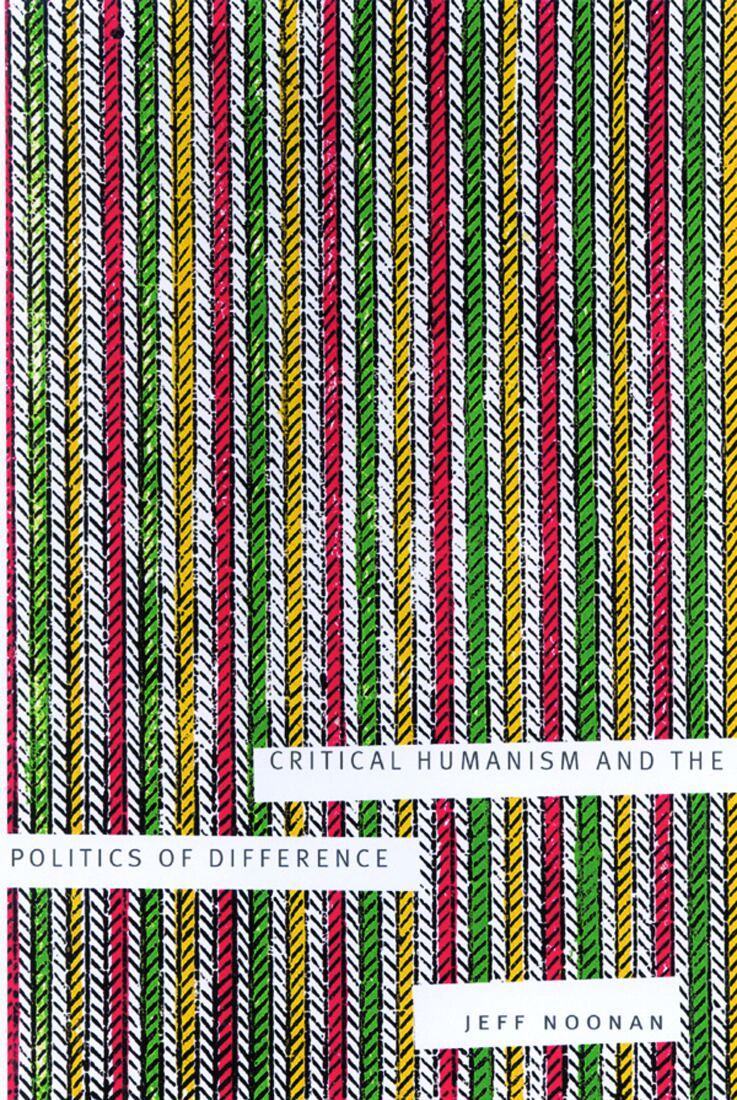
Critical Humanism and the Politics of Difference
Noonan shows that at the core of postmodern philosophy, with its claim that culture creates humans, is a concern to dethrone the modern understanding of human beings as subjects, as builders of their world and free when those world-building activities are the outcome of free choices. He explains that because the postmodern conception of human being does not capture what is universal in all humans it is incapable of critically responding to the forcible subordination of different cultures to European \"humanity.\" When oppressed groups explain why they struggle against oppression, they invoke just that idea of human being as subjectivity that postmodern philosophy claims is the basis of oppression. Noonan argues that the voices of cultural differences, when they struggle against the forces of hatred and exclusion, do not ground themselves just in the particular value of their culture but in the universal value of human freedom and self-determination.
eBook

Critical Humanism and the Politics of Difference
Noonan shows that at the core of postmodern philosophy, with its claim that culture creates humans, is a concern to dethrone the modern understanding of human beings as subjects, as builders of their world and free when those world-building activities are the outcome of free choices. He explains that because the postmodern conception of human being does not capture what is universal in all humans it is incapable of critically responding to the forcible subordination of different cultures to European \"humanity.\" When oppressed groups explain why they struggle against oppression, they invoke just that idea of human being as subjectivity that postmodern philosophy claims is the basis of oppression. Noonan argues that the voices of cultural differences, when they struggle against the forces of hatred and exclusion, do not ground themselves just in the particular value of their culture but in the universal value of human freedom and self-determination.
eBook

Critical Humanism and the Politics of Difference
An insightful look at sex, gender, ethnicity, and race as different ways of expressing an underlying human nature or essence.
eBook

Humanities, Education, and the Cultivation of Inner Depth: Against the Cult of Quantification
We live in the age where quality of education is being reduced to the satisfaction of quantified learning outcomes. These outcomes are supposed to serve student’s educational needs and better prepare them for life-long challenges in modern society. I will argue that there is a contradiction at the heart of learning outcomes—to the extent that they measure anything, it is rote performance in a temporally closed environment. Thus, there is no way to measure whether or not a course cultivates in students the disposition toward critical engagement with the world that proponents of learning outcomes claim to value. That disposition, I will argue, is better cultivated through traditional, discipline-centred humanistic education. Learning outcomes mistake measurable performance with the inner ethical and political depth required for critical engagement with the world because they commit what McMurtry calls “the externalist fallacy.”
Journal Article

The Historical and Contemporary Life-Value of the Canadian Labour Movement
Neo-liberal ideology has attempted to set different groups of workers— employed and unemployed, public and private sector, unionized and non-unionized—in opposition to each other. A successful response will require more than clear philosophical principles. It will require detailed, difficult, and long-term political efforts to construct solidarity. At the same time, that practical political work requires principles. The most effective principles on the basis of which solidarity can be built are those that disclose shared interests. The life-value principles underlying the most significant achievements of the union movement are the best means by which the shared interests of all workers can be disclosed. L'idéologie néo-libérale s'est efforcée de monter différents groupes de travailleurs les uns contre les autres – salariés contre chômeurs, secteur public contre secteur privé, syndiqués contre non syndiqués. Afin de faire front, on doit riposter avec d'autres armes que les grands principes philosophiques. L'édification de la solidarité nécessite des efforts politiques distincts, difficiles et à long terme. Dans le même temps, tout effort d'organisation politique fait appel à des principes. Les principes les plus efficaces pour resserrer les liens de solidarité sont ceux qui se fondent sur les intérêts communs. C'est ainsi que les valeurs humaines qui sont à la base des accomplissements les plus marquants du mouvement syndical constituent la meilleure manière de mettre en lumière les intérêts communs de tous les travailleurs.
Journal Article

Education, Social Interaction, and Material Co-presence: Against Virtual Pedagogical Reality
A crucial role of the educator, we contend, is to motivate students to want to feel the pain that all cognitive growth requires. This challenge, we will suggest, makes a certain form of conflict essential to the pedagogical relationship, a conflict which requires copresence in shared physical space. If we are correct, then on-line contexts are not conducive to education. Virtual environments permit the exchange of useful (and useless) information, but the absence of genuine, felt human contact limits their educational value, even when they provide highly mediated social interactions.
Journal Article