
Catalogue Search | MBRL


Are you sure you want to remove the book from the shelf?

{{itemTitle}}
33
result(s) for
"Ntelitheos, Dimitrios"
Sort by:


Compounding in Greek as Phrasal Syntax
This paper provides a syntactic analysis of two types of compounds in Greek: synthetic and phrasal compounds derived from agentive nominalizations of verbal strings containing an internal argument of the verb. The analysis is couched within a ‘morphology as syntax’ account and uses independently motivated syntactic tools to show that both types of compounds are derived in syntax proper without any need for a separate morphological component. The differences in the syntactic properties of the two types of compounds are explained with reference to the ‘size’ or ‘complexity’ of the projected internal arguments, which can be either ‘roots’, in the case of synthetic compounds, or unquantized nominals projected as NumPs, which require special licensing conditions in the case of phrasal compounds. Differences in prosodic and semantic interpretation are also explained with reference to phase theory and the type/number of phase domains within the structure of the two types of compounds.
Journal Article

Rethinking templates: A syntactic analysis of verbal morphology in Emirati Arabic
This paper presents an analysis of the morphosyntax and lexical semantics of the system of verbal forms of Emirati Arabic (EA, the variety of Gulf Arabic spoken in the United Arab Emirates) in terms of syntactic decomposition of argument structure. We argue that verbal meaning is a function of at least two syntactic functional heads: Voice and little v; and a lexical head: the consonantal root. We will further show that the unified syntactic structure, resulting from the interaction of the semantics and argument structure of the root with little v and Voice, captures the regularities as well as the exceptions in the interpretation of the verb forms of EA.
Journal Article
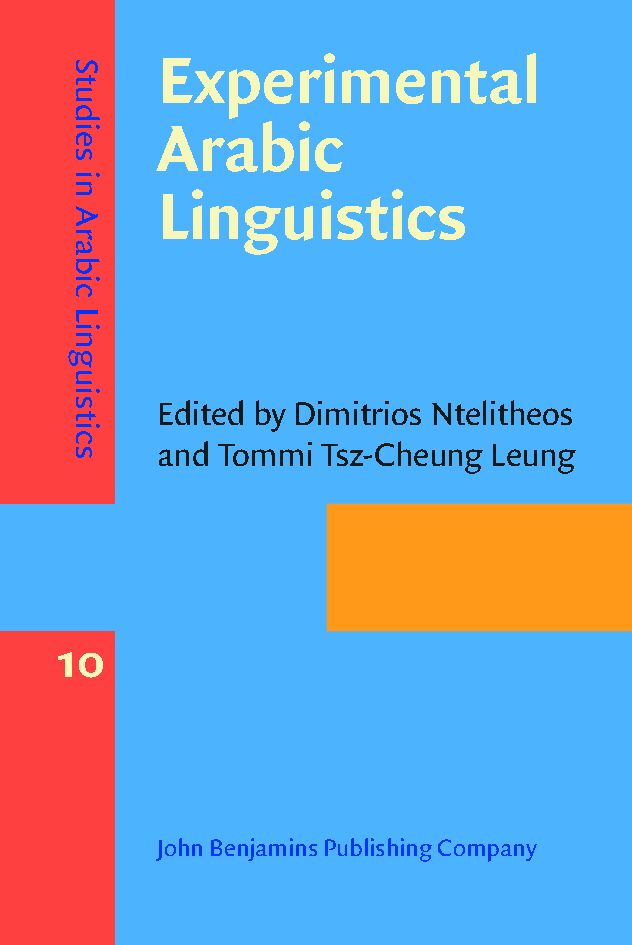
Experimental Arabic Linguistics
This volume is the first systematic attempt to survey current progress in the relatively new field of Experimental Arabic Linguistics. While experimental work on Arabic linguistics has appeared sporadically in several venues in the past, the chapters in this book provide a more coherent picture of the exciting directions which the field is pursuing. They provide insights into the complex nature of the Arabic language and how native speakers process it, using cutting-edge experimental methodologies in the fields of phonetics, psycholinguistics, and typical and atypical language development. This volume is of particular interest to scholars, researchers, and students at both the undergraduate and graduate level, in the fields of linguistics and language studies and can be a point of reference for scholars and researchers in the fields of theoretical and experimental Arabic linguistics.
eBook

Deriving nominals : a syntactic account of Malagasy nominalizations
This book provides original fieldwork data, uniquely generating all Malagasy deverbal nominals from a single structure-building mechanism, allowing variable syntactic attachment heights for different nominalizers and tracing the derivation of participant nominals to a relative clause source.
eBook

Input effects in the acquisition of verb inflection: Evidence from Emirati Arabic
This study investigates the acquisition of the Imperfective verb inflection paradigm in Emirati Arabic (EA), to determine whether the learning process is sensitive to the phonological and typological properties of the input. We collected data from 48 participants aged 2;7 to 5;9 years, using an elicited production paradigm. Input frequencies of inflectional contexts, verb types and tokens were obtained from corpora of child-directed and adult EA. Children's accuracy was inversely related to the input frequency of inflectional contexts, but not related to type and token frequency or phonological neighborhood density. Token frequency interacted with age, such that younger children performed considerably worse on low-frequency tokens, but older children performed equally well on high- and low-frequency tokens. We conclude that learning is input-driven, but that a sufficiently regular paradigm allows children to eventually generalise across all items earlier than in previously studied European languages.
Journal Article

Gerundive Nominals in Malagasy
In this paper, I provide a novel syntactic analysis of nominalizations in Malagasy (Western Austronesian). Malagasy has a nominalizing prefix f-that derives action and abstract nominalizations when attached to the circumstantial voice form of the verb. These nomináis exhibit mixed verbal and nominal properties, and their interpretation is often ambiguous between an eventive or a circumstantial meaning. This has led to the assumption that these nominals are formed in the lexicon or a \"lexical\" syntactic component of syntax: \"l-syntax\" (Paul 1996). I show that f-nominalizations in Malagasy can in fact be divided into a class of nominals that exhibit mainly nominal properties (\"result nominals\" in the terminology of Grimshaw 1990), and a second, productive, class of nomináis that exhibit internal verbal properties. In order to capture these properties, I propose that gerundive f-nominals are formed in the syntactic component with the nominalizer f-projecting a nominal inflection phrase replacing the tense inflection that appears in finite clauses (cf. also Baker 2005). The analysis maintains the intuition in traditional Malagasy grammars that the nominalizer f-replaces tense (Dez 1980:102; Fugier 1999:43), and predicts that all verbal functional projections below tense should be present, while all clausal projections above tense should be absent. For result gerundive nomináis, I assume a lower site of attachment for the nominalizer, and thus the fact that these nomináis exhibit less verbal and more nominal properties is attributed to the lack of the relevant verbal functional projections.
Journal Article


The morphosyntax of nominalizations: A case study
This dissertation discusses the morphosyntactic properties of nominalizations, based on data from Malagasy (Austronesian). It is proposed that nominalizations are derived through syntactic means and that their internal syntactic structure contains a verbal core and possibly additional clausal functional projections. The variation in morphosyntactic and distributional properties that different nominalization exhibit are attributed to the height of attachment of the nominalizer. It is proposed that the nominalizer in Malagasy attaches at different heights in the clausal structure, defining CP domains, in which aspectual projections play the role of lower tense heads. These projections are phases (in the sense of Chomsky 2001), with specific phonological, aspectual, and interpretive proerties. As a consequence, participant (and action) nominalizations are viewed as reduced headless relative clauses, whose nominal status and semantic interpretation is derived by raising a null generic NP to the specifier of the projection headed by the nominalizer. Support for the proposal is provided from the distribution of voice morphology in Malagasy (and Austronesian in general), the application of binding principles and observation of A' effects in participant nominalizations, and from crosslinguistic data which shows a strong connection between participant nominalizations and headless relative clauses.
Dissertation