
Catalogue Search | MBRL


Are you sure you want to remove the book from the shelf?

{{itemTitle}}
7
result(s) for
"Nutter, Jude"
Sort by:


I wish I had a heart like yours, Walt Whitman
In Return of the Heroes, Walt Whitman refers to the casualties of the American Civil War: the dead to me mar not. . . . / they fit very well in the landscape under the trees and grass. . . . In her new poetry collection, Jude Nutter challenges Whitman's statement by exploring her own responses to war and conflict and, in a voice by turns rueful, dolorous, and imagistic, reveals why she cannot agree. Nutter, who was born in England and grew up in Germany, has a visceral sense of history as a constant, violent companion. Drawing on a range of locales and historical moments—among them Rwanda, Sarajevo, Nagasaki, and both world wars—she replays the confrontation of personal history colliding with history as a social, political, and cultural force. In many of the poems, this confrontation is understood through the shift from childhood innocence and magical thinking to adult awareness and guilt. Nutter responds to Whitman from another perspective as well. It was Whitman who wrote that he could live with animals because, among other things, they are placid, self-contained, and guiltless. As counterpoint, Nutter weaves a series of animal poems—a kind of personal bestiary—throughout the collection that reveals the tragedy and violence also inherent in the lives of animals. Here, as in much of Nutter's previous work, the boundaries between the animal and human worlds are permeable; the urgent voice of the poet insists we recognize that Even from a distance, suffering / is suffering. Here is both acknowledgment and challenge: distance may be measured in terms of time, culture, or place, or it may be caused by the gap between animals and humans, but it is our responsibility to speak against atrocity and bloodshed, however voiceless we may feel.
eBook

Photograph, Germany, 1970
To her left, just beyond the border of the picture, is the house she lives in and from which she can ride her white, three-speed bicycle, out through the front gate, over the cricket pitch, down past the pig farm and into Bergen-Belsen; a house that contained, toward the end of the war, eight hundred sixty-nine Gypsies, Jews and others - overflow from the camp next door as Stalin advanced and Hitler panicked and prisoners were shuffled west. To her right, beyond the border of the picture, is the cemetery where, three decades from now, between the dark gum line of the hedge and a full-grown cedar, the bones of sixty-four bodies will be reburied, unnamed and all together, in a plot the size of a double bed after being uncovered by the German workers breaking ground for a new gymnasium right where she is standing. Peacock, Cabbage White, Sulphur Yellow; Mantis, Cockchafer, Devil's Coach-horse: in her small room a parquetry of bodies on plastic fold-out tables and every specimen labeled with region, with country, with nearest town; with date and host plant and method of collection.
Journal Article
Ropes
Ken Smith His rooms were all foliage and daylight with fish tanks on the sill of every window so that every single chair he had offered a view of tetras and danios patrolling and sewing their colours across the city's skyline. Over his bed, a framed print ofthat famous shot looking east from the guard tower on Bernauerstrasse toward the block of flats he'd lived in then; the church and the wall so close he must have kicked it in his sleep. In the foreground, on western soil, the viewing scaffold's small, crude platform which he couldn't help seeing, every day, out of his window; which she could not help climbing, on a field trip, in her blue and yellow bell-bottomed pantsuit a thin, sad girl, jostled about among her friends like a bright float until she slipped down, once again, to street level and someone took her picture as she teetered, heel to toe, arms out for balance, like wings, along the tram lines until they vanished under the wall. [...]the best moment of all: house lights and street lights both coming on, simultaneously, on either side of the border which will become, years from now, two pale lines of bricks set flush with the streets and cobblestones of Berlin, where she will spend, happily, a whole spring afternoon in Potsdamer Platz watching him stride, oblivious to everyone, back and forth across it.
Journal Article
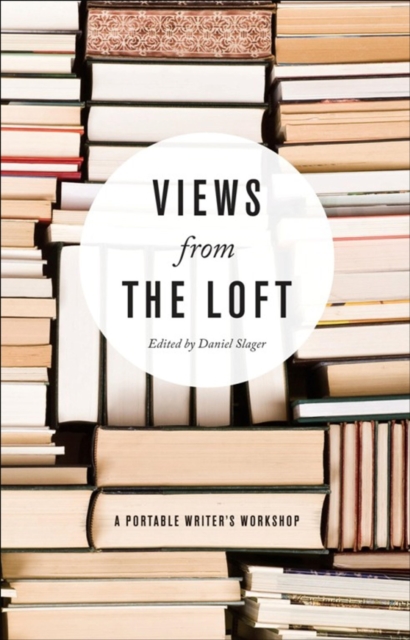
Views from the Loft
Teachers, exercises, mentors, critiques, humor, and inspiration: these form the fuel all writers need when they get down to work every day. For decades the Loft Literary Center has provided this fuel to an enormous community of writers. Views from the Loft brings together the collected wisdom of that community -- its authors, students, and editors -- giving anyone the tools and inspiration necessary to thrive in the writing life. A who's who of writers on writing ranging from the National Book Award-winning poet Mark Doty to Newbery medal-winning children's author Kate DiCamillo, and touching on issues as delicate as the representation of family in memoir and as hilarious as a \"sad-epiphany poem\" mad lib for frustrated poets, this book is an essential collection of crucial tips and challenging questions for everyone who puts pen to page. The essays and interviews in this book include superstar writers like Rick Bass, Michael Cunningham, Grace Paley, Susan Power, Susan Straight, Marilyn Hacker, and many, many more.
eBook

