
Catalogue Search | MBRL


Are you sure you want to remove the book from the shelf?

{{itemTitle}}
36
result(s) for
"Nystuen, Gro"
Sort by:

Human rights, corporate complicity and disinvestment
\"How can businesses and their shareholders avoid moral and legal complicity in human rights violations? This central and contemporary issue in the field of ethics, politics and law is of concern to intergovernmental organizations such as the UN and to many NGOs, as well as investors and employees. In this volume legal scholars and political philosophers identify and address the intertwined issues of moral and legal complicity in human rights violations by companies and those who invest in them. By describing the legal aspects of human rights violations in the corporate sphere, addressing the complicity of companies with regard to such norms and exploring the influence of investors, the book provides a thorough introduction to corporate social responsibility. Human Rights, Corporate Complicity and Disinvestment will set the research agenda on socially responsible investment for years to come\"-- Provided by publisher.
Book
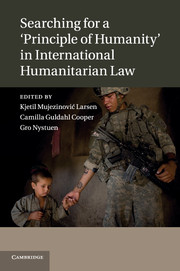
Searching for a 'Principle of Humanity' in International Humanitarian Law
The legal norms of International Humanitarian Law are the product of a compromise between humanitarian considerations and the demands of military necessity. In Searching for a 'Principle of Humanity' in International Humanitarian Law, international legal scholars consider whether humanitarian considerations have an independent legal impact on IHL beyond the formation of these norms. They ask whether a 'principle of humanity' can be said to have legal force in its own right. Moreover, the book investigates whether regional or national differences are emerging regarding the import and emphasis placed on humanitarian considerations. For instance, do states which are not directly affected by armed conflict attach a greater weight to humanitarian considerations when interpreting and applying IHL than those states which are more directly involved in armed conflicts? Specifically, this book examines whether a particular 'Nordic perspective' can be identified, owing to those states' involvement in armed conflicts outside their own territories in the post-Second World War era.
eBook

Human Rights, Corporate Complicity and Disinvestment
How can businesses and their shareholders avoid moral and legal complicity in human rights violations? This central and contemporary issue in the field of ethics, politics and law is of concern to intergovernmental organizations such as the UN and to many NGOs, as well as investors and employees. In this volume legal scholars and political philosophers identify and address the intertwined issues of moral and legal complicity in human rights violations by companies and those who invest in them. By describing the legal aspects of human rights violations in the corporate sphere, addressing the complicity of companies with regard to such norms and exploring the influence of investors, the book provides a thorough introduction to corporate social responsibility. Human Rights, Corporate Complicity and Disinvestment will set the research agenda on socially responsible investment for years to come.
eBook
Achieving peace or protecting human rights? : conflicts between norms regarding ethnic discrimination in the Dayton Peace Agreement
This book is a legal analysis of the Dayton Peace Agreement and its inherent contradictions between human rights and an ethnically based political system. As a member of the EU delegation in Dayton, the author explains some of the backgrounds for the peace agreement and she points to its potential for political reform.
eBook

The nuclear weapons ban treaty and the non-proliferation regime
The Treaty on the Prohibition of Nuclear Weapons (TPNW), adopted by the United Nations General Assembly in July 2017, has been met with mixed reactions. While supporters have described the Treaty as a watershed in the struggle for disarmament, others have expressed fervent opposition. One of the most serious charges levelled at the TPNW is that it will undermine the long-standing nuclear Non-Proliferation Treaty (NPT), by many regarded as a cornerstone of the international security architecture. Critics have contended that the new agreement risks eroding the system of safeguards designed to prevent the spread of nuclear weapons, derailing disarmament efforts within the NPT framework, and aggravating political division between nuclear and non-nuclear powers. Investigating the legal and political cogency of these arguments, we argue that not only may the TPNW be reconciled with existing legal instruments, the new Treaty supports and reinforces key norms and institutions on which the nuclear non-proliferation and disarmament regime is based. Furthermore, any technical challenges that might arise in the future may be addressed at meetings of states party; the drafters envisioned a dynamic process of institutional adaptations and expansion. The main challenge facing advocates of the Treaty is political: convincing the nuclear-armed states to disarm.
Journal Article

Human rights, corporate complicity and disinvestment
\"How can businesses and their shareholders avoid moral and legal complicity in human rights violations? This central and contemporary issue in the field of ethics, politics and law is of concern to intergovernmental organizations such as the UN and to many NGOs, as well as investors and employees. In this volume legal scholars and political philosophers identify and address the intertwined issues of moral and legal complicity in human rights violations by companies and those who invest in them. By describing the legal aspects of human rights violations in the corporate sphere, addressing the complicity of companies with regard to such norms and exploring the influence of investors, the book provides a thorough introduction to corporate social responsibility. Human Rights, Corporate Complicity and Disinvestment will set the research agenda on socially responsible investment for years to come\"--
Book
Disinvestment on the basis of corporate contribution to human rights violations: the case of the Norwegian Government Pension Fund
IntroductionTo what extent can companies be morally, or even legally, responsible for human rights abuses that take place in connection with their conduct of business? Moreover, to what extent can investors be responsible for unethical conduct by companies within their portfolio?Such questions have been discussed for many years and in many different settings; within religious groups, in financial institutions and, not least, in civil society. There has been extensive debate over the past years in many international fora, including the UN, about the concept of corporate responsibility for human rights abuses. The launching of the UN Global Compact in 1999, as well as the ‘Draft Norms on the Responsibilities of Transnational Corporations and Other Business Enterprises with Regard to Human Rights’ (the Draft Norms), which were discussed but not adopted by the UN Commission on Human Rights in 2004, reflect such debates. The Secretary-General’s Special Representative on business and human rights, John Ruggie, has contributed to these discussions, as have a number of other intergovernmental organizations, non-governmental organizations, academics, companies and governments.
Book Chapter
Introduction
In the twenty-first century, questions of corporate conduct in relation to human rights have come to the forefront of public attention. Globalization has brought multinational companies in closer contact with people in many countries, often countries where the state does not live up to ideals or legal obligations of protecting the human rights of their populations. The issues have reached the intergovernmental level of attention and action. It suffices here to refer to the UN Global Compact initiative launched by UN Secretary-General Kofi Annan in 2000 and the current United Nations process of establishing norms related to companies’ conduct in relation to human rights led by Professor John Ruggie. Six out of ten Global Compact principles address human rights. At the same time as companies’ activities have come in closer contact with people, increased use of market economy solutions through institutional investment has brought more citizens into closer contact with ownership of multinational companies. Pension funds and government funds have grown, and invest much of their stakeholders’ or beneficiaries’ money in listed multinational corporations. Thus people in many countries are linked with human rights violations in other countries. Such links can be seen or felt as issues of complicity in corporate wrongdoing.Several institutional investors such as pension funds, especially responsible private funds and government funds have established policies and practices to handle issues of corporate involvement which they find unethical. Basically, there are three main alternatives: (1) avoid investment in certain industries because of characteristics of the industry as such, (2) avoid investment in companies that through their conduct violate norms that the investor wants to uphold, or (3) engage directly or indirectly with specific companies with an aim to make them change their conduct or line of production. These alternatives can also be combined. None of them are clearly always best, or most ethical. And they can easily conflict and create tensions between activists and investment managers.
Book Chapter