
Catalogue Search | MBRL


Are you sure you want to remove the book from the shelf?

{{itemTitle}}
23
result(s) for
"Orelus, Pierre W"
Sort by:

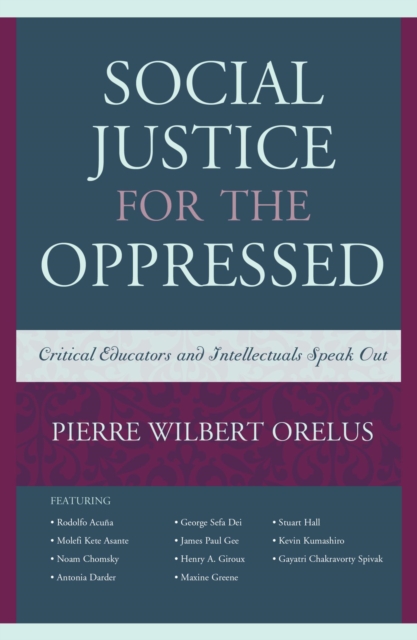
Social justice for the oppressed
This book draws from interviews conducted with prominent social justice educators and activist intellectuals, such as Noam Chomsky, Gayatri Spivak, Stuart Hall, Henry Giroux, Antonia Darder, Molefi Asante, and Maxine Greene, to examine various forms of social inequities occurring in schools and society perpetrated by those in power. These educators and intellectuals use examples drawn from both personal and professional experiences and relevant literature to point out the manner in which multiple forms of oppression intersect, in both hidden and visible ways, to affect the lives of oppressed groups and disfranchised communities. This book seeks to shed light on various manifestations of social injustices aiming to inspire critical, radical thoughts for socio-political action leading to educational and social change.
eBook


Can subaltern professors speak?: examining micro-aggressions and lack of inclusion in the academy
Purpose
The purpose of this paper is to highlight various ways in which micro-aggressions and other forms of institutional oppression have affected subaltern professors and students in the academy.
Design/methodology/approach
This qualitative case study draws from testimonios collected from fall 2010 to spring 2016. Six testimonios are incorporated in the study, and they stem from a various set of data. These testimonios show patterns across data set regarding systemic oppression subaltern that professors have experienced in the academy.
Findings
As the findings of this study show, subaltern professors face intersecting forms of discrimination – often race, language, accent, gender, and class based – in predominantly white institutions. Their testimonios unravel the complexity of the professional, academic, and personal lives of these professors highlighting their professional achievements and successes. Their testimonios demonstrate at the same time the ways in which various forms of oppression might have limited their life chances and opportunities.
Research limitations/implications
Suggestions are made as to how social justice educators and policy makers can collectively challenge and eradicate these social wrongs.
Originality/value
This paper is an original take on both micro-aggressions and institutional oppression affecting subaltern professors and students.
Journal Article

Radical voices for democratic schooling
Class struggle unchained: an interview with Peter McLaren -- Neoliberalism and education: an interview with Bradley Porfilio -- the fight against neo-liberalism has just begun: a dialogue with Dave Hill -- Resisting neoliberalism with hope: a dialogue with Noam Chomsky -- Neoliberalism in the academic borderlands: an on-going struggle for equality. a dialogue with Antonia Darder -- Class warfare: a dialogue with Pepi Leistyna -- Higher education, neoliberalism, democracy, and community: challenges for educators working with linguistically and culturally diverse students: a dialogue with Hermán García -- Democracy and social justice in a capitalist society: is this possible? a conversation with Shirley Steinberg.
eBook

Unpacking the Race Talk
Race is one of the most contested topics. With the political victory of Barack Obama as the first African American president, discussions about racial issues in the United States have surfaced to the forefront of political debates. Yet, critics have argued that there is not much discussion about race given its significance in the history of this country. Informed by critical race theory, this paper examines the underlying reasons explaining the silence of many people about race. It goes on to examine race through a mosaic lens, pointing out various factors directly connected to it, such as racial identity politics, racism, multiracialism, and White hegemony. Finally, this paper analyzes the manner in which socially constructed racial stereotypes have contributed to and have been used to justify the poor socioeconomic situation and marginalization of People of Color, including linguistically and culturally diverse students.
Journal Article

Unveiling the Web of Race, Class, Language, and Gender Oppression: Challenges for Social Justice Educators
There is often a tendency to focus on one form of oppression and pay less attention to, or leave others out, despite the fact that a vast body of research shows that all forms of oppression are interconnected. This paper aims to counter this tendency that has been circulated in the mainstream media as well as in institutions such as schools. Specifically, drawing on the scholarly work of feminist, socio-cultural, and critical race theorists, this paper critically examines the effects of intersectional oppression on people, particularly those who have been pushed to the margins because of their targeted social identities, and proposes alternative ways to combat these forms of oppression.
Journal Article

Youth of Color Living and Learning in the Age of Racial Paranoia: What Social Justice Educators Need to Know
Fearing the other has been entrenched in the minds of many Americans. With Donald J. Trump becoming president of the U.S., overt racism is being reinserted into mainstream politics. Trump's victory has ushered in an era beset by racial paranoia-fear socially constructed about Black and Brown bodies, learned at home, in schools, and from the mainstream media, and expressed in unjust and, at times, violent manners. Indeed, racial paranoia has caused racially prejudiced individuals or groups to behave and act in violent ways against people of color. This essay draws from critical race theory and present day political events involving the Donald Trump government to explore racial paranoia and its multilayered effects on people of color, particularly youth of color. This article underscores plausible parallels between racial paranoia and the attitude, behavior, and actions of people holding White supremacist ideology and their violence against people of all colors, particularly youth of color. This articler provides suggestions that might serve educators who are working with historically disenfranchised youth of color, including immigrant youth of color.
Journal Article
