
Catalogue Search | MBRL


Are you sure you want to remove the book from the shelf?

{{itemTitle}}
39,227
result(s) for
"Pál"
Sort by:


Mobility and Cultural Authority in Contemporary China
Chinese citizens are becoming increasingly mobile, both inside China and abroad, as migrant workers, tourists, and students. China is caught between perceived benefits and dangers posed by mobility, complicated by the government's own conflicting impulses to support and discourage it.Mobility and Cultural Authority in Contemporary Chinademonstrates this intricate balance through an in-depth look at patterns of migration and state response.
Pál Nyíri argues that the loosening of China's restrictions on internal and international migration, its promotion of domestic tourism, and its increasingly positive portrayal of migrants all follow a similar logic in which mobility comes to epitomize a new and modern China. Yet the loosening of administrative control is compensated by the imposition of cultural control over how mobility is represented and how mobile citizens make sense of their new experiences, as well as by continued restrictions on types of movement that are seen as undesirable.
With ever-growing popular and academic scrutiny of the topic of national and international migration, this compact, engrossing, and timely study is well poised to be read widely by scholars interested in globalization, nationalization, modernization, tourism, and modern China.
eBook

Involvement of extrasynaptic glutamate in physiological and pathophysiological changes of neuronal excitability
Glutamate is the most abundant neurotransmitter of the central nervous system, as the majority of neurons use glutamate as neurotransmitter. It is also well known that this neurotransmitter is not restricted to synaptic clefts, but found in the extrasynaptic regions as ambient glutamate. Extrasynaptic glutamate originates from spillover of synaptic release, as well as from astrocytes and microglia. Its concentration is magnitudes lower than in the synaptic cleft, but receptors responding to it have higher affinity for it. Extrasynaptic glutamate receptors can be found in neuronal somatodendritic location, on astroglia, oligodendrocytes or microglia. Activation of them leads to changes of neuronal excitability with different amplitude and kinetics. Extrasynaptic glutamate is taken up by neurons and astrocytes mostly via EAAT transporters, and astrocytes, in turn metabolize it to glutamine. Extrasynaptic glutamate is involved in several physiological phenomena of the central nervous system. It regulates neuronal excitability and synaptic strength by involving astroglia; contributing to learning and memory formation, neurosecretory and neuromodulatory mechanisms, as well as sleep homeostasis.The extrasynaptic glutamatergic system is affected in several brain pathologies related to excitotoxicity, neurodegeneration or neuroinflammation. Being present in dementias, neurodegenerative and neuropsychiatric diseases or tumor invasion in a seemingly uniform way, the system possibly provides a common component of their pathogenesis. Although parts of the system are extensively discussed by several recent reviews, in this review I attempt to summarize physiological actions of the extrasynaptic glutamate on neuronal excitability and provide a brief insight to its pathology for basic understanding of the topic.
Journal Article
Scenic Spots
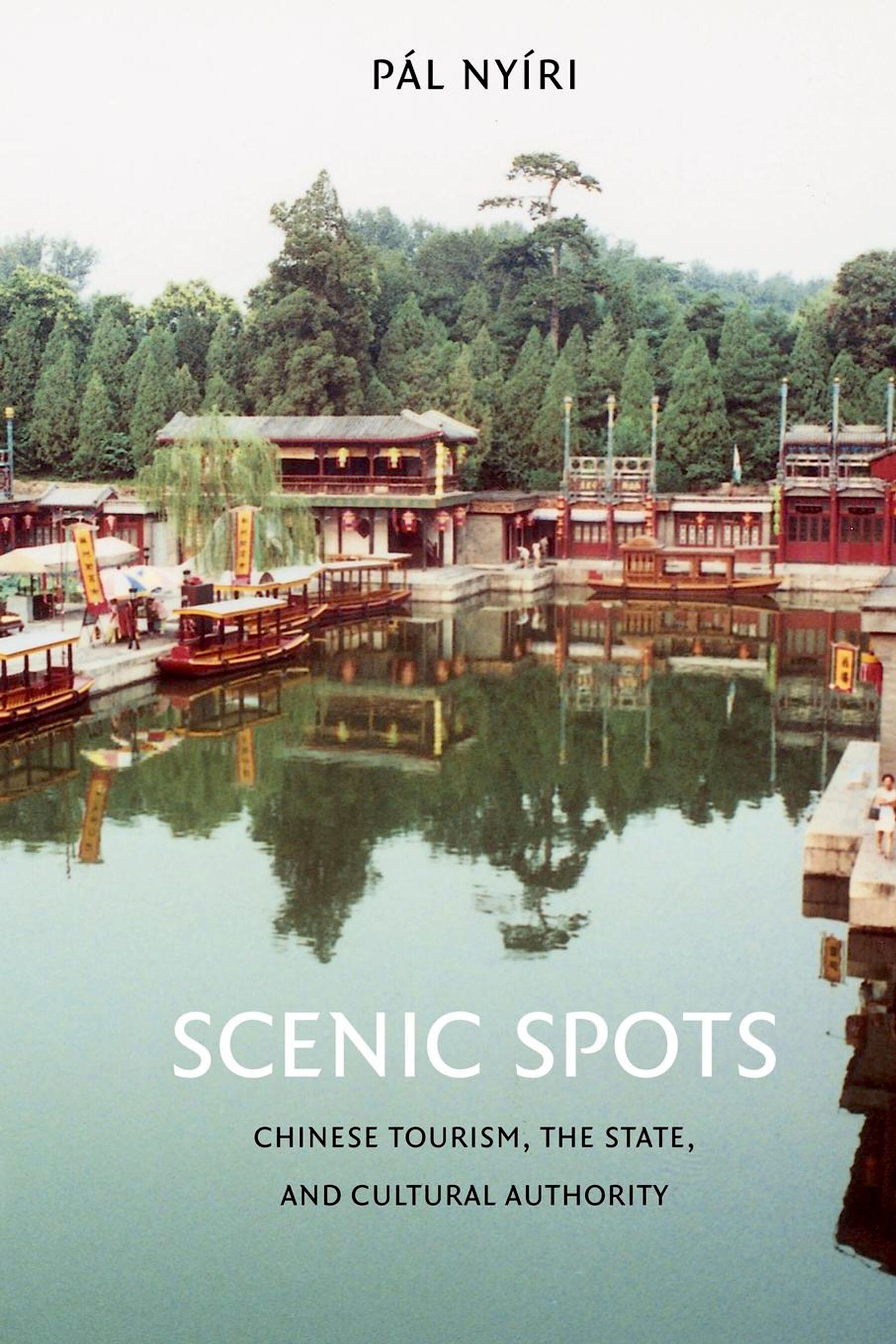
Twenty years ago, commercial tourism in the People's Republic of China hardly existed. Today, China has a burgeoning tourist industry, characterized by a unique style with deep roots in traditional Chinese culture. Scenic Spots is an engaging exploration of why Chinese tourists pursue certain kinds of experiences, what they make of them, and how their experiences and interpretations are shaped by the state.Working from within a Chinese cultural framework, Pál Nyíri argues that China's brand of tourism is distinct from the traditions of both Western bourgeois tourism, which values authenticity, and Soviet tourism, with its emphasis on rugged and selfless experience. In China, tourism development is guided by the state, and \"scenic spots\" (jingdian) and theme parks are used to demonstrate China's heroic past and as tools of patriotic education and modernization - or as forms of \"indoctritainment.\" The tourist site is perceived as a product, and, as such, it is bounded, approved, rated, and consumed.In a style both straightforward and provocative, Nyíri argues that the uniformity and undisguised commercialism of Chinese tourist sites are a direct result of the state's ultimate authority to determine the meaning of landscape and to control culture. Scenic Spots serves as a lens through which to explore mechanisms of cultural control and resistance in a highly commercialized sphere of everyday life in contemporary China.
eBook
Mobility and Cultural Authority in Contemporary China
Chinese citizens are becoming increasingly mobile, both inside China and abroad, as migrant workers, tourists, and students. China is caught between perceived benefits and dangers posed by mobility, complicated by the government's own conflicting impulses to support and discourage it. Mobility and Cultural Authority in Contemporary China demonstrates this intricate balance through an in-depth look at patterns of migration and state response.Pál Nyíri argues that the loosening of China's restrictions on internal and international migration, its promotion of domestic tourism, and its increasingly positive portrayal of migrants all follow a similar logic in which mobility comes to epitomize a new and modern China. Yet the loosening of administrative control is compensated by the imposition of cultural control over how mobility is represented and how mobile citizens make sense of their new experiences, as well as by continued restrictions on types of movement that are seen as undesirable.With ever-growing popular and academic scrutiny of the topic of national and international migration, this compact, engrossing, and timely study is well poised to be read widely by scholars interested in globalization, nationalization, modernization, tourism, and modern China.
eBook

Astrocytes convert network excitation to tonic inhibition of neurons
Background
Glutamate and γ-aminobutyric acid (GABA) transporters play important roles in balancing excitatory and inhibitory signals in the brain. Increasing evidence suggest that they may act concertedly to regulate extracellular levels of the neurotransmitters.
Results
Here we present evidence that glutamate uptake-induced release of GABA from astrocytes has a direct impact on the excitability of pyramidal neurons in the hippocampus. We demonstrate that GABA, synthesized from the polyamine putrescine, is released from astrocytes by the reverse action of glial GABA transporter (GAT) subtypes GAT-2 or GAT-3. GABA release can be prevented by blocking glutamate uptake with the non-transportable inhibitor DHK, confirming that it is the glutamate transporter activity that triggers the reversal of GABA transporters, conceivably by elevating the intracellular Na
+
concentration in astrocytes. The released GABA significantly contributes to the tonic inhibition of neurons in a network activity-dependent manner. Blockade of the Glu/GABA exchange mechanism increases the duration of seizure-like events in the low-[Mg
2+
]
in vitro
model of epilepsy. Under
in vivo
conditions the increased GABA release modulates the power of gamma range oscillation in the CA1 region, suggesting that the Glu/GABA exchange mechanism is also functioning in the intact hippocampus under physiological conditions.
Conclusions
The results suggest the existence of a novel molecular mechanism by which astrocytes transform glutamat
ergic
excitation into GABA
ergic
inhibition providing an adjustable,
in situ
negative feedback on the excitability of neurons.
Journal Article

Good stories overwrite creativity: the three eras of city competition
Today cities in national and global competition focus on creativity. Although the creative city concept was invented by Gunnar Törnqvist in 1983, today the dominant concept is creative class articulated by Richard Florida in 2004. Cities are engaged to strengthen their social and cultural environment in the direction indicated in the works by Törnqvist, Peter Hall, Charles Landry, and Florida, and take effort to embed their fame as creative cities to their city branding. This let them communicate a creative image and develop an emotional bond to this image among larger social groups of tourists, employees and beyond. Consequently, their position in competition is improving. The emergence of creativity basically changed the characteristics of city competition since the turn of the millennia, cities – stakeholders in particular – focused on investment and infrastructure development beforehand. As the concept of the creative city already stabilized itself in worldwide city development and branding a new turn might come, and the market of good stories is emerging in city communication which can dim or even overwrite the importance of creativity. While good stories were always part of marketing, and contributed to city planning since the 1980s, their growing importance in city branding can reach a hypothetical point where a new market level develops, and a narrative turn occurs. In such cases, cities themselves carry good stories and the represented virtual reality creates a new market, where creativity will be only one among other stories. In this study we sketch up the three eras of branding in city competition, focusing on the emerging and fading role of creativity.
Journal Article

Network-level architecture and the evolutionary potential of underground metabolism
A central unresolved issue in evolutionary biology is how metabolic innovations emerge. Low-level enzymatic side activities are frequent and can potentially be recruited for new biochemical functions. However, the role of such underground reactions in adaptation toward novel environments has remained largely unknown and out of reach of computational predictions, not least because these issues demand analyses at the level of the entire metabolic network. Here, we provide a comprehensive computational model of the underground metabolism in Escherichia coli . Most underground reactions are not isolated and 45% of them can be fully wired into the existing network and form novel pathways that produce key precursors for cell growth. This observation allowed us to conduct an integrated genome-wide in silico and experimental survey to characterize the evolutionary potential of E. coli to adapt to hundreds of nutrient conditions. We revealed that underground reactions allow growth in new environments when their activity is increased. We estimate that at least ∼20% of the underground reactions that can be connected to the existing network confer a fitness advantage under specific environments. Moreover, our results demonstrate that the genetic basis of evolutionary adaptations via underground metabolism is computationally predictable. The approach used here has potential for various application areas from bioengineering to medical genetics.
Journal Article

Scenic Spots
Twenty years ago, commercial tourism in the People s Republic of China hardly existed. Today, China has a burgeoning tourist industry, characterized by a unique style with deep roots in traditional Chinese culture. Scenic Spots is an engaging exploration of why Chinese tourists pursue certain kinds of experiences, what they make of them, and how their experiences and interpretations are shaped by the state.
Working from within a Chinese cultural framework, P l Ny ri argues that China s brand of tourism is distinct from the traditions of both Western bourgeois tourism, which values authenticity, and Soviet tourism, with its emphasis on rugged and selfless experience. In China, tourism development is guided by the state, and scenic spots (jingdian) and theme parks are used to demonstrate China s heroic past and as tools of patriotic education and modernization or as forms of indoctritainment. The tourist site is perceived as a product, and, as such, it is bounded, approved, rated, and consumed.
In a style both straightforward and provocative, Ny ri argues that the uniformity and undisguised commercialism of Chinese tourist sites are a direct result of the state s ultimate authority to determine the meaning of landscape and to control culture. Scenic Spots serves as a lens through which to explore mechanisms of cultural control and resistance in a highly commercialized sphere of everyday life in contemporary China.
eBook

Glutathione-Related Enzymes and Proteins: A Review
The tripeptide glutathione is found in all eukaryotic cells, and due to the compartmentalization of biochemical processes, its synthesis takes place exclusively in the cytosol. At the same time, its functions depend on its transport to/from organelles and interorgan transport, in which the liver plays a central role. Glutathione is determined as a marker of the redox state in many diseases, aging processes, and cell death resulting from its properties and reactivity. It also uses other enzymes and proteins, which enables it to engage and regulate various cell functions. This paper approximates the role of these systems in redox and detoxification reactions such as conjugation reactions of glutathione-S-transferases, glyoxylases, reduction of peroxides through thiol peroxidases (glutathione peroxidases, peroxiredoxins) and thiol–disulfide exchange reactions catalyzed by glutaredoxins.
Journal Article