
Catalogue Search | MBRL


Are you sure you want to remove the book from the shelf?

{{itemTitle}}
24
result(s) for
"Pantsov, Alexander V"
Sort by:
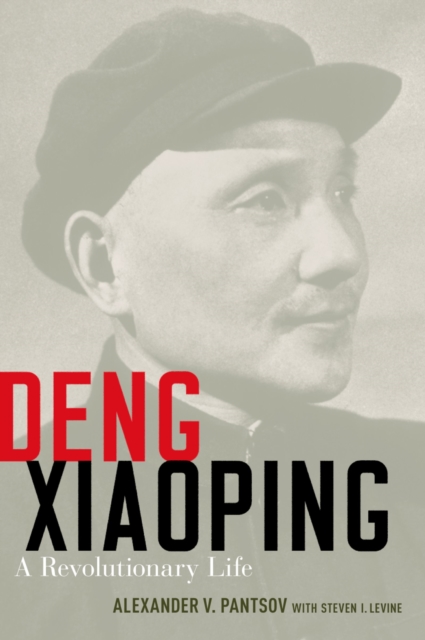
Deng Xiaoping
Deng Xiaoping joined the Chinese Communist movement as a youth and rose in its ranks to become an important lieutenant of Mao's from the 1930s onward. Two years after Mao's death in 1976, Deng became the de facto leader of the Chinese Communist Party and the prime architect of China's post-Mao reforms. Abandoning the Maoist socio-economic policies he had long fervently supported, he set in motion changes that would dramatically transform China's economy, society, and position in the world. Three decades later, we are living with the results. China has become the second largest economy and the workshop of the world. And while it is essentially a market economy (\"socialism with Chinese characteristics\"), Deng and his successors ensured the continuation of CCP rule by severely repressing the democratic movement and maintaining an iron grip on power. When Deng died at the age of 92 in 1997, he had set China on the path it is following to this day. Alexander Pantsov and Steven Levine's new biography of Deng Xiaoping does what no other biography has done: based on newly discovered documents, it covers his entire life, from his childhood and student years to the post-Tiananmen era. Thanks to unprecedented access to Russian archives containing massive files on the Chinese Communist Party, the authors present a wealth of new material on Deng dating back to the 1920s. In a long and extraordinary life, Deng navigated one epic crisis after another. Born in 1904, Deng, like many Asian revolutionary leaders, spent part of the 1920s in Paris, where he joined the CCP in its early years. He then studied in the USSR just as Stalin was establishing firm control over the Soviet communist party. He played an increasingly important role in the troubled decades of the 1930s and 1940s that were marked by civil war and the Japanese invasion. He was commissar of a communist-dominated area in the early 1930s, loyal henchman to Mao during the Long March, regional military commander in the anti-Japanese war, and finally a key leader in the 1946-49 revolution. During Mao's quarter century rule, Deng oscillated between the heights and the depths of power. He was purged during the Cultural Revolution, only to reemerge after Mao's death to become China's paramount leader until his own death in 1997. This objective, balanced, and unprecedentedly rich biography changes our understanding of one of the most important figures in modern history.
eBook


Stalin Watches Mao: Documents from the Top Secret Soviet Archives
The documents published below are preserved in the former Institute of Marxism-Leninism Central Party Archives in Moscow recently renamed Russian State Archives of Social and Political History. They are locked in the fifteen-volume Mao Zedong personal dossier collected by the Comintern and Soviet Communist Party officials (collection 495, depository 225, file 71). Even today public access to them is highly restricted. These documents deal with Mao Zedong's first visit to Moscow in December 1949 - February 1950. They demonstrate that Stalin paid an enormous amount of attention to Mao as the new leader of China whom he did not know personally. He wanted to know everything about him: his political views, his attitude to the Soviet Union and Stalin himself, and even the condition of his health. The information he received was overall positive. Mao seemed to be healthy and loyal to Stalin, and he appeared likely to remain a close partner for a long time. Stalin had to take this into account.
Journal Article

Comintern activists in China
It is no secret that Comintern emissaries played an important part in revolutionizing China in the 1920s and 1930s. They served as the most essential link between Moscow's leaders and Chinese revolutionaries, transmitting Soviet policy down to China and submitting information about the latter up to their Kremlin bosses. Not all of them were simple reporters and spies. Many offered their own concepts of the revolution in the hope of influencing the Soviet policy makers. Did they do it on their own initiative? To what extent could they actually enjoy their theoretical independence? How long could they do it? This chapter examines various archival sources, including the former top secret Stalin and Dimitrov files, personal dossiers of the Comintern Executive (ECCI) activists, and the documentary collection of the Chinese Communist Party (CCP) delegation to the Comintern, to illuminate these issues and to offer some thoughts in this regard.
Book Chapter


Bolshevik Concepts of the Chinese Revolution, 1919-1927
The Bolshevik policy in China before and during the Chinese revolution of 1925-27 has been the object of numerous scholarly inquiries. Historians have often been inspired to analyze the profound ideological impact that the Bolsheviks had on the Chinese Communist movement in its early years. There has been a great deal of interest in the role Soviet leaders played in events which led to the profound defeat inflicted on the CCP by the Guomindang (GMD), former allies in the United Front against foreign imperialism. To what degree was the Comintern, under first Lenin and then Stalin, responsible for this defeat? Could Trotsky have radically changed the situation in China had his ideas been accepted in time by the Comintern Executive (ECCI)? What considerations guided these three leaders of the Soviet Communist Party (Bolshevik) (SCP(B)) in formulating their China policy? How, precisely, did they differ in their assessments of the strategic and tactical tasks of the communists in China?
Book Chapter
