
Catalogue Search | MBRL


Are you sure you want to remove the book from the shelf?

{{itemTitle}}
2,890
result(s) for
"Parry, John T"
Sort by:


Understanding torture
Prohibiting torture will not end it. In Understanding Torture, John T. Parry explains that torture is already a normal part of the state coercive apparatus. Torture is about dominating the victim for a variety of purposes, including public order; control of racial, ethnic, and religious minorities; and— critically—domination for the sake of domination. Seen in this way, Abu Ghraib sits on a continuum with contemporary police violence in U.S. cities; violent repression of racial minorities throughout U.S. history; and the exercise of power in a variety of political, social, and interpersonal contacts. Creating a separate category for an intentionally narrow set of practices labeled and banned as torture, Parry argues, serves to normalize and legitimate the remaining practices that are \"not torture.\" Consequently, we must question the hope that law can play an important role in regulating state violence. No one who reads this book can fail to understand the centrality of torture in modern law, politics, and governance.
eBook

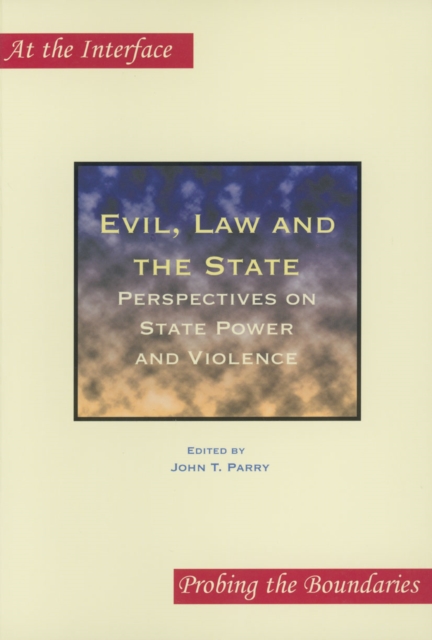
Evil, Law and the State
The topic of \"evil\" means different things depending upon context. For some, it is an archaic term, while others view it as a central problem of ethics, psychology, or politics. Coupled with state power, the problem of evil takes on a special salience for most observers. When governments do evil -in whatever way we define the term - the scale of harm increases, sometimes exponentially. The evils of state violence, then, demand our attention and concern. Yet the linkage of evil with state power does not resolve the underlying question of how to understand the concepts that we invoke when we use the term. Instead, the question becomes what evil means in the context of and in relation to state power. The fifteen essays in this book bring multiple perspectives to bear on the problems of state-sponsored evil and violence, and on the ways in which law enables or responds to them. The approaches and conclusions articulated by the various contributors sometimes complement and sometimes stand in tension with each other, but as a whole they contribute to our ongoing effort to understand the characteristics and workings of state power, and our need to grapple with the harm it causes.
eBook

Finding a Right to Be Tortured
This essay explores some of the conflicts at the core of liberal rights by comparing Ian McEwan's recent novel Saturday with Jeffrie Murphy's igjz article, \"Moral Death: A Kantian Essay on Psychopathy.\" Read together, these texts describe the role of rights in the \"war on terror,\" particularly the way in which the terrorist (or person analogous to a terrorist) is easily defined within a liberal state as the person without rights. At the same time, however, the terrorist can also be described as a person who has different, more intrusive and amorphous rights. In contrast to the more familiar but elusive right \"to be let alone,\" these different rights-which in other contexts might be called welfare rights-include rights to be treated, cared for, and, if necessary, dominated and controlled. They are also rights that generalize beyond the context of terrorism.
Journal Article

The shape of modern torture : extraordinary rendition and ghost detainees
Extraordinary rendition and holding of ghost detainees exemplify qualities of modern torture - international and United States law on torture and coercion enable rather than prevent modern practice of state torture - ways in which use of extraordinary rendition and creation of \"ghost detainees\" exemplify characteristics of modern torture - whether these examples have a more general application.
Journal Article

The Political Theory of Treaties in the Restatements of Foreign Relations Law
Treaties are legal documents, and these questions raise legal issues to which international and domestic law provide answers.1 But these questions also raise basic issues about how states organize themselves internally, how they interact with each other, and how they conceptualize these processes. [...]the act of making, complying with, or breaking a treaty is also a political act, and the significance of these political actions varies across time and space in ways that interact with theories about the nature of political life and political organization. [...]the ways in which the law of treaties makes assumptions about political relationships provide a useful vantage point for evaluating, not only the law of treaties, but also the relative strength of various approaches to political life and organization. [...]the effort to connect treaties and political theory demonstrates not just the impact of political theory on treaties but also the impact of treaties on political theory.
Journal Article


Ahmad and Others v. The United Kingdom (Eur. Ct. H.R.)
In Ahmad and Others v. United Kingdom, the European Court of Human Rights (the Court) upheld the extradition of several suspected terrorists to the United States, despite the possibility that if convicted, the suspects could face life sentences and imprisonment or both, in a “supermax” prison. This decision marks another important step in the development of the Court’s Article 3 extradition jurisprudence. It also illustrates the uneasy tension between that jurisprudence and the efforts of European states to cooperate with U.S. anti-terror initiatives.
Journal Article