
Catalogue Search | MBRL


Are you sure you want to remove the book from the shelf?

{{itemTitle}}
11
result(s) for
"Paternoster, Annick"
Sort by:
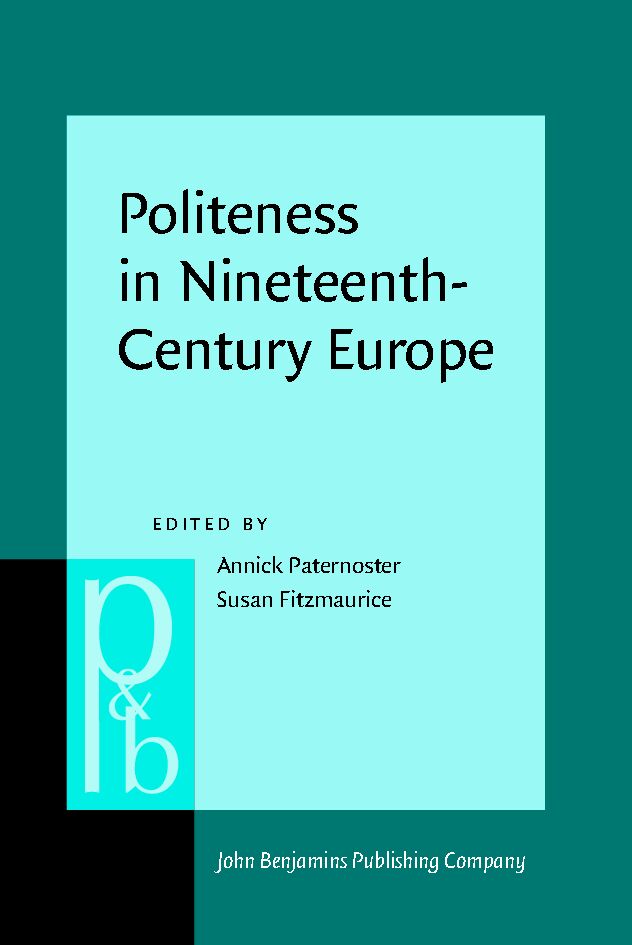
Politeness in Nineteenth-Century Europe
This volume explores a pivotal period in European history, the 'long' nineteenth century. The central innovation of this volume consists in its use of a wide range of politeness metasources -- grammar books, schoolbooks, conduct books, etiquette books, and letter-writing manuals -- to access social norms.
eBook

Decorum and Indecorum in the \Seconda redazione\ of Baldassare Castiglione's \Libro del Cortegiano\
Between the \"Seconda redazione\" (1520-21) and the third manuscript (1524, published 1528) Castiglione rewrote almost half of the \"Libro del Cortegiano.\" Where others have examined changes in socio-political and cultural references, this study focuses on dialogue interaction and on the specific use of decorum in opening and closing sequences of the debate in the \"Seconda redazione.\" The rebellious behaviour of several characters and the general concern in Book III to guarantee them a fair and equal treatment point towards an open, informal, horizontal type of interaction, which will be swept away by the strict politeness rituals of the Cortegiano.
Journal Article

Poetik des Dialogs: Aktuelle Theorie und rinascimentales Selbstverständnis
Poetik des Dialogs: Aktuelle Theorie und rinascimentales Selbstverstandnis, edited by Klaus W. Hempfer, is reviewed.
Book Review

Aptum. Retorica ed ermeneutica nel dialogo umanistico e rinascimentale nell'Italia del quattro- e primo cinquecento
The literary dialogue of the humanistic period (Fr. Petrarca, L. Bruni, P. Bracciolini, L. Valla and Cr. Landino) adopts two specific rhetorical figures from its Ciceronian model. On the one hand, the minutio, by which the speaker expresses his humility before the hearers, and, on the other hand, the dissimulatio, by which the speaker hides that he is only uttering a feigned opinion. Both are applications of aptum, the basic rule of rhetoric that aims at the adaptation of the oration to the circumstances. The necessity to adapt one's opinion to another person's view reflects the fundamental relativity of each opinion. The aptum looses these methodological implications in the Italian courtly dialogue of P. Bembo (Gli Asolani) and of B. Castiglione (Il Cortegiano). In The Courtier, which is both a dialogue and a treatise on behaviour, as well as an application of the behaviour codified within the dialogue, the minutio becomes an expression of mere courtesy, an arrivist means to social distinction. However, this arrivism is not allowed to surface and is hidden by means of dissimulatio. This arrivist use of courtesy was attacked by P. Aretino, whose Sei giornate is a parody of the hypocrisy of courtly conduct, but, as a manual for \"distinguished\" social behaviour, The Courtier is the cradle of contemporary western courtesy.
Dissertation