
Catalogue Search | MBRL


Are you sure you want to remove the book from the shelf?

{{itemTitle}}
15
result(s) for
"Patterson, David A. author"
Sort by:

Computer Organization and Design: The Hardware/software Interface
What's New in the Third Edition, Revised Printing The same great book gets better! This revised printing features all of the original content along with these additional features: Appendix A (Assemblers, Linkers, and the SPIM Simulator) has been moved from the CD-ROM into the printed book Corrections and bug fixesThird Edition featuresNew pedagogical features Understanding Program Performance - Analyzes key performance issues from the programmer's perspective Check Yourself Questions - Helps students assess their understanding of key points of a section Computers In the Real World - Illustrates the diversity of applications of computing technology beyond traditional desktop and servers For More Practice - Provides students with additional problems they can tackle In More Depth - Presents new information and challenging exercises for the advanced student New reference features Highlighted glossary terms and definitions appear on the book page, as bold-faced entries in the index, and as a separate and searchable reference on the CD. A complete index of the material in the book and on the CD appears in the printed index and the CD includes a fully searchable version of the same index. Historical Perspectives and Further Readings have been updated and expanded to include the history of software RD. CD-Library provides materials collected from the web which directly support the text. In addition to thoroughly updating every aspect of the text to reflect the most current computing technology, the third edition Uses standard 32-bit MIPS 32 as the primary teaching ISA. Presents the assembler-to-HLL translations in both C and Java. Highlights the latest developments in architecture in Real Stuff sections: - Intel IA-32 - Power PC 604 - Google's PC cluster - Pentium P4 - SPEC CPU2000 benchmark suite for processors - SPEC Web99 benchmark for web servers - EEMBC benchmark for embedded systems - AMD Opteron memory hierarchy - AMD vs. 1A-64 New support for distinct course goals Many of the adopters who have used our book throughout its two editions are refining their courses with a greater hardware or software focus. We have provided new material to support these course goals: New material to support a Hardware Focus Using logic design conventions Designing with hardware description languages Advanced pipelining Designing with FPGAs HDL simulators and tutorials Xilinx CAD tools New material to support a Software Focus How compilers work How to optimize compilers How to implement object oriented languages MIPS simulator and tutorial History sections on programming languages, compilers, operating systems and databases On the CD NEW: Search function to search for content on both the CD-ROM and the printed text CD-Bars: Full length sections that are introduced in the book and presented on the CD CD-Appendixes: Appendices B-D CD-Library: Materials collected from the web which directly support the text CD-Exercises: For More Practice provides exercises and solutions for self-study In More Depth presents new information and challenging exercises for the advanced or curious student Glossary: Terms that are defined in the text are collected in this searchable reference Further Reading: References are organized by the chapter they support Software: HDL simulators, MIPS simulators, and FPGA design tools Tutorials: SPIM, Verilog, and VHDL Additional Support: Processor Models, Labs, Homeworks, Index covering the book and CD contents Instructor Support Instructor support provided on textbooks.elsevier.com: Solutions to all the exercises Figures from the book in a number of formats Lecture slides prepared by the authors and other instructors Lecture notes
eBook

The age of the democratic revolution
For the Western world, the period from 1760 to 1800 was the great revolutionary era in which the outlines of the modern democratic state came into being. Here for the first time in one volume is R. R. Palmer's magisterial account of this incendiary age. Palmer argues that the American, French, and Polish revolutions-and the movements for political change in Britain, Ireland, Holland, and elsewhere-were manifestations of similar political ideas, needs, and conflicts. Palmer traces the clash between an older form of society, marked by legalized social rank and hereditary or self-perpetuating elites, and a new form of society that placed a greater value on social mobility and legal equality.
Featuring a new foreword by David Armitage, this Princeton Classics edition ofThe Age of the Democratic Revolutionintroduces a new generation of readers to this enduring work of political history.
eBook

Exile
The life of a human community rests on common experience. Yet in modem life there is an experience common to all that threatens the very basis of community -- the experience of exile. No one in the modem world has been spared the encounter with homelessness. Refugees and fugitives, the disillusioned and disenfranchised grow in number every day. Why does it happen? What does it mean? And how are we implicated?
David Patterson responds to these and related questions by examining exile, a primary motif in Russian thought over the last century and a half. By \"exile\" he means not only a form of punishment but an existential condition.
Drawing on texts by such familiar figures as Dostoevsky, Tolstoy, Solzhenitsyn, and Brodsky, as well as less thoroughly examined figures, including Florensky, Shestov, Tertz, and Gendelev, Patterson moves beyond the political and geographical fact of exile to explore its spiritual, metaphysical, and linguistic aspects. Thus he pursues the connections between exile and identity, identity and meaning, meaning and language.
Patterson shows that the problem of meaning in human life is a problem of homelessness, that the effort to return from exile is an effort to return meaning to the word, and that the exile of the word is an exile of the human being. By making heard voices from the Russian wilderness, Patterson makes visible the wilderness of the world.
eBook


Cannabis
This new book addresses the ongoing debate on cannabis policy and provides guidance on how to regulate its sale and distribution.Instead of taking a stance for or against cannabis use, the book: - suggests we employ strategies similar to those used in alcohol control to create a solid foundation of policy and best practices; - focuses on how we.
eBook

Hebrew Language and Jewish Thought
Drawing on more than three hundred Hebrew roots, the author shows that Jewish thought employs Hebrew concepts and categories that are altogether distinct from those that characterize the Western speculative tradition. Among the key categories that shape Jewish thought are holiness, divinity, humanity, prayer, responsibility, exile, dwelling, gratitude, and language itself. While the Hebrew language is central to the investigation, the reader need not have a knowledge of Hebrew in order to follow it. Essential reading for students and scholars of Judaism, this book will also be of value to anyone interested in the categories of thinking that form humanity's ultimate concerns.
David Patterson holds the Bornblum Chair in Judaic Studies at the University of Memphis. He has written numerous books on Jewish thought, Holocaust studies, and other topics. He received the Koret Jewish Book Award for his study of Holocaust diaries Along the Edge of Annihilation (1999).
Introduction 1. Opening Remarks on the Holy Tongue 2. First Things 3. Giving Voice to G-d 4. The Good 5. For the Sake of Another 6. The Soul 7. Exile 8. Dwelling 9. The House of the Book 10. The Word 11. The Holy 12. Closing Remarks. Hebrew Roots of Words Examined
eBook

Brown v. Board of Education
Most Americans still see Brown as a triumph--but was it? Patterson shrewdly explores the provocative questions that still swirl around the case. Could the Court--or President Eisenhower--have done more to ensure compliance with Brown? Did the decision touch off the modern civil rights movement? How useful are court-ordered busing and affirmative action against racial segregation? To what extent has racial mixing affected the academic achievement of black children? Where indeed do we go from here to realize the expectations of Marshall, Ellison, and others in 1954?.
eBook
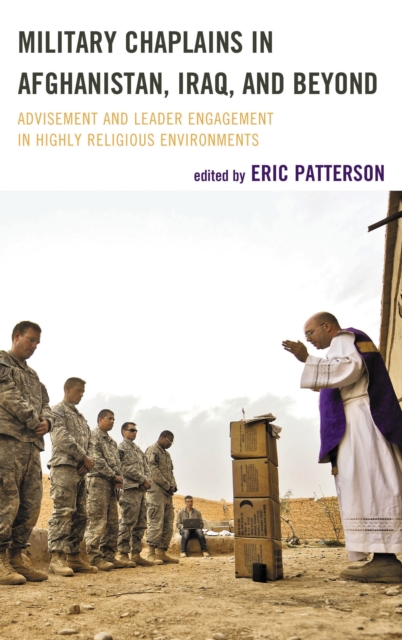
Military Chaplains in Afghanistan, Iraq, and Beyond
The role of military chaplains has changed over the past decade as Western militaries have deployed to highly religious environments such as East Africa, Afghanistan, and Iraq. U.S. military chaplains, who are by definition non-combatants, have been called upon by their war-fighting commanders to take on new roles beyond providing religious services to the troops. Chaplains are now also required to engage the local citizenry and provide their commanders with assessments of the religious and cultural landscape outside the base and reach out to local civilian clerics in hostile territory in pursuit of peace and understanding. In this edited volume, practitioners and scholars chronicle the changes that have happened in the field in the twenty-first century. Using concrete examples, this volume takes a critical look at the rapidly changing role of the military chaplain, and raises issues critical to U.S. foreign and national security policy and diplomacy.
eBook