
Catalogue Search | MBRL


Are you sure you want to remove the book from the shelf?

{{itemTitle}}
356
result(s) for
"Paxton, Robert O"
Sort by:
تشريح الفاشية
يتناول هذا الكتاب : \"الفاشية\"ما هي الفاشية ؟ اقترح العديد من المؤلفين تعريفات، لكن معظمهم فشلوا في تجاوز الملخص. يجيب المؤرخ المحترم روبرت أو باكستون على هذا السؤال لأول مرة من خلال التركيز على الخرسانة : ما فعله الفاشيون، بدلا من ما قالوا. من أول العصابات النظامية العنيفة التي تضرب \"أعداء الدولة\"، من خلال صعود موسوليني إلى السلطة، إلى التطرف الفاشي الألماني في الحرب العالمية الثانية، يظهر باكستون بوضوح لماذا جاء الفاشيون إلى السلطة في بعض البلدان وليس في غيرها، ويستكشف ما إذا كان يمكن للفاشية موجودة خارج الإعداد الأوروبي في أوائل القرن العشرين الذي ظهرت فيه. سيكون لتشريح الفاشية تأثير دائم على فهمنا للتاريخ الأوروبي الحديث، تماما مثلما أعادت فيشي فرنسا الكلاسيكية في باكستون تحديد رؤيتنا للحرب العالمية الثانية. استنادا إلى عمر البحث، يحول هذا الكتاب الهام والمهم معرفتنا بالفاشية-\"الابتكار السياسي الرئيسي في القرن العشرين ومصدر الكثير من آلامها\".
BOOK

Season of Infamy
In 1939, the 65-year old French political economist Charles Rist was serving as advisor to the French government and consultant to the international banking and business world. As France anxiously awaited a German invasion, Rist traveled to America to negotiate embargo policy. Days after his return to Paris, the German offensive began and with it the infamous season of occupation. Retreating to his villa in Versailles, Rist turned his energies to the welfare of those closest to him, while in his diary he began to observe the unfolding of the war. Here the deeply learned Rist investigates the causes of the disaster and reflects on his country's fate, placing the behavior of the \"people\" and the \"elite\" in historical perspective. Though well-connected, Rist and his family and friends were not exempt from the perils and tragedies of war, as the diary makes clear. Season of Infamy presents a distinctive, closely-observed view of life in France under the occupation.
eBook

The Five Stages of Fascism
Paxton describes the five major difficulties that stand in the way of any effort to define fascism and discusses how German Nazism and Italian Fascism are conceptually related.
Journal Article

French peasant Fascism
The Greenshirts, a far-right peasant movement in 1930s France, wanted to transform the Republic into an authoritatian, agrarian state. They succeeded only in mounting sporadic local actions, but they permitted a fresh look at the strengths and weaknesses of fascism in French rural Society, and at the enduring French perception of themselves as a peasant nation.
eBook
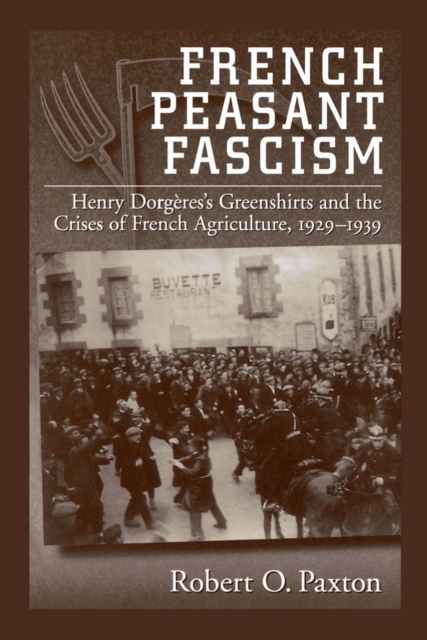
French peasant fascism : Henry Dorgère's Greenshirts and the crises of French agriculture, 1929-1939
French Peasant Fascism is the first account of the Greenshirts, a militant right-wing peasant movement in 1930s France that sought to transform the Republic into an authoritarian, agrarian state. Author Robert Paxton examines the Greenshirts in five case studies, throwing new light on Frenchrural society and institutions during the Depression and on the emergence of a new rural leadership of authentic farmers. Paxton points out that fascism remained weak in the French countryside because the French state protected landowners more effectively than did those of Weimar Germany and Italy,and becau
eBook
French peasant fascism : Henry Dorgère's Greenshirts and the crises of French agriculture, 1929-1939 / Robert O. Paxton
French Peasant Fascism is the first account of the Greenshirts, a militant right-wing peasant movement in 1930s France that sought to transform the Republic into an authoritarian, agrarian state. Author Robert Paxton examines the Greenshirts in five case studies, throwing new light on French rural society and institutions during the Depression and on the emergence of a new rural leadership of authentic farmers. Paxton points out that fascism remained weak in the French countryside because the French state protected landowners more effectively than did those of Weimar Germany and Italy, and because French rural notables were so firmly embedded in social and economic power. Although the Greenshirts disappeared with the Third Republic, they left a double legacy: a tradition of peasant direct action, which is still exercised today; and the idea of France as a peasant nation, whose identity and virtues rest upon the persistence of a large peasant sector. That self-image continues to influence French policy choices today, long after the social structure on which it rested has disappeared. -- Publisher.
eBook

The Five Stages of Fascism
At first sight, nothing seems easier to understand than fascism.¹ It presents itself to us in crude, primary images: a chauvinist demagogue haranguing an ecstatic crowd; disciplined ranks of marching youths; uniform-shirted militants beating up members of some demonised minority; obsessive preoccupation with community decline, humiliation or victimhood; and compensatory cults of unity, energy, and purity, pursued with redemptive violence.
Yet, great difficulties arise as soon as one sets out to define fascism.² Its boundaries are ambiguous in both space and time. Do we include Stalin? Do we reach outside Europe to charismatic dictators in developing countries like Nkrumah, with
Book Chapter