
Catalogue Search | MBRL


Are you sure you want to remove the book from the shelf?

{{itemTitle}}
150
result(s) for
"Penny, H. Glenn"
Sort by:

Performing indigeneity : global histories and contemporary experiences
\"This engaging collection of essays discusses the complexities of \"being\" indigenous in public spaces. Laura R. Graham and H. Glenn Penny bring together a set of highly recognized junior and senior scholars, including indigenous scholars, from a variety of fields to provoke critical thinking about the many ways in which individuals and social groups construct and display unique identities around the world. The case studies in Performing Indigeneity underscore the social, historical, and immediate contextual factors at play when indigenous people make decisions about when, how, why, and who can \"be\" indigenous in public spaces. Performing Indigeneity invites readers to consider how groups and individuals think about performance and display and focuses attention on the ways that public spheres, both indigenous and nonindigenous ones, have received these performances. The essays demonstrate that performance and display are essential to the creation and persistence of indigeneity, while also presenting the conundrum that in many cases \"indigeneity\" excludes some of the voices or identities that the category purports to represent. \"-- Provided by publisher.
Book


Historical culture by restitution? : a debate on art, museums, and justice
\"Looted art, art theft, colonial collections of cultural objects - not only since the controversy over the Nigerian Benin bronzes at the Humboldt Forum in the German capital Berlin and other European museums a dispute over how to deal with exhibits from colonial contexts erupted. The debate, which has been ongoing among experts for some time, gained new political momentum in 2018 when France's President Macron announced that objects of colonial provenance in French museums would be returned to their societies of origin, and initiated concrete steps. The demand for restitution of art treasures of colonial provenance raises fundamental and extremely complex questions about the presence of the past in ethical, scientific, political, legal and aesthetic dimensions. They concern art historians and museum professionals, cultural historians, historians of science, lawyers and history teachers as well as visitors to museums with colonial collections, who are made aware of the provenance of objects there. This volume, published in Germany in 2021, was a first attempt at illuminating the historio-cultural dimensions of the debate and bringing them to the attention of a broader public. German and international authors contributed essays making clear, how important it is to take a differentiated look at a central part of the current social debate on the legacy of colonialism. This volume was well received. As colonialism is by definition an international phenomenon, the current debate in Germany is presented here in an English language version now.\"--publisher.
BOOK

Material Connections: German Schools, Things, and Soft Power in Argentina and Chile from the 1880s through the Interwar Period
From the late nineteenth century through the interwar period, the production and consumption of German things played critical roles in delineating and connecting a wide variety of German places in Latin America. Such places became ubiquitous in Chile and Argentina. They flourished because there was ample room in the German imagination for the multiplicity of German places and the cultural hybridity that accompanied them to extend beyond Imperial Germany's national boundaries and colonial possessions. They also flourished because host societies found virtue in having those German places in their states. This essay uses German schools in Argentina and Chile as a window into the emergence of such German places and the soft power that accompanied them. Scholars often overlook that power when they focus on colonial questions or formal and informal imperialism in Latin America. More than any other institution, German schools became sites where the production and consumption of German things were concentrated and multilayered, and where the consistencies and great varieties of Germanness that arrived and evolved in Latin America gained their clearest articulation. Because those schools were both centers of communities and nodes in a global pedagogical network that thrived during the interwar period, they provide us with great insight into a nexus of motivations that created German places in Latin America. Life around these schools also underscores the importance of studying immigrants and their things together.
Journal Article

Latin American Connections: Recent Work on German Interactions with Latin America
German interactions with Latin America have a long history. Indeed, early modern historians have demonstrated that people from German-speaking central Europe took part in all aspects of the European conquest of Central and South America. They have shown that these people were critical to mining operations and publishing in sixteenth-century Mexico; they have found them among Portuguese and Spanish sailors and soldiers almost everywhere; and they have located them playing important roles in a wide range of professions from Mexico to the south of Chile.
Journal Article

Germans Abroad: Respatializing Historical Narrative
The introductory essay engages with recent work on the myriad groups of German speakers that flourished outside the borders of the German nation-state between the 1880s and the 1930s. Since the end of the Second World War, scholars have treated the notion of the Auslandsdeutsche (German expatriates) with considerable ideological suspicion. This essay, however, argues that a German history that moves beyond those prejudices and integrates these communities of German-speakers into a more inclusive historiography offers us the chance to create a dialog between German national history and the histories of the nations and regions in which German cultures took hold and, to use the language of the times, where German colonies were founded. The integration of these German spaces and their diverse communities into our historical narratives offers us the chance to fashion a more inclusive notion of German history, one that effectively decenters the role of the German nation-state by recognizing the inherently polycentric character of German nationhood during this period.
Journal Article

Performing Indigeneity
This engaging collection of essays discusses the complexities of \"being\" indigenous in public spaces. Laura R. Graham and H. Glenn Penny bring together a set of highly recognized junior and senior scholars, including indigenous scholars, from a variety of fields to provoke critical thinking about the many ways in which individuals and social groups construct and display unique identities around the world. The case studies inPerforming Indigeneityunderscore the social, historical, and immediate contextual factors at play when indigenous people make decisions about when, how, why, and who can \"be\" indigenous in public spaces.
Performing Indigeneityinvites readers to consider how groups and individuals think about performance and display and focuses attention on the ways that public spheres, both indigenous and nonindigenous ones, have received these performances. The essays demonstrate that performance and display are essential to the creation and persistence of indigeneity, while also presenting the conundrum that in many cases \"indigeneity\" excludes some of the voices or identities that the category purports to represent.
eBook

Worldly provincialism
Worldly Provincialism introduces readers to the intellectual history that drove the emergence of German anthropology. Drawing on the most recent work on the history of the discipline, the contributors rethink the historical and cultural connections between German anthropology, colonialism, and race. By showing that German intellectual traditions differed markedly from those of Western Europe, they challenge the prevalent assumption that Europeans abroad shared a common cultural code and behaved similarly toward non-Europeans. The eloquent and well-informed essays in this volume demonstrate that early German anthropology was fueled by more than a simple colonialist drive. Rather, a wide range of intellectual history shaped the Germans' rich and multifarious interest in the cultures, religions, physiognomy, physiology, and history of non-Europeans, and gave rise to their desire to connect with the wider world. Furthermore, this volume calls for a more nuanced understanding of Germany's standing in postcolonial studies. In contrast to the prevailing view of German imperialism as a direct precursor to Nazi atrocities, this volume proposes a key insight that goes to the heart of German historiography: There is no clear trajectory to be drawn from the complex ideologies of imperial anthropology to the race science embraced by the Nazis. Instead of relying on a nineteenth-century explanation for twentieth-century crimes, this volume ultimately illuminates German ethnology and anthropology as local phenomena, best approached in terms of their own worldly provincialism.
eBook
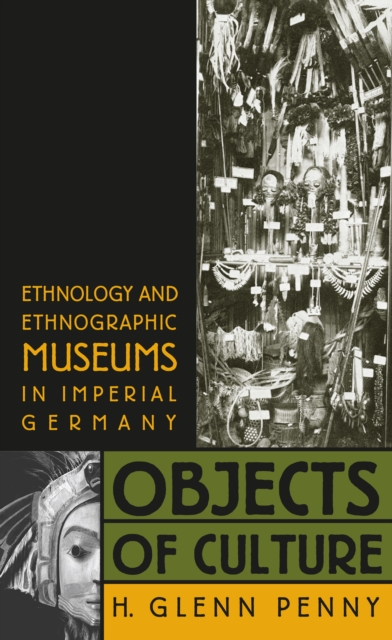
Objects of culture : ethnology and ethnographic museums in imperial Germany
In the late nineteenth century, Germans spearheaded a worldwide effort to preserve the material traces of humanity, designing major ethnographic museums and building extensive networks of communication and exchange across the globe. In this groundbreaking study, Glenn Penny explores the appeal of ethnology in Imperial Germany and analyzes the motivations of the scientists who created the ethnographic museums. Penny shows that German ethnologists were not driven by imperialist desires or an interest in legitimating putative biological or racial hierarchies. Overwhelmingly antiracist, they aspired to generate theories about the essential nature of human beings through their museums' collections. They gained support in their efforts from boosters who were enticed by participating in this international science and who used it to promote the cosmopolitan character of their cities and themselves. But these cosmopolitan ideals were eventually overshadowed by the scientists' more modern, professional, and materialist concerns, which dramatically altered the science and its goals. By clarifying German ethnologists' aspirations and focusing on the market and conflicting interest groups, Penny makes important contributions to German history, the history of science, and museum studies.
eBook
Elusive Authenticity: The Quest for the Authentic Indian in German Public Culture
The German fascination with the American Indian is legion, enduring, and much more than a current, post-modern enchantment with ‘the primitive.’ Indeed, the special and continuing relationship between Germans and Indians is well known, and in recent years it has received considerable scholarly attention. One striking aspect of this relationship is the seemingly endless effort by scholars, museum curators, pedagogues, and dilettantes of all fashions to control the discourse on ‘Indianness’ in Germany by denouncing popular clichés and attempting to replace them with new versions of ‘the authentic Indian.’ Their ongoing efforts to harness concepts of authenticity while policing this discourse are hardly surprising; indeed they have become predictable. But the lack of self-reflection with which most people participate in this process is remarkable. Few laymen or scholars seem to notice that they are the latest participants in a repetitive process that has been going on in German-speaking lands for close to 200 years, and even fewer seem to notice the ironic turn it has recently taken.
Journal Article