
Catalogue Search | MBRL


Are you sure you want to remove the book from the shelf?

{{itemTitle}}
198
result(s) for
"Perkins, David N"
Sort by:


Future wise : educating our children for a changing world
\"How to teach big understandings and the ideas that matter most. Everyone has an opinion about education, and teachers face pressures from Common Core content standards, high-stakes testing, and countless other directions. But how do we know what today's learners will really need to know in the future? Future Wise: Educating Our Children for a Changing World is a toolkit for approaching that question with new insight. There is no one answer to the question of what's worth teaching, but with the tools in this book, you'll be one step closer to constructing a curriculum that prepares students for whatever situations they might face in the future. K-12 teachers and administrators play a crucial role in building a thriving society. David Perkins, founding member and co-director of Project Zero at Harvard's Graduate School of Education, argues that curriculum is one of the most important elements of making students ready for the world of tomorrow. In Future Wise, you'll learn concepts, curriculum criteria, and techniques for prioritizing content so you can guide students toward the big understandings that matter. Understand how learners use knowledge in life after graduation Learn strategies for teaching critical thinking and addressing big questions Identify top priorities when it comes to disciplines and content areas Gain curriculum design skills that make the most of learning across the years of education Future Wise presents a brand new framework for thinking about education. Curriculum can be one of the hardest things for teachers and administrators to change, but David Perkins shows that only by reimagining what we teach can we lead students down the road to functional knowledge. Future Wise is the practical guidebook you need to embark on this important quest\"-- Provided by publisher.
Book

The Mind's Best Work
Over the years, tales about the creative process have flourished-tales of sudden insight and superior intelligence and personal eccentricity. Coleridge claimed that he wrote \"Kubla Khan\" in one sitting after an opium-induced dream. Poe declared that his \"Raven\" was worked out \"with the precision and rigid consequence of a mathematical problem.\" D. N. Perkins discusses the creative episodes of Beethoven, Mozart, Picasso, and others in this exploration of the creative process in the arts, sciences, and everyday life. Table of Contents:
A Parable 1. Witnesses to Invention 2. Creative Moments 3. Ways of the Mind 4. Critical Moments 5. Searching For 6. Plans Down Deep 7. Plans Up Front 8. Lives of Inquiry 9. Having It 10. The Shape of Making
Notes Sources Index Reviews of this book: A delightful book, easy to read, amusing and jammed with intriguing \"personal experiments,\" puzzles for the reader that offer insights into creative thinking. It is a valuable book because it summarizes well the results of recent investigations and effectively debunks a variety of cherished myths... Read the book for fun. Read it to find out what psychologists are up to. --New York Times Book Review Reviews of this book: The Mind's Best Work [is] a guided tour of the new psychology of creative thinking... Perkins belongs in that rare company of Lewis Thomas and other popularizers of science who combine a lively style, playful wit and discriminating scholarship. --Newsday Reviews of this book: A survey of scientific research that's also a work of playful wit. --Newsweek
eBook
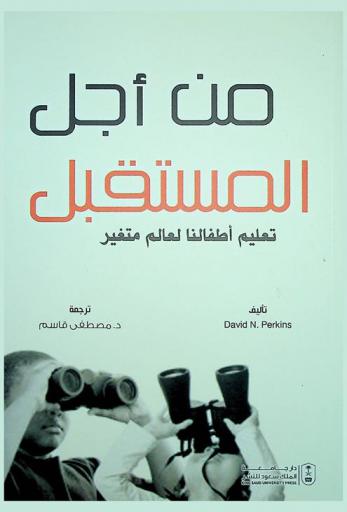
من أجل المستقبل : تعليم أطفالنا لعالم متغير
يضع الكتاب الحالي أيدينا على أزمة مزدوجة تفوت على الكثيرين منا في محتوى التعليم ما قبل الجامعي ومخرجاته وعلاقتها بالحياة المعاصرة يتمثل شقها الأول في أن معظم ما ندرسه عادة ليس مهما لحياة المتعلمين ولا يقدم عائد استثمار جيد، ويتمثل شقها الثاني في أن هناك الكثير مما لا ندرسه عادة يمكن أن يكون مهما كثيرا لحياة المتعلمين ويحقق عائدا أفضل. يفلت الكتاب من إسار النظرة الضيقة التي تستحوذ عليها المشكلات اليومية والفنية في التعليم ما قبل الجامعي ويطرح للنقاش موضوع التعلم الجدير بالحياة والجاهز للحياة وما ينطوي عليه ضمنا من أننا نعد أطفالنا لعالمنا القديم وطرقنا القديمة في الحياة والتفكير والمعرفة.
Book
The mind's best work
Over the years, tales about the creative process have flourished-- tales of sudden insight and superior intelligence and personal eccentricity. D. N. Perkins discusses the creative episodes of Beethoven, Mozart, Picasso, and others in this exploration of the creative process in the arts, sciences, and everyday life.
eBook

تقويم عادات العقل وإعداد التقارير عنها
في هذا الدليل تجد نماذج عديدة من حقيبة نمو التعليم ومحاكات تصحيح الأداء ومهمات تقوم مدى تمكن الطلاب من السلوكات الذكية ويبحث بتعمق في استراتيجيات التقويم والإبلاغ التي تساعد مدرستك في أن تنمي ثقافة مدرسية عميقة ويعلمك كيف تشجع طلابك على التأمل في تفكيرهم، تقويم ما إن كانوا ينمون ويستخدمون عادات العقل ويحددون تقدمهم.
BOOK

Dimensions of Causal Understanding: the Role of Complex Causal Models in Students' Understanding of Science
This article argues that an important source of the difficulties posed by particular concepts and theories is the narrow range of \"types of causal models\" with which most learners are familiar. Most learners are familiar with relatively simple styles of causal models, but many concepts and theories in science depend on styles substantially more complex. The authors offer an analysis of four dimensions of complex causality and argue that the increasingly complex styles along the dimensions present challenges that help to explain students' difficulties in mastering science concepts. Two types of evidence are offered: (1) analyses of students' understanding of several challenging science concepts based on the extant literature and research; and (2) two intervention studies are reviewed, involving teaching interventions where cultivating greater complexity in students' causal models led to better understanding. The interventions involve context-situated, inquiry-centered learning experiences that draw students' attention to how they are modelling the causality involved in particular phenomena and encourage more sophisticated causal modelling, embedded in their science learning. (Contains 3 tables and 3 figures.)
Journal Article

