
Catalogue Search | MBRL


Are you sure you want to remove the book from the shelf?

{{itemTitle}}
65
result(s) for
"Peter H. van der Laan"
Sort by:
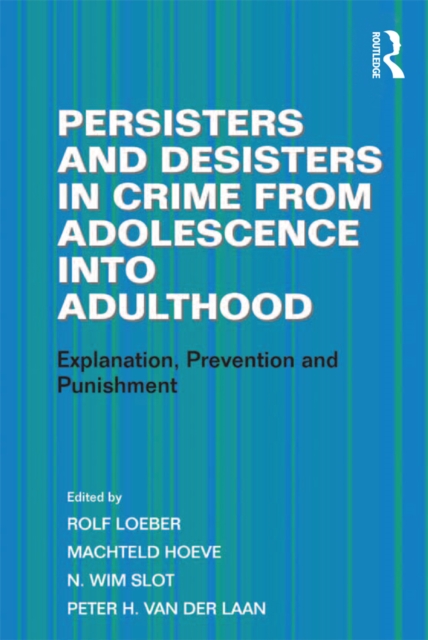
Persisters and Desisters in Crime from Adolescence into Adulthood
Too many juvenile delinquents persist in their offending into adulthood. They constitute a major burden for individual victims, for businesses and the justice system, all contributing to the total cost of crime for society. Focusing on the transition between juvenile offending and adult crime, this book examines research based on Dutch, European and North-American studies on the persistence and discontinuity of offending between late adolescence and early adulthood. Presenting empirical studies showing why persistence or discontinuity take place, the book provides up-to-date information on preventive and remedial interventions to promote discontinuity of offending amongst young adults. From the same team who produced 'Tomorrow's Criminals', this book will be a valuable resource for criminologists, criminal justice professionals, psychologists, sociologists, and psychiatrists interested in juvenile and young adult offenders, as well as those interested in what makes career criminals and youth who reform.
eBook
Brief report: Free-living physical activity levels and cognitive control in multi-problem young adults
Previous studies indicate a positive association between physical activity and cognitive control in sedentary but healthy adults, yet not much is known about physical activity levels in multi-problem young adults. We examined the level of self-reported free-living physical activity (i.e., MET minutes per week) in an ecological valid sample of young adults facing multiple problems, including unemployment, lack of education, frequent substance use, and history of delinquency. We compared cognitive control with an age- and sex-matched control sample. Additionally, the association between physical activity and cognitive control (i.e., response inhibition, error processing, interference effect) in the multi-problem group was examined. Physical activity and cognitive control were measured with the International Physical Activity Questionnaire-Long Form and three cognitive control experiments (i.e., Flanker, Go/NoGo, Stroop), respectively. With M = 4428 Metabolic Equivalents (METs), our multi-problem sample (n = 63) showed physical activity levels similar to the age- and sex-matched control sample from the general population (n = 62). The multi-problem young adults also showed impaired cognitive control indexed as decreased response inhibition and decreased Flanker correctness effect compared to their peers. We could not find an association between self-reported physical activity and cognitive control in the multi-problem sample. Due to the small sample size, results should be interpreted with caution. However, future dose-response studies could still use these results to further examine if within-individual increased physical activity may possibly lead to improved cognitive control in (already relatively active) multi-problem young adults.
Journal Article

The Relationship Between Parenting and Delinquency: A Meta-analysis
This meta-analysis of 161 published and unpublished manuscripts was conducted to determine whether the association between parenting and delinquency exists and what the magnitude of this linkage is. The strongest links were found for parental monitoring, psychological control, and negative aspects of support such as rejection and hostility, accounting for up to 11% of the variance in delinquency. Several effect sizes were moderated by parent and child gender, child age, informant on parenting, and delinquency type, indicating that some parenting behaviors are more important for particular contexts or subsamples. Although both dimensions of warmth and support seem to be important, surprisingly very few studies focused on parenting styles. Furthermore, fewer than 20% of the studies focused on parenting behavior of fathers, despite the fact that the effect of poor support by fathers was larger than poor maternal support, particularly for sons. Implications for theory and parenting are discussed. [PUBLICATION ABSTRACT]
Journal Article
A Meta-analysis of Attachment to Parents and Delinquency
To investigate the link between attachment to parents and delinquency, and the potential moderating effects of age and sex, 74 published and unpublished manuscripts (N=55,537 participants) were subjected to a multilevel meta-analysis. A mean small to moderate effect size was found (r=0.18). Poor attachment to parents was significantly linked to delinquency in boys and girls. Stronger effect sizes were found for attachment to mothers than attachment to fathers. In addition, stronger effect sizes were found if the child and the parent had the same sex compared to cross-sex pairs of children and parents. Age of the participants moderated the link between attachment and delinquency: larger effect sizes were found in younger than in older participants. It can be concluded that attachment is associated with juvenile delinquency. Attachment could therefore be a target for intervention to reduce or prevent future delinquent behavior in juveniles.[PUBLICATION ABSTRACT]
Journal Article

The effectiveness of social skills training (SST) for juvenile delinquents: a meta-analytical review
Objectives
To examine the effectiveness of social skills training (SST) for juvenile offenders and for whom and under which conditions SSTs are the most effective.
Methods
Multilevel meta-analyses were conducted to examine the effectiveness of juvenile offender SST compared to no/placebo treatment and alternative treatment on offending, externalizing problems, social skills, and internalizing problems.
Results
Beneficial effects were only found for offending and social skills compared to no/placebo treatment. Compared to alternative treatment, small effects on only reoffending were found. Moderator analyses yielded larger effects on offending, with larger post-treatment effects on social skills. Effects on externalizing behavior were only reported in the USA, and effects on social skills were larger when the outcomes were reported through self-report.
Conclusions
SST may be a too generic treatment approach to reduce juvenile delinquency, because dynamic risk factors for juvenile offending are only partially targeted in SST.
Journal Article
Trajectories of Delinquency and Parenting Styles
We investigated trajectories of adolescent delinquent development using data from the Pittsburgh Youth Study and examined the extent to which these different trajectories are differentially predicted by childhood parenting styles. Based on self-reported and official delinquency seriousness, covering ages 10-19, we identified five distinct delinquency trajectories differing in both level and change in seriousness over time: a nondelinquent, minor persisting, moderate desisting, serious persisting, and serious desisting trajectory. More serious delinquents tended to more frequently engage in delinquency, and to report a higher proportion of theft. Proportionally, serious persistent delinquents were the most violent of all trajectory groups. Using cluster analysis we identified three parenting styles: authoritative, authoritarian (moderately supportive), and neglectful (punishing). Controlling for demographic characteristics and childhood delinquency, neglectful parenting was more frequent in moderate desisters, serious persisters, and serious desisters, suggesting that parenting styles differentiate non- or minor delinquents from more serious delinquents. [PUBLICATION ABSTRACT]
Journal Article

INDIVIDUAL STABILITY OF ANTISOCIAL BEHAVIOR FROM CHILDHOOD TO ADULTHOOD: TESTING THE STABILITY POSTULATE OF MOFFITT'S DEVELOPMENTAL THEORY
This paper presents a test of Moffitt's (1993) prediction on the stability of longitudinal antisocial behavior, using data from the South‐Holland Study. Aggressive (overt) and non‐aggressive antisocial (covert) behaviors were measured when subjects were 6–11 years old, and at follow‐ups when they were 12–17 years old and 20–25 years old. In accordance with the postulate, we did find a higher level of stability of overt behavior from childhood to adulthood, compared with childhood to adolescence, especially in combination with early manifestations of status violations and/or covert behavior in childhood. Results related to the stability of covert behavior were not in accordance with the prediction, but did support the recently proposed adjustment to the starting age of the adult phase.
Journal Article
Social skills training for juvenile delinquents: post-treatment changes
Objectives
To examine the post-treatment effectiveness of an outpatient, individual social skills training for juvenile delinquents in the Netherlands and to conduct moderator tests for age, gender, ethnicity, and risk of reoffending.
Methods
The sample consisted of juveniles who received Tools4U, a social skills training with a parental component, as a penal sanction (
N
= 115). Propensity score matching was used to select a control group of juveniles receiving treatment as usual (TAU) of
n
= 108 juveniles (of a total of
N
= 354). Assessment of impulsivity, social perspective-taking, social problem-solving, critical reasoning, developmental task-related skills, and treatment integrity took place before and immediately after the treatment.
Results
Treatment integrity was found to be sufficient, so that treatment effects could be attributed to the Tools4U training. Tools4U was more effective than TAU in reducing impulsivity, cognitive distortions (self-centering and assuming the worst), and social perspective-taking deficits (hostile intent attribution). No treatment effects were found on adolescents’ social problem-solving skills, and only caretakers of girls showed improvement in parenting skills. Effects on developmental task-related skills were not in the expected direction: after Tools4U, juveniles reported significantly less social acceptance and self-worth than juveniles receiving TAU.
Conclusions
Tools4U showed generally small effects and no effects on protective factors, which might limit the long-term treatment effects on delinquency. Treatment effects may be improved by implementing additional techniques and improving the parental component for boys in particular.
Journal Article
A randomized controlled trial of the effectiveness of multisystemic therapy in the Netherlands: post-treatment changes and moderator effects
Objective
In the present randomized controlled trial, the effectiveness of multisystemic therapy (MST) in The Netherlands was examined. Moderator tests were conducted for ethnicity, age and gender.
Methods
The sample consisted of
N
= 256 adolescents, referred because of conduct problems, and randomized to MST or treatment as usual (TAU). Assessments (questionnaires and observational ratings) took place before and immediately after the treatment.
Results
MST was more effective than TAU in decreasing externalizing behavior, ODD, CD and property offences, but not for violence. Findings were mixed for adolescents’ and parental cognitions: the MST group, compared to TAU, showed an improvement in parental sense of competence, and a decrease in adolescents’ hostility, but no change in self-esteem and an increase in personal failure. MST was effective for positive dimensions of parenting and associations with prosocial peers, but not for relationships with deviant peers. MST was equally effective for adolescents of different ages and with different ethnicities. However, MST showed larger (and more positive) effects for adolescent cognitions for boys than for girls.
Conclusions
Effects of MST in The Netherlands are generally comparable to the positive findings reported in American and Norwegian trials. MST seems equally effective across age and ethnic minority groups, but some gender moderator effects were found for adolescent cognitions.
Journal Article
Follow-up of a social skills training (SST) for juvenile delinquents: effects on reoffending
Objectives
To examine (1) the long-term effects on reoffending of an individual SST for juvenile delinquents in The Netherlands and (2) whether effects differ by demographic and offense history characteristics.
Methods
The present study is a follow-up of a matched control study comparing post-treatment effects of
N
= 115 juveniles receiving Tools4U, an SST with a parental component, to
N
= 108 control group juveniles receiving treatment as usual (TAU). Analyses were conducted separately for delinquents and truants. Effects in terms of recidivism were assessed using official delinquency data after 6 and 12 months and 1.46 years after SST termination. Percentage of recidivists, number of re-arrests, and violent recidivism were outcome variables.
Results
Overall, 39% of the juveniles reoffended, and there were no differences between Tools4U and TAU on any of the selected recidivism outcomes. Additionally, demographic and delinquency characteristics and post-treatment effects did not moderate effectiveness.
Conclusions
Tools4U was not more effective than TAU in preventing recidivism, which may be explained by a generally low percentage of recidivists. With established treatment integrity, and a lack of well-researched effective treatment alternatives, Tools4U could still be a reasonable treatment option for
adolescent onset
juvenile offenders, although more research is needed to confirm this.
Journal Article