
Catalogue Search | MBRL


Are you sure you want to remove the book from the shelf?

{{itemTitle}}
89
result(s) for
"Peyman Vahabzadeh"
Sort by:

Violence and nonviolence : conceptual excursions into phantom opposites
\"Through an original and close reading of the key literature regarding both revolutionary violence and nonviolence, this book collapses the widely-assumed concepts of violence and nonviolence as mutually exclusive. By revealing that violence and nonviolence are braided concepts arising from human action, Peyman Vahabzadeh submits that in many cases the actions deemed to be either violent or nonviolent might actually produce outcomes that are not essentially different. Vahabzadeh offers a conceptual phenomenology of the key thinkers and theorists of both revolutionary violence and various approaches to nonviolence. Arguing that violence is inseparable from civilizations, Violence and Nonviolence concludes by making a number of original conceptualizations regarding the relationship between violence and nonviolence, exploring the possibility of a nonviolent future and proposing to understand the relationship between the two concepts as concentric, not opposites.\"-- Provided by publisher.
Book
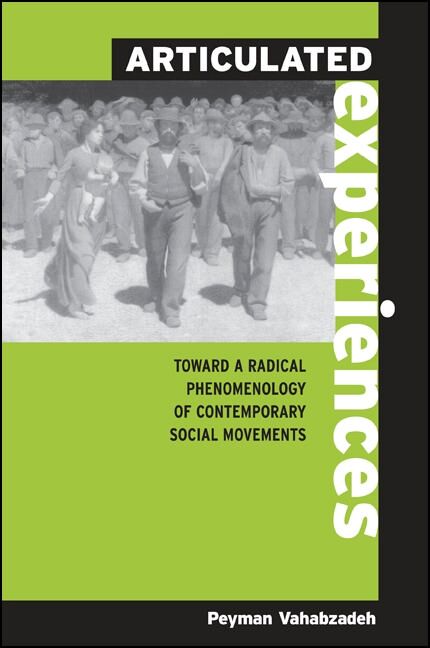
Articulated Experiences
By reexamining the very foundations of everyday acting and thinking and stepping into the open expanse of a possible transition to a postmodern era, this book presents a radical phenomenological approach to the study of contemporary social movements. It offers a theory of acting that refuses to surrender to norms and legislations and thus always intimates a mode of thinking that challenges various manifestations of ultimacy. Vahabzadeh invites us to radically rethink many basic principles that inform our lives, such as the democratic discourse, the concept of rights, liberal democratic regimes, time and epochs, oppression, acting, and the practice of sociology, in an effort to instate a reworked concept of experience in theories about social movements.
eBook

Articulated experiences : toward a radical phenomenology of contemporary social movements
By reexamining the very foundations of everyday acting and thinking and stepping into the open expanse of a possible transition to a postmodern era, this book presents a radical phenomenological approach to the study of contemporary social movements. It offers a theory of acting that refuses to surrender to norms and legislations and thus always intimates a mode of thinking that challenges various manifestations of ultimacy. Vahabzadeh invites us to radically rethink many basic principles that inform our lives, such as the democratic discourse, the concept of rights, liberal democratic regimes, time and epochs, oppression, acting, and the practice of sociology, in an effort to instate a reworked concept of experience in theories about social movements.
eBook

A Guerrilla Odyssey
Emerging in the early 1970s, the Organization of Iranian People’s Fadai Guerrillas (OIPFG) became one of the most important secular leftist political organizations in Iran. Despite their lasting influence and the way in which their efforts helped shape the history of Iran for decades to come, little is known about the group. A Guerrilla Odyssey presents the first comprehensive examination of the rise and fall of the Fadai urban guerrilla movement in Iran. Drawing on exhaustive analyses of the published and unpublished works of the Fadai Guerrillas, as well as of archival material and interviews with activists, the author demonstrates historically and sociologically the conditions that surrounded the debut and demise of the urban guerrilla warfare that defined Iranian political life in the 1970s. Vahabzadeh offers a critique of various aspects of the Fadai’s theories of national liberation in an attempt to reconsider the painful relationship among modernization, secularism, and democracy in contemporary Iran. In addition, the author makes a compelling case explaining why older revolutionary social movements of the 1960s and 1970s have transformed into the new democratic social movements that emerged from the 1980s onward in the form of today’s women’s, student, and youth movements in Iran. A Guerilla Odyssey is a meticulously researched and engrossing narrative that promises to be a major contribution to the field of Iranian history.
eBook


A Guerrilla Odyssey
Emerging in the early 1970s, the Organization of Iranian People’s Fadai Guerrillas (OIPFG) became one of the most important secular leftist political organizations in Iran. Despite their lasting influence and the way in which their efforts helped shape the history of Iran for decades to come, little is known about the group. A Guerrilla Odyssey presents the first comprehensive examination of the rise and fall of the Fadai urban guerrilla movement in Iran. Drawing on exhaustive analyses of the published and unpublished works of the Fadai Guerrillas, as well as of archival material and interviews with activists, the author demonstrates historically and sociologically the conditions that surrounded the debut and demise of the urban guerrilla warfare that defined Iranian political life in the 1970s. Vahabzadeh offers a critique of various aspects of the Fadai’s theories of national liberation in an attempt to reconsider the painful relationship among modernization, secularism, and democracy in contemporary Iran. In addition, the author makes a compelling case explaining why older revolutionary social movements of the 1960s and 1970s have transformed into the new democratic social movements that emerged from the 1980s onward in the form of today’s women’s, student, and youth movements in Iran. A Guerilla Odyssey is a meticulously researched and engrossing narrative that promises to be a major contribution to the field of Iranian history.
eBook


Mustafa Shu'a'iyan and Fada'iyan-i Khalq: Frontal Politics, Stalinism, and the Role of Intellectuals in Iran
This paper presents a glance into the life and times of the forgotten Iranian revolutionary and political theorist, Mustafa Shu'a'iyan, and his engagement with the orthodox and militant Iranian Left of the 1970s. A brief biographical sketch situates Shu'a'iyan in the context of the leftist groups of his time. In particular, the paper shows how upon his agonizing organizational relationship with the People's Fada'i Guerrillas, he set himself the unenviable task of launching the pathology of Stalinism that dominated the Iranian Left for decades. In this context, his bitter debate with the Fada'i Guerrillas on the role of the intellectuals in revolutionary struggle appears as a step toward unravelling the plagues that have won the Iranian Left its ill repute of being ideologically and organizationally undemocratic.
Journal Article