
Catalogue Search | MBRL


Are you sure you want to remove the book from the shelf?

{{itemTitle}}
70
result(s) for
"Phelps, Wesley G"
Sort by:


Before Lawrence v. Texas
In 2003 the US Supreme Court overturned anti-sodomy laws across the country, ruling in Lawrence v. Texas that the Constitution protects private consensual sex between adults. To some, the decision seemed to come like lightning from above, altering the landscape of America’s sexual politics all at once. In actuality, many years of work and organizing led up to the legal case, and the landmark ruling might never have happened were it not for the passionate struggle of Texans who rejected their state’s discriminatory laws.Before Lawrence v. Texas tells the story of the long, troubled, and ultimately hopeful road to constitutional change. Wesley G. Phelps describes the achievements, setbacks, and unlikely alliances along the way. Over the course of decades, and at great risk to themselves, gay and lesbian Texans and their supporters launched political campaigns and legal challenges, laying the groundwork for Lawrence. Phelps shares the personal experiences of the people and couples who contributed to the legal strategy that ultimately overturned the state’s discriminatory law. Even when their individual court cases were unsuccessful, justice seekers and activists collectively influenced public opinion by insisting that their voices be heard. Nine Supreme Court justices ruled, but it was grassroots politics that vindicated the ideal of equality under the law.
eBook


A People's War on Poverty
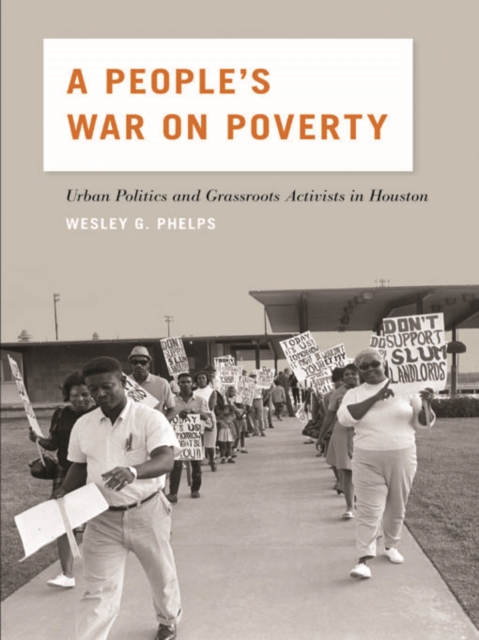
InA People's War on Poverty, Wesley G. Phelps investigates the on-the-ground implementation of President Lyndon Johnson's War on Poverty during the 1960s and 1970s. He argues that the fluid interaction between federal policies, urban politics, and grassroots activists created a significant site of conflict over the meaning of American democracy and the rights of citizenship that historians have largely overlooked. In Houston in particular, the War on Poverty spawned fierce political battles that revealed fundamental disagreements over what democracy meant, how far it should extend, and who should benefit from it. Many of the program's implementers took seriously the federal mandate to empower the poor as they pushed for a more participatory form of democracy that would include more citizens in the political, cultural, and economic life of the city.
At the center of this book are the vitally important but virtually forgotten grassroots activists who administered federal War on Poverty programs, including church ministers, federal program volunteers, students, local administrators, civil rights activists, and the poor themselves. The moderate Great Society liberalism that motivated the architects of the federal programs certainly galvanized local antipoverty activists in Houston. However, their antipoverty philosophy was driven further by prophetic religious traditions and visions of participatory democracy and community organizing championed by the New Left and iconoclastic figures like Saul Alinsky. By focusing on these local actors, Phelps shows that grassroots activists in Houston were influenced by a much more diverse set of intellectual and political traditions, fueling their efforts to expand the meaning of democracy. Ultimately, this episode in Houston's history reveals both the possibilities and the limits of urban democracy in the twentieth century.
eBook

INTRODUCTION
On May 22, 1964, President Lyndon Johnson delivered the keynote address to the graduating class of the University of Michigan in Ann Arbor. In a speech designed to announce the launching of his Great Society, Johnson pledged “an end to poverty and racial injustice, to which we are totally committed in our time.” In response to the African American civil rights movement, Johnson had made remarkable progress in using the power of the federal government to help movement activists tear down the walls of racial segregation in the American South. And indeed, the passage of the Civil Rights Act of
Book Chapter