
Catalogue Search | MBRL


Are you sure you want to remove the book from the shelf?

{{itemTitle}}
232
result(s) for
"Pickowicz, Paul"
Sort by:

Liangyou : kaleidoscopic modernity and the Shanghai global metropolis, 1926-1945
\"This collection of original essays explores the rise of popular print media in China as it relates to the quest for modernity in the global metropolis of Shanghai from 1926 to 1945. It does this by offering the first extended look at the phenomenal influence of the Liangyou pictorial, 'The Young Companion', arguably the most exciting monthly periodical ever published in China. Special emphasis is placed on the profound social and cultural impact of this glittering publication at a pivotal time in China. The essays explore the dynamic concept of \"kaleidoscopic modernity\" and offer individual case studies on the rise of \"art\" photography, the appeals of slick patent medicines, the resilience of female artists, the allure of aviation celebrities, the feistiness of women athletes, representations of modern masculinity, efforts to regulate the female body and female sexuality, and innovative research that locates the stunning impact of Liangyou in the broader context of related cultural developments in Tokyo and Seoul.\" -- Book Jacket.
Book
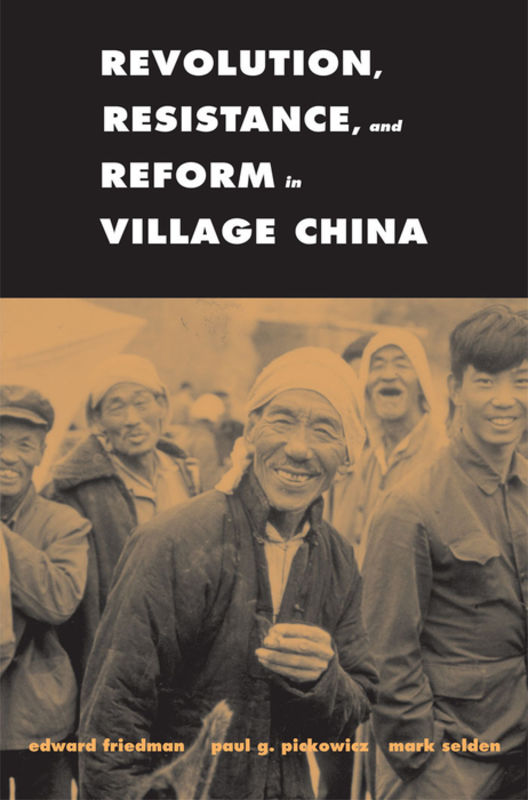
Revolution, Resistance, and Reform in Village China
Drawing on more than a quarter century of field and documentary research in rural North China, this book explores the contested relationship between village and state from the 1960s to the start of the twenty-first century. The authors provide a vivid portrait of how resilient villagers struggle to survive and prosper in the face of state power in two epochs of revolution and reform. Highlighting the importance of intra-rural resistance and rural-urban conflicts to Chinese politics and society in the Great Leap and Cultural Revolution, the authors go on to depict the dynamic changes that have transformed village China in the post-Mao era.This book continues the dramatic story in the authors' prizewinningChinese Village, Socialist State. Plumbing previously untapped sources, including interviews, archival materials, village records and unpublished memoirs, diaries and letters, the authors capture the struggles, pains and achievements of villagers across three generations of social upheaval.
eBook


China tripping : encountering the everyday in the People's Republic
\"Influential China experts reflect on their cultural/social encounters while traveling and living in China, covering a half century of American experiences\"-- Provided by publisher.
Book

China on Film
Leading scholar Paul G. Pickowicz traces the dynamic history of Chinese filmmaking and discusses its course of development from the early days to the present. Moving decade by decade, he explores such key themes as the ever-shifting definitions of modern marriage in 1920s silent features, East-West cultural conflict in the movies of the 1930s, the strong appeal of the powerful melodramatic mode of the 1930s and 1940s, the polarizing political controversies surrounding Chinese filmmaking under the Japanese occupation of Shanghai in the 1940s, and the critical role of cinema during the bloody civil war of the late 1940s. Pickowicz then considers the challenging Mao years, including chapters on legendary screen personalities who tried but failed to adjust to the new socialist order in the 1950s, celebrities who made the sort of artistic and political accommodations that would keep them in the spotlight in the post-revolutionary era, and insider film professionals of the early 1960s who actively resisted the most extreme forms of Maoist cultural production. The book concludes with explorations of the highly cathartic films of the early post-Mao era, edgy postsocialist movies that appeared on the eve of the Tiananmen demonstrations of 1989, the relevance of the Eastern European “velvet prison” cultural production model, and the rise of underground and independent filmmaking beginning in the 1990s. Throughout its long history of film production, China has been embroiled in a seemingly unending series of wars, revolutions, and jarring social transformations. Despite daunting censorship obstacles, Chinese filmmakers have found ingenious ways of taking political stands and weighing in—for better or worse—on the most explosive social, cultural, and economic issues of the day. Exploring the often gut-wrenching controversies generated by their work, Pickowicz offers a unique and perceptive window on Chinese culture and society.
eBook

Liangyou
This collection of original essays explores the rise of popular print media in China as it relates to the quest for modernity in the global metropolis of Shanghai from 1926 to 1945. It does this by offering the first extended look at the phenomenal influence of the Liangyou pictorial, The Young Companion, arguably the most exciting monthly periodical ever published in China. Special emphasis is placed on the profound social and cultural impact of this glittering publication at a pivotal time in China.The essays explore the dynamic concept of \"kaleidoscopic modernity\" and offer individual case studies on the rise of \"art\" photography, the appeals of slick patent medicines, the resilience of female artists, the allure of aviation celebrities, the feistiness of women athletes, representations of modern masculinity, efforts to regulate the female body and female sexuality, and innovative research that locates the stunning impact of Liangyou in the broader context of related cultural developments in Tokyo and Seoul.Contributors include: Paul W. Ricketts, Timothy J. Shea, Emily Baum, Maura Elizabeth Cunningham, Jun Lei, Amy O'Keefe, Hongjian Wang, Ha Yoon Jung, Lesley W. Ma, Tongyun Yin, and Wang Chuchu.
eBook
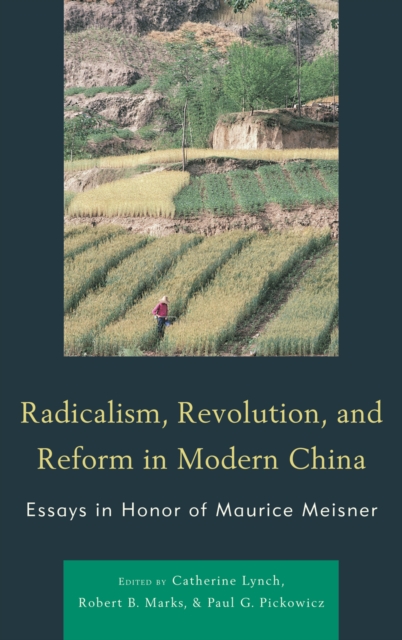
Radicalism, revolution, and reform in modern China
This volume illuminates the relationship of China's radical past to its reformist present as China makes a way forward through very differently conceived and contested visions of the future. In the context of early twenty-first century problems and the failures of global capitalism, is China's history of revolutionary socialism an aberration that is soon to be forgotten, or can it serve as a resource for creating a more fully human and radically democratic China with implications for all of us? Ranging from the early years of China's revolutionary twentieth-century to the present, the essays collected here look at the past and present of China with a view toward better understanding the ideas, ideals, and people who have dared to imagine radical transformation of their worlds and to assess the conceptual, political, and social limitations of these visions and their implementations. The volume's chapters focus on these issues from a range of vantage points, representing a spectrum of current scholarship. The first half of the book brings new insights to understanding how early-twentieth century intellectuals interpreted ideas that allowed them to break with China's past and to envision new paths to a modern future. It treats of Chen Duxiu, a founder of the Communist party, Mao Zedong, and Mao in relation to the non-Communist Liang Shuming and with the Dalai Lama. With continuing threads of nation and nationalities, of peasants, utopias and dystopias linking the chapters, the book's second half looks broadly at the consequences of the implementations of radical ideas, at the same time critiquing our accepted frameworks of analysis. Moving up to the present, the book investigates the effects of the reforms since the 1980s on long-term environmental degradation and on the emergence of a capitalist rural economy. It gives an unsparing view into contemporary rural China through independent films. The book concludes with an analysis of the unshakable persistence of the shibboleth, \"the rise of China,\" in popul
eBook

Revisiting Cold War Propaganda: Close Readings of Chinese and American Film Representations of the Korean War
No doubt the most memorable 1950s American propaganda film on the Korean War was Pork Chop Hill (1959), directed by Lewis Milestone, who made the anti-war classic All Quiet on the Western Front (1930). The most popular and influential on the Chinese side was Shangganling (The Battle of Sangkumryung Ridge or The Battle of Triangle Hill; 1956). Both deal with a single battle in which a small, dedicated unit is seen defending a remote hill top in the face of an overwhelming enemy onslaught. Their purpose was to convey political messages and teach long-term lessons to members of the audience well after the Korean War was over. But a shot by shot and character by character comparison and close reading reveals both parallels and differences.
Journal Article

Zheng Junli, Complicity and the Cultural History of Socialist China, 1949–1976
This article explores cultural producation during the Mao era (1949–76) by focusing on the evolving relationship between artists and the party-state. The emphasis is on state direction of art in the all-important film industry. From 1949, well-known bourgeois Republican-era artists willingly began the complicated, painful and sometimes deadly process of adjusting to Communist Party state building, nation building and political domination. The career of influential film director Zheng Junli is examined as a case study of creative and strategic accommodation to new circumstances on the one hand, and of complicity on the other. Zheng is seen in his dual and contradictory roles as both trusted, ever loyal insider and unreliable, even degenerate, outsider. His Mao-era films, especially the spectacular Great Leap Forward production of Lin Zexu, are analysed in terms of their political thrust and reception in the difficult-to-predict world of the People's Republic.
Journal Article