Catalogue Search | MBRL


Are you sure you want to remove the book from the shelf?

{{itemTitle}}
50
result(s) for
"Picone, Michael D."
Sort by:

Lyrical Code-Switching, Multimodal Intertextuality, and Identity in Popular Music
Augmenting the author’s prior research on lyrical code-switching, as presented in Picone, “Artistic Codemixing”, published in 2002, various conceptual frameworks are made explicit, namely the enlistment of multimodal and intertextual approaches for their methodological usefulness in analyzing and interpreting message-making that incorporates lyrical code-switching as one of its components. Conceived as a bipolarity, the rooted (or local) and the transcendent (or global), each having advantages in the negotiation of identity, is also applied to the analysis. New departures include the introduction of the notion of “curated lyrical code-switching” for the purpose of analyzing songs in which multiple performers are assigned lyrics in different languages, as a function of their respective proficiencies, as curated by the person or persons having authorial agency and taking stock of the social semiotics relevant to the anticipated audience. Moving beyond the negotiation of the identity of the code-switching composer or performer, in another new departure, attention is paid to the musical identity of the listener. As a reflection of the breadth of lyrical code-switching, a rich assortment of examples draws from the musical art of Beyoncé, Jon Batiste, Stromae, Shakira, BTS, NewJeans, Indigenous songsmiths, Cajun songsmiths, Latin Pop and Hip-Hop artists, songs composed for international sports events, and other sources.
Journal Article

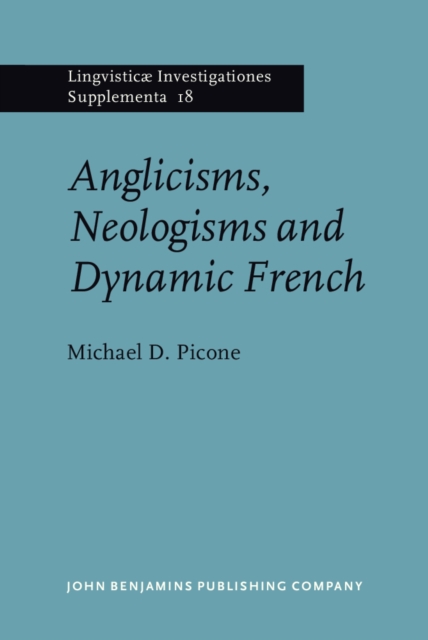
Anglicisms, Neologisms and Dynamic French
This comprehensive study of Anglicisms in the context of accelerated neological activity in Contemporary Metropolitan French not only provides detailed documentation and description of a fascinating topic, but opens up new vistas on issues of general linguistic interest: the effects of technology on language, the analyticity-syntheticity controversy, the lexical contribution to language vitality, the study of compound word formation, the interplay between cultural and linguistic affectivity. By investigating the dynamics of borrowing within the larger framework of general neological productivity and by bringing to bear cognitive and pragmatic considerations, a much-needed fresh approach to the entire question of Anglicisms takes shape. All pertinent phenomena regarding Anglicisms in French - a topic which continues to command the attention of language commentators and defenders in France and elsewhere - are explored: integral borrowings, semantic calques, structural calques, the generation of pseudo-Anglicisms and hybrids, graphological and phonological phenomena. In each case, the phenomenon is investigated in the proper context of its interaction with other pertinent neological, phonological and sociocultural developments. These include general changes in French compound word formation, modified derivational dynamics, the microsystem of pseudo-Classical morphology, historic phonological instabilities, the pressure for more synthetic types of lexical production in relation to the needs of technology and society. Rather than adhering rigidly to any single theoretical model, there is an attempt to set up a dialog between differing models in order to arrive at a multidimensional view of the phenomena investigated.
eBook

New Perspectives on Language Variety in the South
The third installment in the landmark LAVIS (Language
Variety in the South) series,
New Perspectives on Language Variety in the South: Historical
and Contemporary Approaches brings together essays devoted
to the careful examination and elucidation of the rich linguistic
diversity of the American South, updating and broadening the work
of the earlier volumes by more fully capturing the multifaceted
configuration of languages and dialects in the South. Beginning
with an introduction to American Indian languages of the
Southeast, five fascinating essays discuss indigenous languages,
including Caddo, Ofo, and Timucua, and evidence for the
connection between the Pre-Columbian Southeast and the Caribbean.
Five essays explore the earlier Englishes of the South, covering
topics such as the eighteenth century as the key period in the
differentiation of Southern American English and the use of new
quantitative methods to trace the transfer of linguistic features
from England to America. They examine a range of linguistic
resources, such as plantation overseers’ writings, modern
blues lyrics, linguistic databases, and lexical and locutional
compilations that reveal the region’s distinctive dialectal
traditions.
New Perspectives on Language Variety in the South: Historical
and Contemporary Approaches widens the scope of inquiry into
the linguistic influences of the African diaspora as evidenced in
primary sources and records. A comprehensive essay redefines the
varieties of French in Louisiana, tracing the pathway from
Colonial Louisiana to the emergence of Plantation Society French
in a diglossic relationship with Louisiana Creole. A further
essay maps the shift from French to English in family documents.
An assortment of essays on English in the contemporary South
touch on an array of compelling topics from discourse strategies
to dialectal emblems of identity to stereotypes in popular
perception. Essays about recent Latino immigrants to the South
bring the collection into the twenty-first century, taking into
account the dramatic increase in the population of Spanish
speakers and illuminating the purported role of
“Spanglish,” the bilingual lives of Spanish-speaking
Latinos in Mississippi, and the existence of regional Spanish
dialectal diversity.
eBook

Comic Art in Museums and Museums in Comic Art
Initially, being mass produced and sequential, comic art was excluded from fine art museums. Some comics artists themselves have expressed ambivalence about the value of inclusion (but counter-arguments are proposed, challenging the perception of incompatibility). However, a pivotal element in the break from the ranks of artistic modernism has been the appropriation of comic art motifs for use in museum-grade pop art, figuration narrative and their successors. In counterpoint, comic art is replete with examples of museum art being appropriated in order to obtain diegetic enrichment of various sorts, either for the purpose of parody or in relation to plot construction. Against this backdrop, and abetted by the twin challenge that art museums are facing to remain relevant and to increase revenue, a game-changing development is afoot, leading to a co-operative re-positioning of art museums and comics artists. With the Louvre taking the lead, many art museums in France and Italy are now commissioning works of comic art based on the museum's own collections, often launched with companion exhibits. The resultant 'art within art' lends itself readily to rich experimentation with themes incorporating intertextuality and parallel narrative.
Journal Article