
Catalogue Search | MBRL


Are you sure you want to remove the book from the shelf?

{{itemTitle}}
4
result(s) for
"Pijpers, Robert J."
Sort by:

Governing access to gold in Ghana: in-depth geopolitics on mining concessions
Studies of articulations between large- and small-scale mining have overlooked the subterranean dimension of extraction and ignored how mining companies and artisanal miners cohabit in places with long histories of small-scale mining and are affected by their different capacities to access specific mineral deposits. Drawing on a study of two gold concessions in Ghana, this article focuses on three factors that influence modalities of governing access to gold in such sites: the stage of a mining operation, the local socio-political context, and the characteristics of the subterranean structure. We call the combination and interplay of these factors ‘in-depth geopolitics’. The article shows how this interplay affects the strategies used by both large- and small-scale miners to work out arrangements of cohabitation and ways of governing access, control and maintenance to gold in spatial settings where both types of gold mining occur side by side. By tracing ethnographically the variations of ‘in-depth geopolitics’, this article critically engages with ideas of subterranean sovereignty, mining enclaves, state–company–community relations, and the socio-spatial characteristics of mining concessions. Les études sur les articulations entre les activités minières à grande et à petite échelle ont occulté la dimension souterraine de l'extraction et ignoré la manière dont les sociétés minières et les artisans mineurs cohabitent dans des lieux qui ont une longue histoire d'exploitation minière à petite échelle et sont affectés par différentes capacités à accéder aux gisements. S'appuyant sur une étude de deux concessions aurifères au Ghana, cet article traite de trois facteurs qui influencent les modalités de gouvernance d'accès à l'or sur ces sites : le stade d'exploitation minière, le contexte sociopolitique local et les caractéristiques de structure souterraine. Les auteurs appellent « géopolitique en profondeur » la combinaison et l'interaction de ces facteurs. L'article montre comment cette interaction affecte les stratégies utilisées par les mineurs à grande et à petite échelle pour trouver des modes de cohabitation et de gouvernance d'accès, de contrôle et de maintenance de l'or dans les espaces où se côtoient ces deux types d'exploitation aurifère. En faisant un tracé ethnographique des variations de « géopolitique en profondeur », cet article traite de manière critique des idées de souveraineté souterraine, d'enclaves minières, des relations État/entreprise/communauté et des caractéristiques socio-spatiales des concessions minières.
Journal Article
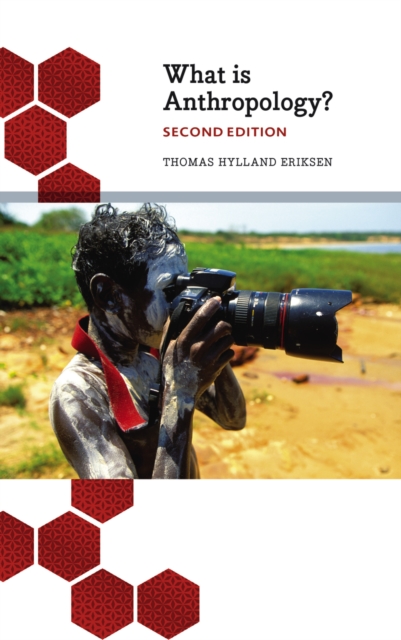
What is Anthropology?
Leading anthropologist Thomas Hylland Eriksen shows how anthropology is a revolutionary way of thinking about the human world. Perfect for students, but also for those who have never encountered anthropology before, this book explores the key issues in an exciting and innovative way. Lucid and accessible, What is Anthropology? draws examples from current affairs as well as previous anthropological studies. He looks at the history of anthropology, its unique research methods and some of its central concepts, such as society, culture and translation. This second edition contains a new introduction, as well as updates throughout. New content includes discussions about Brexit, the rise of the populist Right in Europe, the anthropology of climate change and social media. What is Anthropology? shows in persuasive ways why anthropology is a fundamental intellectual discipline, perhaps more so in the 21st century than ever before.
eBook

Pattern and incidence of first site recurrences following sentinel node procedure in melanoma patients
Studies of large series of melanoma patients indicated that the average incidence of developing a recurrence during follow‐up was 40%. The most frequent first sites of these recurrences were the regional lymph nodes. We hypothesized that the sentinel node (SN) procedure may change the pattern of recurrence by reducing the number of first recurrences in the regional lymph node basin during follow‐up to a negligible number, and that locoregional cutaneous and distance metastases are the major future sites of recurrence. We further studied the influence of SN status together with different influential factors on prognosis. An SN procedure with a triple technique was performed in 250 consecutive patients with proven AJCC stages I and II cutaneous melanoma. The median follow‐up was 38 months. So far, 44 patients (18%) have developed a recurrence of the disease. The distribution of localization of the first metastases was as follows: 23 patients (52%) with a locoregional cutaneous recurrence; 4 (9%) with recurrence in the regional lymph node basin; 2 (5%) with recurrence in an interval node; and 15 (34%) with distant recurrence. The relative risk of developing recurrence for SN‐positive patients is 4.2; for Breslow thickness of 1.51 to 4.00 mm it is 5.5, and thicker than 4.0 mm it is 6.2; for lymphatic invasion 7.6; and for ulceration 3.8. We conclude that the SN procedure changes the pattern of recurrences during follow‐up by reducing the number of first recurrences within the regional lymph node basin to a negligible number. High Breslow thickness, lymphatic invasion, and ulceration of the primary melanoma are strong risk factors for recurrence. Résumé L’incidence de récidive de mélanome dans les grandes séries est de l’ordre de 40%. Ces récidives intéressent le plus souvent les ganglions lymphatiques régionaux. Notre hypothèse est que la technique de ganglion sentinelle (GS) réduit le nombre de récidives initiales dans le territoire de drainage direct alors que les récidives sont alors cutanées, locorégionales et à distance. Si cela était vrai, le nombre total de récidives pourrait être diminué. Nous avons étudié l’influence du GS et d’autres facteurs pronostiques. Chez 250 patients atteints de mélanome cutané stades I et II selon la classification AJCC, on a réalisé la technique de GS par la technique triple. La médiane de suivi a été de 38 mois. Jusqu’à présent, 44 patients (18%) ont développé une récidive. La distribution du site de la première métastase a été comme suit: récidive locorégionale cutanée 23 patients (52%), récidive régionale ganglionnaire: quatre (9%); récidive dans un ganglion intermédiaire: deux (5%); et récidive à distance 15 (34%). Le risque relatif (RR) de développer une récidive chez le patient GS positif a été de 4.2, de 5.5 chez le patient ayant un score de Breslow entre 1.51–4.0, et de 6.2 lorsque l’épaisseur a été de plus de 4 mm. Le RR a été de 6.2 en cas d’envahissement lymphatique et de 3.8 en cas d’ulcération. Nous concluons que la technique du GS réduit nettement l’incidence de récidive mais n’empêche pas le patient de développer une récidive. Le risque de développer une récidive lymphatique régionale est devenu rare. L’indexe élevé de Breslow, une invasion lymphatique et l’ulcération du mélanome primaire sont des facteurs prédictifs de récidive importants. Resumen Los estudios sobre grandes series de pacientes con melanoma indican que la tasa promedio de recurrencia primaria en el curso del seguimiento es 40%. El sitio más frecuente de recurrencia primaria es la zona de ganglios regionales. Hemos planteado la hipótesis de que la técnica del ganglio centinela (GC) reduce el número de recurrencias a los ganglios regionales a una cifra mínima, y que las metástasis a los ganglios locales‐regionales y a distancia habrán de ser los lugares de recurrencia. Si esto resulta ser cierto, se podría reducir el número total de recurrencias. También estudiamos la influencia del estado del GC y la de otros factores sobre el pronóstico. En 250 pacientes consecutivos con melanoma cutáneo en estados I y II (AJCC) se realizó el procedimiento del GC mediante una técnica triple. El tiempo promedio de seguimiento fue 38 meses. Hasta el momento, 44 pacientes (18%) han desarrollado recurrencia, con la siguiente distribución: 23 pacientes (52%) con recurrencia local‐regional cutánea, cuatro (9%) con recurrencia en la zona linfática‐regional; 2 (5%) con recurrencia a un ganglio de intervalo; y 15 (34%) con recurrencia a distancia. El riesgo relativo de recurrencia en pacientes con GC positivo es 4.2; en melanomas con espesor de Breslow entre 1.51 y 5.5 mm y de más de 4.0 mm es 6.2; cuando hay invasión linfática el riesgo en 7.6; cuando hay ulceración es 3.8. Nuestra conclusión es que el procedimiento del GC ha reducido claramente la incidencia de recurrencia, aunque ello no quiere decir que prevenga la recurrencia en todos los pacientes. La recurrencia ganglionar local‐regional aparece poco común. Un espesor de Breslow grueso, la invasión linfática y la ulceración del melanoma primario son todos factores fuertes de riesgo de recurrencia.
Journal Article
The gamma-ray giant flare from SGR1806-20: Evidence for crustal cracking via initial timescales
We report here on serendipitous observations of the intense gamma-ray flare from SGR 1806-20 that occured on 27 December 2004. Unique data from the Cluster and Double Star-2 satellites, designed to study the Earth's magnetosphere, provide the first observational evidence of three separate timescales within the early (first 100ms) phases of this class of events. These observations reveal that, in addition to the initial very steep (<0.25ms) X-ray onset, there is firstly a 4.9ms exponential rise timescale followed by a continued exponential rise in intensity on a timescale of 70ms. These three timescales are a prominent feature of current theoretical models including the timescale (several ms) for fracture propagation in the crust of the neutron star.
Paper