
Catalogue Search | MBRL


Are you sure you want to remove the book from the shelf?

{{itemTitle}}
2,011
result(s) for
"Policy, Board on Health Sciences"
Sort by:

Exploring medical and public health preparedness for a nuclear incident : proceedings of a workshop
\"The National Academies of Sciences, Engineering, and Medicine held a workshop on August 22-23, 2018, in Washington, DC, to explore medical and public health preparedness for a nuclear incident. The event brought together experts from government, nongovernmental organizations, academia, and the private sector to explore current assumptions behind the status of medical and public health preparedness for a nuclear incident, examine potential changes in these assumptions in light of increasing concerns about the use of nuclear warfare, and discuss challenges and opportunities for capacity building in the current threat environment. This publication summarizes the presentations and discussions from the workshop.\"--Publisher's description.
Book

Relieving Pain in America
Chronic pain costs the nation up to $635 billion each year in medical treatment and lost productivity. The 2010 Patient Protection and Affordable Care Act required the Department of Health and Human Services (HHS) to enlist the Institute of Medicine (IOM) in examining pain as a public health problem.
In this report, the IOM offers a blueprint for action in transforming prevention, care, education, and research, with the goal of providing relief for people with pain in America. To reach the vast multitude of people with various types of pain, the nation must adopt a population-level prevention and management strategy. The IOM recommends that HHS develop a comprehensive plan with specific goals, actions, and timeframes. Better data are needed to help shape efforts, especially on the groups of people currently underdiagnosed and undertreated, and the IOM encourages federal and state agencies and private organizations to accelerate the collection of data on pain incidence, prevalence, and treatments. Because pain varies from patient to patient, healthcare providers should increasingly aim at tailoring pain care to each person's experience, and self-management of pain should be promoted. In addition, because there are major gaps in knowledge about pain across health care and society alike, the IOM recommends that federal agencies and other stakeholders redesign education programs to bridge these gaps. Pain is a major driver for visits to physicians, a major reason for taking medications, a major cause of disability, and a key factor in quality of life and productivity. Given the burden of pain in human lives, dollars, and social consequences, relieving pain should be a national priority.
eBook

Conflict of Interest in Medical Research, Education, and Practice
Collaborations of physicians and researchers with industry can provide valuable benefits to society, particularly in the translation of basic scientific discoveries to new therapies and products. Recent reports and news stories have, however, documented disturbing examples of relationships and practices that put at risk the integrity of medical research, the objectivity of professional education, the quality of patient care, the soundness of clinical practice guidelines, and the public's trust in medicine.
Conflict of Interest in Medical Research, Education, and Practice provides a comprehensive look at conflict of interest in medicine. It offers principles to inform the design of policies to identify, limit, and manage conflicts of interest without damaging constructive collaboration with industry. It calls for both short-term actions and long-term commitments by institutions and individuals, including leaders of academic medical centers, professional societies, patient advocacy groups, government agencies, and drug, device, and pharmaceutical companies. Failure of the medical community to take convincing action on conflicts of interest invites additional legislative or regulatory measures that may be overly broad or unduly burdensome.
Conflict of Interest in Medical Research, Education, and Practice makes several recommendations for strengthening conflict of interest policies and curbing relationships that create risks with little benefit. The book will serve as an invaluable resource for individuals and organizations committed to high ethical standards in all realms of medicine.
eBook

Psychosocial Interventions for Mental and Substance Use Disorders
Mental health and substance use disorders affect approximately 20 percent of Americans and are associated with significant morbidity and mortality. Although a wide range of evidence-based psychosocial interventions are currently in use, most consumers of mental health care find it difficult to know whether they are receiving high-quality care. Although the current evidence base for the effects of psychosocial interventions is sizable, subsequent steps in the process of bringing a psychosocial intervention into routine clinical care are less well defined. Psychosocial Interventions for Mental and Substance Use Disorders details the reasons for the gap between what is known to be effective and current practice and offers recommendations for how best to address this gap by applying a framework that can be used to establish standards for psychosocial interventions.
The framework described in Psychosocial Interventions for Mental and Substance Use Disorders can be used to chart a path toward the ultimate goal of improving the outcomes. The framework highlights the need to (1) support research to strengthen the evidence base on the efficacy and effectiveness of psychosocial interventions; (2) based on this evidence, identify the key elements that drive an intervention's effect; (3) conduct systematic reviews to inform clinical guidelines that incorporate these key elements; (4) using the findings of these systematic reviews, develop quality measures - measures of the structure, process, and outcomes of interventions; and (5) establish methods for successfully implementing and sustaining these interventions in regular practice including the training of providers of these interventions.
The recommendations offered in this report are intended to assist policy makers, health care organizations, and payers that are organizing and overseeing the provision of care for mental health and substance use disorders while navigating a new health care landscape. The recommendations also target providers, professional societies, funding agencies, consumers, and researchers, all of whom have a stake in ensuring that evidence-based, high-quality care is provided to individuals receiving mental health and substance use services.
eBook

Beyond the HIPAA Privacy Rule
In the realm of health care, privacy protections are needed to preserve patients' dignity and prevent possible harms. Ten years ago, to address these concerns as well as set guidelines for ethical health research, Congress called for a set of federal standards now known as the HIPAA Privacy Rule.
In its 2009 report, Beyond the HIPAA Privacy Rule: Enhancing Privacy, Improving Health Through Research, the Institute of Medicine's Committee on Health Research and the Privacy of Health Information concludes that the HIPAA Privacy Rule does not protect privacy as well as it should, and that it impedes important health research.
eBook

The CTSA Program at NIH
In 2006 the National Institutes of Health (NIH) established the Clinical and Translational Science Awards (CTSA) Program, recognizing the need for a new impetus to encourage clinical and translational research. At the time it was very difficult to translate basic and clinical research into clinical and community practice; making it difficult for individual patients and communities to receive its benefits. Since its creation the CTSA Program has expanded, with 61 sites spread across the nation's academic health centers and other institutions, hoping to provide catalysts and test beds for policies and practices that can benefit clinical and translation research organizations throughout the country.
The NIH contracted with the Institute of Medicine (IOM) in 2012 to conduct a study to assess and provide recommendations on appropriateness of the CTSA Program's mission and strategic goals and whether changes were needed. The study was also address the implementation of the program by the National Center for Advancing Translational Sciences (NCATS) while exploring the CTSA's contributions in the acceleration of the development of new therapeutics. A 13-member committee was established to head this task; the committee had collective expertise in community outreach and engagement, public health and health policy, bioethics, education and training, pharmaceutical research and development, program evaluation, clinical and biomedical research, and child health research.
The CTSA Program at NIH: Opportunities for Advancing Clinical and Translational Research is the result of investigations into previous program evaluations and assessments, open-session meetings and conference class, and the review of scientific literature. Overall, the committee believes that the CTSA Program is significant to the advancement of clinical and translational research through its contributions. The Program would benefit from a variety of revisions, however, to make it more efficient and effective.
eBook

Medications for Opioid Use Disorder Save Lives
The opioid crisis in the United States has come about because of excessive use of these drugs for both legal and illicit purposes and unprecedented levels of consequent opioid use disorder (OUD). More than 2 million people in the United States are estimated to have OUD, which is caused by prolonged use of prescription opioids, heroin, or other illicit opioids. OUD is a life-threatening condition associated with a 20-fold greater risk of early death due to overdose, infectious diseases, trauma, and suicide. Mortality related to OUD continues to escalate as this public health crisis gathers momentum across the country, with opioid overdoses killing more than 47,000 people in 2017 in the United States. Efforts to date have made no real headway in stemming this crisis, in large part because tools that already exist-like evidence-based medications-are not being deployed to maximum impact.
To support the dissemination of accurate patient-focused information about treatments for addiction, and to help provide scientific solutions to the current opioid crisis, this report studies the evidence base on medication assisted treatment (MAT) for OUD. It examines available evidence on the range of parameters and circumstances in which MAT can be effectively delivered and identifies additional research needed.
eBook
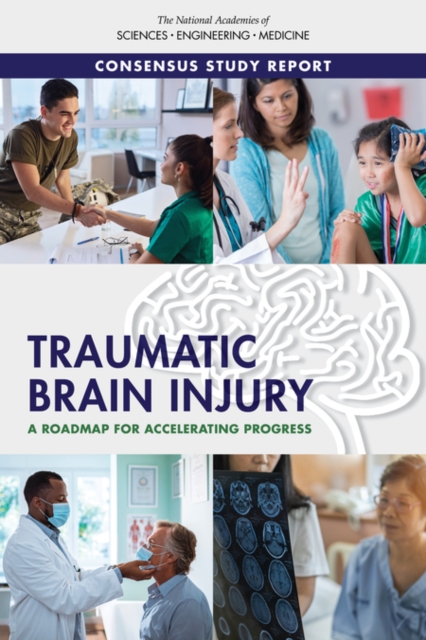
Traumatic Brain Injury
Every community is affected by traumatic brain injury (TBI). Causes as diverse as falls, sports injuries, vehicle collisions, domestic violence, and military incidents can result in injuries across a spectrum of severity and age groups. Just as the many causes of TBI and the people who experience it are diverse, so too are the physiological, cognitive, and behavioral changes that can occur following injury. The overall TBI ecosystem is not limited to healthcare and research, but includes the related systems that administer and finance healthcare, accredit care facilities, and provide regulatory approval and oversight of products and therapies. TBI also intersects with the wide range of community organizations and institutions in which people return to learning, work, and play, including the education system, work environments, professional and amateur sports associations, the criminal justice system, and others.
Traumatic Brain Injury: A Roadmap for Accelerating Progress examines the current landscape of basic, translational, and clinical TBI research and identifies gaps and opportunities to accelerate research progress and improve care with a focus on the biological, psychological, sociological, and ecological impacts. This report calls not merely for improvement, but for a transformation of attitudes, understanding, investments, and care systems for TBI.
eBook

Examining the Health Disparities Research Plan of the National Institutes of Health
In the United States, health among racial and ethnic minorities, as well as poor people, is significantly worse than the overall U.S. population. Health disparities are reflected by indices such as excess mortality and morbidity and shorter life expectancy. Examining the Health Disparities Research Plan of the National Institutes of Health is an assessment of the National Institutes of Health (NIH) Strategic Research Plan and Budget to Reduce and Ultimately Eliminate Health Disparities. It focuses on practical solutions to remedy the state of the current health disparity crisis.
The NIH has played the leading role in conducting extensive research on minority health and health disparities for more than two decades. Although additional research is critical to facilitating a better understanding of the overarching social, economic, educational, and environmental factors that predispose groups to specific diseases and conditions, there is also a great need to translate the existing and new information into best care practices. This means increasing communication with affected populations and their communities. Examining the Health Disparities Research Plan of the National Institutes of Health presents solutions to improving the health disparities nationwide and evaluates the NIH strategy plan designed to actively correct and combat the ongoing health disparities dilemma.
eBook

Sleep Disorders and Sleep Deprivation
Clinical practice related to sleep problems and sleep disorders has been expanding rapidly in the last few years, but scientific research is not keeping pace. Sleep apnea, insomnia, and restless legs syndrome are three examples of very common disorders for which we have little biological information. This new book cuts across a variety of medical disciplines such as neurology, pulmonology, pediatrics, internal medicine, psychiatry, psychology, otolaryngology, and nursing, as well as other medical practices with an interest in the management of sleep pathology. This area of research is not limited to very young and old patients-sleep disorders reach across all ages and ethnicities. Sleep Disorders and Sleep Deprivation presents a structured analysis that explores the following:
Improving awareness among the general public and health care professionals.
Increasing investment in interdisciplinary somnology and sleep medicine research training and mentoring activities.
Validating and developing new and existing technologies for diagnosis and treatment.
This book will be of interest to those looking to learn more about the enormous public health burden of sleep disorders and sleep deprivation and the strikingly limited capacity of the health care enterprise to identify and treat the majority of individuals suffering from sleep problems.
eBook