
Catalogue Search | MBRL


Are you sure you want to remove the book from the shelf?

{{itemTitle}}
82
result(s) for
"Polybius"
Sort by:


Libri IV-VIII
The Bibliotheca Teubneriana, established in 1849, has evolved into the world's most venerable and extensive series of editions of Greek and Latin literature, ranging from classical to Neo-Latin texts. Some 4-5 new editions are published every year. A team of renowned scholars in the field of Classical Philology acts as advisory board: Gian Biagio Conte (Scuola Normale Superiore di Pisa)Marcus Deufert (Universität Leipzig)James Diggle (University of Cambridge)Donald J. Mastronarde (University of California, Berkeley)Franco Montanari (Università di Genova)Heinz-Günther Nesselrath (Georg-August-Universität Göttingen)Dirk Obbink (University of Oxford)Oliver Primavesi (Ludwig-Maximilians Universität München)Michael D. Reeve (University of Cambridge)Richard J. Tarrant (Harvard University) Formerly out-of-print editions are offered as print-on-demand reprints. Furthermore, all new books in the Bibliotheca Teubneriana series are published as eBooks. The older volumes of the series are being successively digitized and made available as eBooks.If you are interested in ordering an out-of-print edition, which hasn't been yet made available as print-on-demand reprint, please contact us: Tessa.Jahn@degruyter.com All editions of Latin texts published in the Bibliotheca Teubneriana are collected in the online database BTL Online.
eBook
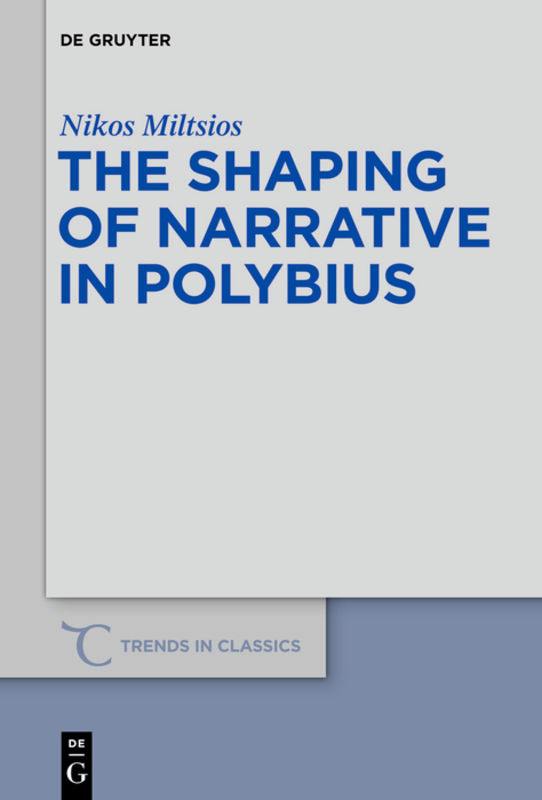
The Shaping of Narrative in Polybius
The narrative artistry of Polybius has received relatively little scholarly attention. Critics have tended to discuss his reflections on the various issues presented in his work or to use him as a source of valuable information about the historical period that he records. This volume, which draws on narratology's analytical tools, focuses instead on the narrative of the Histories, exploring the sophisticated narrative techniques that have gone into shaping it. In doing so, it pays particular attention to the ways the formal aspects of the text contribute to promoting Polybius' thematic concerns. Its aim is not only to present the Histories as the work of an author who has taken pains to provide us with a carefully structured story, but also to illustrate how interpretations of this story can be enriched by a sensitivity to factors such as chronological displacements and variations of focalization.
eBook

