
Catalogue Search | MBRL


Are you sure you want to remove the book from the shelf?

{{itemTitle}}
11
result(s) for
"Preece, Rod, 1939-"
Sort by:

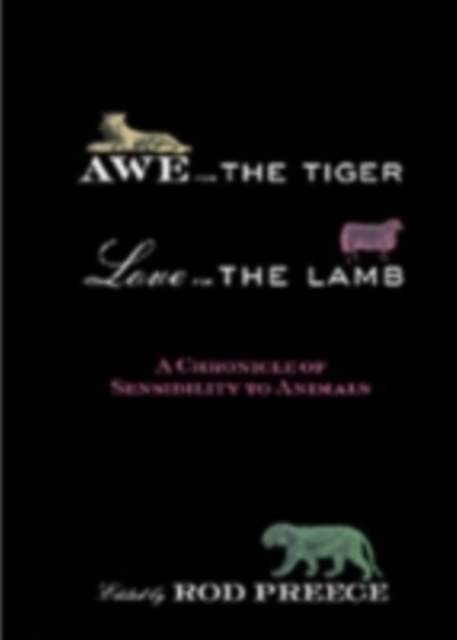
Awe for the tiger, love for the lamb
Respect for animals has always been a part of human consciousness. Poets, thinkers, philosophers, scientists and statesmen have long celebrated our compassion towards Earth's other beasts.Awe for the Tiger, Love for the Lamb compiles the most significant statements of sensibility to animals in the history of thought. From the myths of the ancient world to the Middle Ages to Darwin and beyond, Preece captures the most telling and fascinating accounts of humankind's relationship to the wild world, placing them in historical context. Jung called it an unconscious identity with animals, while Wordsworth saw it as the primal sympathy which having been must ever be. Linking the diverse chords of human experience that are touched by the animal world, Preece shows that despite a historical thread of cruelty, there still remains in all humanity a constant underlying concern for other beings as an integral part of the moral community. With musings and meditations from Lao Tse to Mohammed, from Plato to Jane Goodall, from classical religion to parliamentary proceedings, Awe for the Tiger, Love for the Lamb is an original, superbly researched history that deepens our understanding of all living beings.
eBook

Sins of the flesh
Renowned animal rights author Rod Preece examines the history of vegetarianism in its ethical dimensions, from the origins of humanity through to the present.
eBook

Brute souls, happy beasts, and evolution
In this provocative inquiry into the status of animals in human society from the fifth century BC to the present, Rod Preece provides a wholly new perspective on the human-animal relationship.
eBook

Animals and nature : cultural myths, cultural realities
\"No one tradition alone offers a sufficient respect for other species. Taken together, they may offer a prospect for saner human-animal relations.\".
eBook

Sins of the flesh : a history of ethical vegetarian thought / Rod Preece
From the Publisher: Unlike previous books on the history of vegetarianism, Sins of the Flesh examines the history of vegetarianism in its ethical dimensions, from the origins of humanity through to the present. Full ethical consideration for animals resulting in the eschewing of flesh arose after the Aristotelian period in Greece and recurred in Ancient Rome, but then mostly disappeared for centuries. Despite the occasional presence of ascetic and cultural vegetarianism, it was not until the turn of the nineteenth century that vegetarian thought was revived and enjoyed some success; it subsequently went into another period of decline that lasted through much of the twentieth century. The authority-questioning cultural revolution of the 1960s brought a fresh resurgence of vegetarian ethics that continues to the present day.
eBook

Brute souls, happy beasts, and evolution : the historical status of animals / Rod Preece
\"In this inquiry into the status of animals in human society from the fifth century BC to the present, Rod Preece provides a wholly new perspective on the human-animal relationship. He skillfully demonstrates that, counter to prevailing intellectual opinion, ethical attitudes toward animals are neither restricted to the twentieth century nor the result of Darwin's theory of evolution. They have been part of Western thought and culture for centuries.\" \"Preece builds a cogent and persuasive argument, challenging current assumptions about the historical status of animals in Western civilization. He dispels the notion that animals were denied ethical consideration by Christian doctrine, refutes the claim that the Cartesian conception of animals as automata was widely embraced, and proves that \"theriophily\"--The notion of animal superiority over humans - was given greater credence than is commonly recognized. The exhaustive research and breadth of knowledge that Preece reveals in this book are matched by his belief in our ethical responsibilities to animals.\"--Jacket.
eBook

Animals and nature : cultural myths, cultural realities / Rod Preece
\"In this book, Rod Preece takes issue with the popular but simplistic view that the Western cultural tradition has encouraged attitudes of domination and exploitation toward the natural world, particularly animals. He contends that the much-maligned Western tradition has far more to commend it than is customarily recognized, and that the much-vaunted Oriental and Aboriginal orientations to animals and nature have habitually been described in a misleadingly rosy hue.\" \"The product of six years of intensive research into comparative religion, literature, philosophy, anthropology, mythology, ethnology, and animal welfare science, Animals and Nature will make fascinating reading for anyone interested in cultural, environmental, and animal welfare issues.\"--Jacket.
eBook

Animal welfare & human values / Rod Preece & Lorna Chamberlain
\"As the most populous province in Canada, Ontario is a microcosm of the animal welfare issues which beset Western civilization. The authors of this book, chairman and vice-chairman, respectively, of the Ontario Society for the Prevention of Cruelty to Animals, find themselves constantly being made aware of the atrocities committed in the Society's jurisdiction. They have been, in turn, puzzled, exasperated and horrified at humanity's cruelty to our fellow sentient beings.\" \"The issues discussed in this book are the most contentious in animal welfare disputes - animal experimentation, fur-farming and trapping, the use of animals for human consumption. They are complex issues and should be thought about fairly and seriously.\" \"The authors, standing squarely on the side of the animals, suggest \"community\" and \"belonging\" as concepts through which to understand our relationships to other species. They ground their ideas in Wordsworth's \"primal sympathy\" and Jung's \"unconscious identity\" with the animal realm.\" \"The philosophy developed in this book embraces common sense and compromise as the surest path to the goal of animal welfare. It requires respect and consideration for other species while acknowledging our primary obligations to our fellow humans.\"--Jacket.
eBook