
Catalogue Search | MBRL


Are you sure you want to remove the book from the shelf?

{{itemTitle}}
109
result(s) for
"Product Development "
Sort by:


Establishing postprandial bio-equivalency and IVIVC for generic metformin sustained release small sized tablets
The objective of current study was to develop metformin hydrochloride modified release small sized tablets, and to evaluate its bioequivalence when compared with the reference product (Glucophage
®
SR). The physicochemical properties of the formulated and reference tablets were determined and compared. The in vitro dissolution profiles of formulated tablets were obtained using bio-relevant media and IVIVC was established. Bioequivalence investigation was carried out in 32 healthy male volunteers who received a single dose 1,000 mg of both test and reference products in a randomized two-way crossover design in postprandial conditions. After dosing, serial blood samples were collected for a period of 48 h. Metformin concentration was assayed by using a validated LC–MS/MS method. The log-transformed C
max
and AUC were statistically compared by analysis of variance, and the 90 % confidence intervals (CI) of the ratio of the log-transformed C
max
and AUC between the most promising developed formulation and the reference product were determined. It was deduced that the dissolution rate profile of the formulated modified release small sized tablets was similar to the reference product employed in the study. Their similarity and difference factors were found to be well within the established limits. In the bioequivalence study, the difference in C
max
, AUC
last
and AUC
inf
between the test and reference product was not statistically significant, with the 90 % CI of 100.73–116.20, 86.16–97.37 and 87.12–96.99 %, respectively. The results suggested that the metformin small tablets formulated with reduced quantity of controlled release polymer were found to be bioequivalent in the postprandial state. For these small tablets, pH 5.5 acetate buffer as a bio-relevant dissolution media for the development of IVIVC.
Journal Article
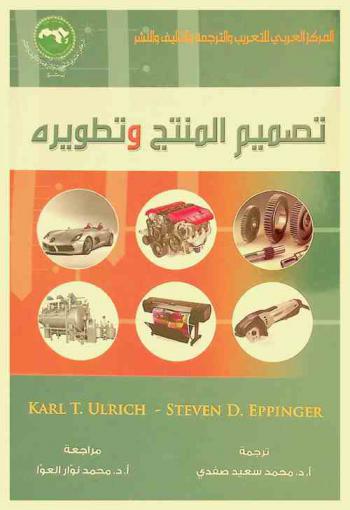
تصميم المنتج وتطويره
يمزج كتاب تصميم المنتج وتطويره، في إصداره الخامس، بين تصورات التسويق والتصميم والتصنيع في نهج موحد لتطوير المنتج، ويهدف إلى مساعدة الطلاب في معرفة حقائق الممارسة الصناعية والأدوار المعقدة والأساسية التي يؤديها مختلف أعضاء فرق تطوير المنتج، ويزود هذا الكتاب الممارسين للأنشطة الصناعية خاصة بمجموعة من طرائق تطوير المنتج، ويمكنهم من تطبيقها في تطوير المشاريع. وقد أفرد عددا من الأمثلة والحالات التي توضح كل طريقة من الطرائق الواردة في الكتاب لتحقيق مزيد من الفائدة ولتبيان إمكانية تطبيق تلك الطرائق على طيف واسع من المنتجات بدءا بالتجهيزات الصناعية وصولا للمنتجات الاستهلاكية.
Book

Rare Diseases and Orphan Products
Rare diseases collectively affect millions of Americans of all ages, but developing drugs and medical devices to prevent, diagnose, and treat these conditions is challenging. The Institute of Medicine (IOM) recommends implementing an integrated national strategy to promote rare diseases research and product development.
eBook


Design Thinking
Develop a more systematic, human-centered, results-oriented thought process Design Thinking is the Product Development and Management Association's (PDMA) guide to better problem solving and decision-making in product development and beyond. The second in the New Product Development Essentials series, this book shows you how to bridge the gap between the strategic importance of design and the tactical approach of design thinking. You'll learn how to approach new product development from a fresh perspective, with a focus on systematic, targeted thinking that results in a repeatable, human-centered problem-solving process. Integrating high-level discussion with practical, actionable strategy, this book helps you re-tool your thought processes in a way that translates well beyond product development, giving you a new way to approach business strategy and more. Design is a process of systematic creativity that yields the most appropriate solution to a properly identified problem. Design thinking disrupts stalemates and brings logic to the forefront of the conversation. This book shows you how to adopt these techniques and train your brain to see the answer to any question, at any level, in any stage of the development process. * Become a better problem-solver in every aspect of business * Connect strategy with practice in the context of product development * Systematically map out your new product, service, or business * Experiment with new thought processes and decision making strategies You can't rely on old ways of thinking to produce the newest, most cutting-edge solutions. Product development is the bedrock of business —whether your \"product\" is a tangible object, a service, or the business itself — and your approach must be consistently and reliably productive. Design Thinking helps you internalize this essential process so you can bring value to innovation and merge strategy with reality.
eBook

Open innovation : new product development essentials from the PDMA
A clear, practical guide to implementing Open Innovation for new product development Open Innovation: New Product Development Essentials from the PDMA is a comprehensive guide to the theory and practice of the Open Innovation method. Written by experts from the Product Development and Management Association, the book packages a collection of Open Innovation tools in a digestible and actionable format. Real-world case studies drawn from the authors' own successes and failures illustrate the concepts presented, providing accurate representation of the opportunities and challenges of Open Innovation implementation. Key tools are presented with a focus on immediate applications for business, allowing NPD professionals to easily discern where this cutting edge development method can push innovation forward. Open Innovation assumes that companies can and should use both internal and external ideas and paths to market, permeating the boundaries between firm and environment. Innovations transfer outward and inward through purchase, licensing, joint ventures, and spin-offs, allowing companies to expand beyond their own research and dramatically improve productivity through collaboration. PDMA Essentials provides practical guidance on exploiting the Open Innovation model to these ends, with clear guidance on all aspects of the new product development process. Topics include: * Product platforming and idea competitions * Customer immersion and interaction * Collaborative product design and development * Innovation networks, rewards, and incentives Many practitioners charged with innovation have only a vague understanding of the specific tools available for Open Innovation, and how they might be applied. As the marketplace shifts dramatically to keep pace with changing consumer behaviors, remaining relevant increasingly means ramping up innovation processes. PDMA Essentials provides the tools NPD practitioners need to implement a leading innovation method, and drive continued growth.
eBook

International Regulatory Harmonization Amid Globalization of Drug Development
The past several decades have been a time of rapid globalization in the development, manufacture, marketing, and distribution of medical products and technologies. Increasingly, research on the safety and effectiveness of new drugs is being conducted in countries with little experience in regulation of medical product development. Demand has been increasing for globally harmonized, science-based standards for the development and evaluation of the safety, quality, and efficacy of medical products. Consistency of such standards could improve the efficiency and clarity of the drug development and evaluation process and, ultimately, promote and enhance product quality and the public health.
To explore the need and prospects for greater international regulatory harmonization for drug development, the IOM Forum on Drug Discovery, Development, and Translation hosted a workshop on February 13-14, 2013. Discussions at the workshop helped identify principles, potential approaches, and strategies to advance the development or evolution of more harmonized regulatory standards. This document summarizes the workshop.
eBook

Evaluation of agronomic and sensory attributes of Quality Protein Maize for acceptability in South-Western Nigeria
Quality Protein Maize (Zea mays) (QPM) varieties have been developed by scientists at the Institute of Agricultural Research and Training in Nigeria. For these varieties to have significant impact, they must possess traits acceptable to farmers. A study was carried out to evaluate the agronomic and sensory traits of two Quality Protein Maize - ART-98-SW-6-OB (QPM1) and ILE-1-OB (QPM2), in comparison with ART-96-SW-1 (High Protein Maize) and SUWAN-1-SR (a popularly grown improved variety) in three maize growing communities of South West, Nigeria. Sixty (60) farmers comprising males and females were evaluated for six sensory parameters. The parameters tested were appearance, colour, flavour, texture, taste and overall acceptability. The results of the agronomic evaluation showed that there were no significant differences in the height of QPM varieties and HPM at harvest. QPM varieties gave the highest grain yield of 2.38t/ha for ART-98-SW-6OB and 2.36t/ha for ILE-1-OB. Sensory evaluation showed that when the maize varieties were processed into corn-soy milk, QPM corn-soy milk had the highest sensory scores for all sensory parameters tested. Quality Protein Maize varieties had high grain yield and were most preferred for maize pudding and corn-soy milk. The QPM varieties, if formulated into foods for household or commercial purposes, should have good chance of being accepted by farmers with continuous promotional campaigns.
Journal Article

The effect of CO₂ and salinity on the cultivation of Scenedesmus obliquus for biodiesel production
Biodiesel is a renewable and environmental friendly energy source that can be produced via tranesterification from various oil crops such as soy bean, sunflower, palm, and algae. In this work, the microalgae Scenedesmus obliquus, S. armatus and S. bernadii, isolated from natural water basins, were enriched in modified Chu 13 medium. Only S. obliquus showed significant oil accumulation and was thus further cultivated in 3 L tubular photo-reactors under mixotrophic conditions (16:8 h light-dark cycle) at room temperature and varying CO₂ (5, 10, and 15%) supply. The results indicated that S. obliquus can be grown under various CO₂ concentrations. A maximum biomass of 2.3 g/L was achieved when 15% CO₂ was used. The effect of salinity on oil storage was also considered, using sodium chloride (NaCl) solutions of varying concentrations (0.05, 0.2, and 0.3 M). Higher lipid contents were found in cells that were subjected to salt stress compared to those in conditions without salt stress. A maximum oil accumulation of 36% was observed within 15 days at 0.3 M NaCl. A biodiesel yield of up to 97.4% was obtained.
Journal Article