
Catalogue Search | MBRL


Are you sure you want to remove the book from the shelf?

{{itemTitle}}
56
result(s) for
"Punathambekar, Aswin"
Sort by:


From Bombay to Bollywood
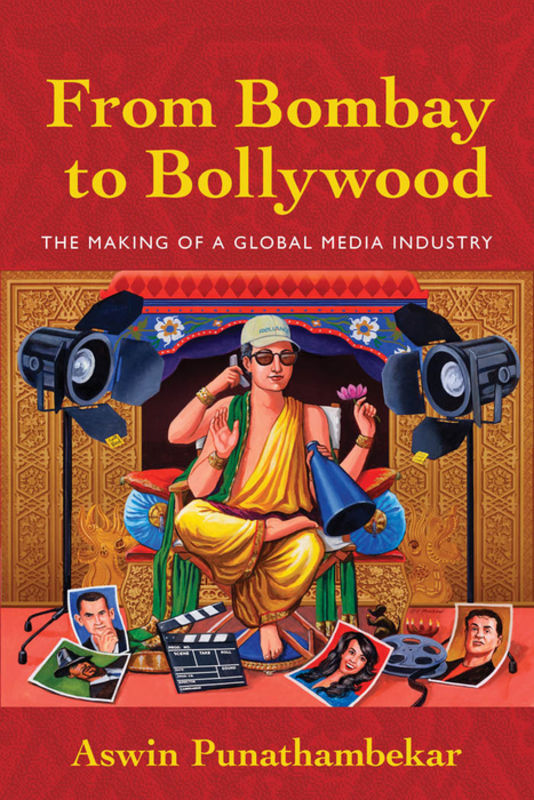
From Bombay to Bollywood analyzes the transformation of the national film industry in Bombay into a transnational and multi-media cultural enterprise, which has come to be known as Bollywood. Combining ethnographic, institutional, and textual analyses, Aswin Punathambekar explores how relations between state institutions, the Indian diaspora, circuits of capital, and new media technologies and industries have reconfigured the Bombay-based industry's geographic reach. Providing in-depth accounts of the workings of media companies and media professionals, Punathambekar has produced a timely analysis of how a media industry in the postcolonial world has come to claim the global as its scale of operations. Based on extensive field research in India and the U.S., this book offers empirically-rich and theoretically-informed analyses of how the imaginations and practices of industry professionals give shape to the media worlds we inhabit and engage with. Moving beyond a focus on a single medium, Punathambekar develops a comparative and integrated approach that examines four different but interrelated media industries--film, television, marketing, and digital media. Offering a path-breaking account of media convergence in a non-Western context, Punathambekar's transnational approach to understanding the formation of Bollywood is an innovative intervention into current debates on media industries, production cultures, and cultural globalization.Aswin Punathambekaris Assistant Professor of Communication Studies at the University of Michigan-Ann Arbor. He is the co-editor ofGlobal Bollywood(NYU Press, 2008).In thePostmillenial Popseries
eBook


Keywords for Media Studies
Introduces key terms, research traditions, debates, and their histories, and offers a sense of the new frontiers and questions emerging in the field of media studies
Keywords for Media Studiesintroduces and aims to advance the field of critical media studies by tracing, defining, and problematizing its established and emergent terminology. The book historicizes thinking about media and society, whether that means noting a long history of \"new media,\" or tracing how understandings of media \"power\" vary across time periods and knowledge formations.Bringing together an impressive group of established scholars from television studies, film studies, sound studies, games studies, and more, each of the 65 essays in the volume focuses on a critical concept, from \"fan\" to \"industry,\" and \"celebrity\" to \"surveillance.\"Keywords for Media Studiesis an essential tool that introduces key terms, research traditions, debates, and their histories, and offers a sense of the new frontiers and questions emerging in the field of media studies.
Visitkeywords.nyupress.orgfor online essays, teaching resources, and more.
eBook
Staging Bollywood
In many respects, the filmic exemplar for Bollywood in a phase of transition is Rommy Rolly, one of the central protagonists inLuck by Chance(2009), a film that takes an affectionate and at times critical look at the workings of the film industry in Bombay. Written and directed by Zoya Akhtar, daughter of established screenwriter Honey Irani and acclaimed lyricist and screenwriter Javed Akhtar, the film revolves around the struggles of two young actors who arrive in Bombay with hopes of making it big in the film industry. Taking us behind the scenes of a film being produced by
Book Chapter
It’s All about Knowing Your Audience
In April 2004 theTimes of Indiabegan publishing a comic strip featuring two characters namedHumandTum. As soon became clear to readers across the country, the comic strips were part of a marketing campaign for a film produced and distributed by Yash Raj Films (Hum Tum, 2004, You and Me, dir. Kunal Kohli). The marketing team at Yash Raj Films had, in what seemed unusual at the time, been involved in the filmmaking process from a very early stage and decided to build a campaign around the film’s protagonist, Karan Kapoor (Saif Ali Khan), who plays the
Book Chapter
Bollywood Is Useful
Held in the “grand ballroom” of the five-star Renaissance Hotel in suburban Bombay, the inauguration of the FICCI-FRAMES 2009 convention was a lavish affair that opened with Amit Mitra, the Secretary-General of FICCI, inviting the Minister of State for Information & Broadcasting and External Affairs, Anand Sharma, on to the stage to light a lamp—a widely practiced ritual to begin an event on an auspicious note. As the ritual came to a close, Mitra invited five others to join the minister on the stage: Sushma Singh, Secretary, Ministry of Information & Broadcasting; Yash Chopra, legendary film producer and director, head of
Book Chapter
Multiplex with Unlimited Seats
“So tell me, you left India for work or for higher studies?” asked Saleem Mobhani, cofounder of the highly popular and successful Bollywood website indiafm.com, a division ofHungama.comand recently rebranded as Bollywoodhungama.com. We were in a conference room in the office of Hungama.com, one of the few media and entertainment portals in India to have survived the dot-com crash. “Higher studies. I left in ’99,” I replied and before I could say more, he interrupted: “If you’ve been in the U.S., you know that it was students and expats sitting on the cutting edge of the boom, people
Book Chapter