
Catalogue Search | MBRL


Are you sure you want to remove the book from the shelf?

{{itemTitle}}
86
result(s) for
"Purs, Aldis"
Sort by:

Baltic facades : Estonia, Latvia and Lithuania since 1945
\"The three so-called 'Baltic states'--Estonia, Latvia, Lithuania--are commonly regarded by outsiders as a single entity. But in reality they are quite distinct countries, each one struggling to find its own place within Europe while preserving a personal identity and local traditions. Baltic Facades presents a radical new reading of these states, with a fresh and up-to-date examination of their individual politics, economies and social and cultural trends. By dispelling the myth of a single, coherent Baltic identity, Aldis Purs is able to take account of the uniqueness of Lithuania, Latvia and Estonia, while examining the anxieties that their peoples feel about their own identities and how others see them. Giving equal weight to developments in politics, economics, and social and cultural trends, Purs develops a thematic framework that places contemporary events in a longer perspective than traditional Cold War-inspired views of the region. His book will appeal in particular to intellectually curious readers, those who seek an account of the Baltic nations that provides a strong sense of place and reaches beyond the restrictions of traditional political history.\"--Page 4 of cover.
Book


Historical dictionary of Latvia
\"Contains a chronology, an introduction, appendixes, an extensive bibliography, and a dictionary section with more than 500 cross-referenced entries on aspects of Latvia.\"--Provided by publisher.
Book

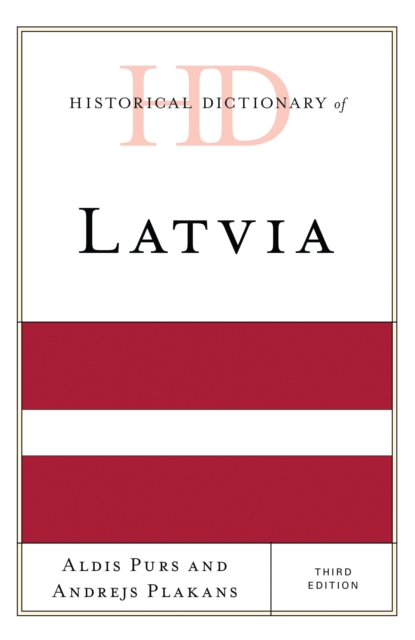
Historical dictionary of Latvia
Latvia is located on the eastern shore of the Baltic Sea. After a brief period of independence between the two World Wars, Latvia was annexed by the USSR in 1940. It reestablished its independence in 1991 following the breakup of the Soviet Union. Although the last Russian troops left in 1994. Latvia continues to revamp its economy for eventual integration into various Western European political and economic institutions. Since May 2004 Latvia is a member of the European Union.
This third edition of Historical Dictionary of Latvia contains a chronology, an introduction, appendixes, and an extensive bibliography. The dictionary section has over 500 cross-referenced entries on important personalities, politics, economy, foreign relations, religion, and culture. This book is an excellent resource for students, researchers, and anyone wanting to know more about Latvia.
eBook


Latvia - a Work in Progress?
A quarter century after the formation of the Popular Front and a decade since joining the EU, processes of state- and nation-building in Latvia are still on-going.Issues such as citizenship, language policy, minority rights, democratic legitimacy, economic stability, and security all remain objects of vigorous public discussion.
eBook

The Baltic States
Since the end of the Cold War there has been an increased interest in the Baltics. The Baltic States brings together three titles, Estonia, Latvia and Lithuania, to provide a comprehensive and analytical guide integrating history, political science, economic development and contemporary events into one account. Since gaining their independence, each country has developed at its own pace with its own agenda and facing its own obstacles. The authors examine the tensions accompanying a post-communist return to Europe after the long years of separation and how each country has responded to the demands of becoming a modern European state. Estonia was the first of the former Soviet republics to enter membership negotiations with the European Union in 1988 and is a potential candidate for the next round of EU expansion in 2004. Lithuania and Latvia have also expressed their desire for future membership of NATO and the EU.
Part 1: Estonia 1. 'One Day There Will Be an Estonian State.' 2. The Long Second World War: Estonia under Occupation 1940-1991 3. Old Wine in New Bottles: The Politics of Independence 4. 'The Little Country that Could.': Estonia's Economic Return to Europe 5. 'The Devil and the Deep Blue Sea.': Foreign Policy Between East and West Part 2: Latvia 6. A Historical Introduction to Modern Latvia 7. Latvia's Politics, 1987-1991: The Thorny Road Towards Independence 8. Latvia's Democracy Examined: 1991-1999 9. Latvia's Economy since 1991 10. The Foreign Policy of Latvia 11. Conclusions Part 3: Lithuania, Revival and Repression 1914-1985 12. Independent Lithuania between Wars 13. Sovietization 1940-1985 Part 4: Lithuania, Independence and the Politics of Transition 1985 - 1999 14. The Achievement of Independence 1985-1991 15. Government and Politics in Independent Lithuania 16. The Lithuanian Economy after Independence 17. Lithuania's Foreign and National Security Policy
David J. Smith is a lecturer in Contemporary History and International Relations and a member of the Baltic Research Unit at the Department of European Studies, University of Bradford, UK. Artis Pabriks is a lecturer at the University of Latvia and Vidzeme University College, Latvia and a frequent political analyst for Latvia's mass media. Aldis Purs is a lecturer at Vidzeme University College, Latvia, having previously compteted a Research Fellowship at the Woddorwo Wilson Centre for International Studies, USA. Thomas Lane is a lecturer in European history and a member of the Baltic Research Unit at the Department of European Studies, University of Bradford, UK.
eBook
Historical dictionary of Latvia, third edition
This third edition of Historical Dictionary of Latvia contains a chronology, an introduction, appendixes, and an extensive bibliography. The dictionary section has over 500 cross-referenced entries on important personalities, politics, economy, foreign relations, religion, and culture.
eBook

Working towards ‘An Unforeseen Miracle’ Redux: Latvian Refugees in Vladivostok, 1918–1920, and in Latvia, 1943–1944
During the First World War the survival of hundreds of thousands of Latvian refugees, dispersed across the Russian Empire, overlapped with issues of identity. Latvians in Siberia and the Far East created a refugee organisation complete with military, diplomatic and cultural programmes for themselves and their homeland. The key players attempted to recreate the same organisational trajectories and outcomes during the Second World War, under very different geopolitical conditions. This article presents new archival research and suggests new interpretations of the dynamic nature of political organisation, refugee experience and identity in Latvia through the first half of the twentieth century. Durant la Première Guerre mondiale, la survie de centaines de milliers de réfugiés Lettons, dispersés à travers l'Empire russe, coïncidait avec des questions d'identité. Des Lettons en Sibérie et dans l'Extrême-Orient ont créé une organisation de réfugiés avec des programmes militaire, diplomatique et culturel pour eux-mêmes et pour la patrie. Les acteurs principaux ont essayé de recréer les mêmes trajectoires organisationnelles et leurs conséquences durant la Deuxième Guerre mondiale. Cet article présente une nouvelle recherche archivistique et suggère de nouvelles interprétations de la nature dynamique de l'organisation politique, de l'expérience et de l'identité des réfugiés en Lettonie durant la première moitié du vingtième siècle. Während des Ersten Weltkriegs war die Frage nach dem Überleben hunderttausender lettischer Flüchtlinge, die über das ganze russische Reich zerstreut waren, mit Fragen nationaler und regionaler Identität eng verknüpft. Letten in Sibirien und dem Fernen Osten gründeten eine Flüchtlingsorganisation, welche über militärische, diplomatische und kulturelle Programme für sich und ihr Heimatland verfügte. Nach dem Zweiten Weltkrieg versuchten die zentralen Akteure wieder, unter ganz anderen geopolitischen Bedingungen, die gleichen organisationellen Strukturen zu schaffen. Indem er erstmals zugängige Archivmaterialien auswertet, bietet dieser Artikel eine Neuinterpretation der Dynamik zwischen politischen Organisationen, Flüchtlingserfahrungen und nationaler Identität in Lettland in der ersten Hälfte des zwanzigsten Jahrhunderts.
Journal Article