
Catalogue Search | MBRL


Are you sure you want to remove the book from the shelf?

{{itemTitle}}
58
result(s) for
"Pynchon, Thomas"
Sort by:


Portrait: George Orwell
A photograph of George Orwell with his adopted son, Richard Horatio Blair taken around 1946 in Islington, which appeared in the Foreword to a new Penguin edition of 1984 by Thomas Pynchon, is presented.
Journal Article
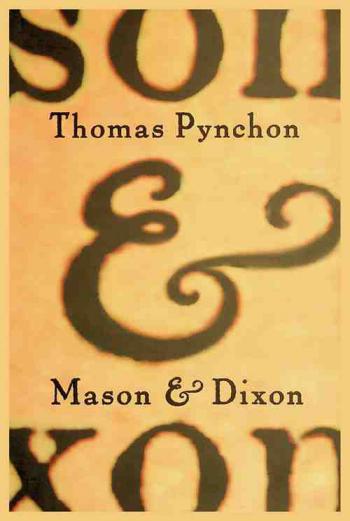
Mason & Dixon
Charles Mason (1728-1786) and Jeremiah Dixon (1733-1779) were the British surveyors best remembered for running the boundary between Pennsylvania and Maryland known as the Mason-Dixon Line. This book provides a fictional account of their story.

New Essays on The Crying of Lot 49
Thomas Pynchon's novel, The Crying of Lot 49, is widely recognized as a significant contemporary work that frames the desire for meaning and the quest for knowledge within the social and political contexts of the fifties and sixties in America. In the introduction to this collection of original essays, Patrick O'Donnell discusses the background and critical reception of the novel. Further essays by five experts on contemporary literature examine: the novel's 'semiotic regime' or the way in which it organizes signs; the comparison of postmodernist Pynchon and the influential South American writer, Jorge Luis Borges; metaphor in the novel; the novel's narrative strategies; and the novel within the cultural contexts of American Puritanism and the Beat movement. Together, these essays provide an examination of the novel within its literary, historical, and scientific contexts.
eBook
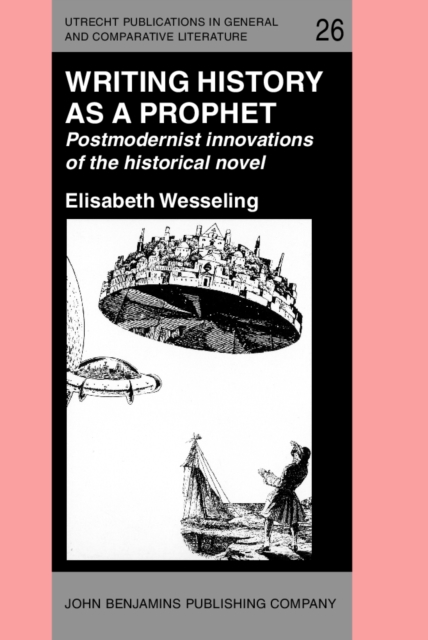
Writing history as a prophet : postmodernist innovations of the historical novel
A postmodernist history of the historical novel, paying special attention to the political implications of the postmodernist toward the past. Beginning with the poetics of Sir Walter Scott, it moves via a global survey of 19th-century historical fiction to modernist innovations in the genre.
eBook
The Cambridge Companion to Thomas Pynchon
The most celebrated American novelist of the past half-century, an indispensable figure of postmodernism worldwide, Thomas Pynchon notoriously challenges his readers. This Companion provides tools for meeting that challenge. Comprehensive, accessible, lively, up-to-date and reliable, it approaches Pynchon's fiction from various angles, calling on the expertise of an international roster of scholars at the cutting edge of Pynchon studies. Part I covers Pynchon's fiction novel-by-novel from the 1960s to the present, including such indisputable classics as The Crying of Lot 49 and Gravity's Rainbow. Part II zooms out to give a bird's-eye-view of Pynchon's novelistic practice across his entire career. Part III surveys major topics of Pynchon's fiction: history, politics, alterity ('otherness') and science and technology. Designed for students, scholars and fans alike, the Companion begins with a biography of the elusive author and ends with a coda on how to read Pynchon and a bibliography for further reading.
eBook


THE HEART'S ETERNAL VOW
For [Florentino Ariza], love's creature, this is an agonizing setback, though nothing fatal. Having sworn to love [Fermina Daza] forever, he settles in to wait for as long as he has to until she's free again. This turns out to be 51 years, 9 months and 4 days later, when suddenly, absurdly, on a Pentecost Sunday around 1930, Dr. Juvenal [Urbino] dies, chasing a parrot up a mango tree. After the funeral, when everyone else has left, Florentino steps forward with his hat over his heart. ''Fermina,'' he declares, ''I have waited for this opportunity for more than half a century, to repeat to you once again my vow of eternal fidelity and everlasting love.'' Shocked and furious, Fermina orders him out of the house. ''And don't show your face again for the years of life that are left to you. . . . I hope there are very few of them.'' [Gabriel Garcia Marquez], straight-faced teller of tall tales, is his biographer. At the age of 19, as he has reported, the young writer underwent a literary epiphany on reading the famous opening lines of Kafka's ''Metamorphosis,'' in which a man wakes to find himself transformed into a giant insect. ''Gosh,'' exclaimed Garcia Marquez, using in Spanish a word we in English may not, ''that's just the way my grandmother used to talk!'' And that, he adds, is when novels began to interest him. Much of what come in his work to be called ''magic realism'' was, as he tells it, simply the presence of that grandmotherly voice. Nevertheless, in this novel we have come a meaningful distance from Macondo, the magical village in ''One Hundred Years of Solitude'' where folks routinely sail through the air and the dead remain in everyday conversation with the living: we have descended, perhaps in some way down the same river, all the way downstream, into war and pestilence and urban confusions to the edge of a Caribbean haunted less by individual dead than by a history which has brought so appallingly many down, without ever having spoken, or having spoken gone unheard, or having been heard, left unrecorded. As revolutionary as writing well is the duty to redeem these silences, a duty Garcia Marquez has here fulfilled with honor and compassion. It would be presumptuous to speak of moving ''beyond'' ''One Hundred Years of Solitude'' but clearly Garcia Marquez has moved somewhere else, not least into deeper awareness of the ways in which, as Florentino comes to learn, ''nobody teaches life anything.'' There are still delightful and stunning moments contrary to fact, still told with the same unblinking humor - presences at the foot of the bed, an anonymously delivered doll with a curse on it, the sinister parrot, almost a minor character, whose pursuit ends with the death of Dr. Juvenal Urbino. But the predominant claim on the author's attention and energies comes from what is not so contrary to fact, a human consensus about ''reality'' in which love and the possibility of love's extinction are the indispensable driving forces, and varieties of magic have become, if not quite peripheral, then at least more thoughtfully deployed in the service of an expanded vision, matured, darker than before but no less clement.
Book Review
