
Catalogue Search | MBRL


Are you sure you want to remove the book from the shelf?

{{itemTitle}}
239
result(s) for
"Pyong Gap Min"
Sort by:


Preserving Ethnicity through Religion in America
Preserving Ethnicity through Religion in Americaexplores the factors that may lead to greater success in ethnic preservation. Pyong Gap Min compares Indian Americans and Korean Americans, two of the most significant ethnic groups in New York, and examines the different ways in which they preserve their ethnicity through their faith. Does someone feel more \"Indian\" because they practice Hinduism? Does membership in a Korean Protestant church aid in maintaining ties to Korean culture?
Pushing beyond sociological research on religion and ethnicity which has tended to focus on whites or on a single immigrant group or on a single generation, Min also takes actual religious practice and theology seriously, rather than gauging religiosity based primarily on belonging to a congregation. Fascinating and provocative voices of informants from two generations combine with telephone survey data to help readers understand overall patterns of religious practices for each group under consideration.Preserving Ethnicity through Religion in Americais remarkable in its scope, its theoretical significance, and its methodological sophistication.
eBook

Transnational Cultural Flow from Home
Transnational Cultural Flow from Home examines New York Korean immigrants’ collective efforts to preserve their cultural traditions and cultural practices and their efforts to transmit and promote them to New Yorkers by focusing on the Korean cultural elements such as language, foods, cultural festivals, and traditional and contemporary performing arts.
eBook

Patterns of Intermarriages and Cross-Generational In-Marriages among Native-Born Asian Americans
This article examines patterns of post-1965 native-born Asian Americans' intermarriages and cross-generational in-marriages using a combined sample of the 2001-2006 American Community Surveys from the Integrated Public Use Microdata Series. The analysis focuses on ethnic and gender differences in intermarriage and cross-generational in-marriage rates and patterns. About 55 percent of native-born Asian Americans are found to be intermarried while another 23 percent are married to 1.5-generation or first-generation co-ethnic immigrants. Thus only 22 percent of native-born Asian Americans are married to co-ethnic native-born Asian Americans. As expected, there are significant ethnic and gender differences in intermarriage and cross-generational in-marriage rates and patterns. This study is significant because it is the first study that has examined intermarriage patterns among post-1965 native-born Asian Americans, the majority of whom are likely to be children of post-1965 Asian immigrants, using the most recent Census data available. It is also significant for studies of the new second generation in general in that it is the first study to show patterns of cross-generational in-marriage among members of the new second generation.
Journal Article
Younger-generation Korean experiences in the United States
Younger-Generation Korean Experiences in the United States: Personal Narratives on Ethnic and Racial Identities compares the formation of the ethnic identities of two distinct cohorts of Korean Americans. Through personal essays, the book explores four influential factors of ethnic identity: retention of ethnic culture; participation in ethnic social networks; links to the mother country and its global power and influence; and experiences with racial prejudice and discrimination. The essays reflect certain major changes between the two cohorts—the first growing up in the 1960s and early 1970s and the second growing up during the 1980s and early 1990s— and proves how an increase in the Korean population and in the number of ethnic organizations helped the second-cohort Korean Americans retain their cultural heritage in a more voluntary, and therefore meaningful, way. This book’s combination of first-hand experiences and critical analysis makes it a valuable resource for studies of ethnicity, culture, identity formation, and the Asian-American experience.
eBook

The movement to promote an ethnic language in American schools
This paper examines a New York Korean immigrants’ movement to promote the Korean language in American schools. This movement includes the efforts of Korean community leaders to include the Korean language in the SAT II tests and to promote it to public schools as a foreign language in the New York–New Jersey area. This movement involves lobbying the College Board, school administrators and school board members, and collecting donations from Korean immigrants and the Korean government to cover expenses for the College Board’s creation of the Korean-language test and public schools’ adoption of the Korean language. Korean-language leaders have depended upon many different organizations and groups, such as Korean parents, Korean churches, Korean-language teachers, the Korean Cultural Center, Samsung, and Korean government agencies for the movement. This paper is significant because no previous study has shown a similar example of an immigrant group’s movement to promote its language in American public schools. It also contributes to transnational studies by documenting the emigrant state’s financial and technical support of its emigrants’ effort to promote the language and culture in a settlement country.
Journal Article

Marital Patterns and Use of Mother Tongue at Home among Native-Born Asian Americans
This article examines marital patterns and use of mother tongue at home among native-born Asian Americans using the 2005–2007 American Community Survey 3-Year Public Use Microdata Sample. There are variations in mother-tongue use across Asian ethnic groups, but variations among different types of marriage are even greater. Those who marry within their ethnicity (in-married) have a greater likelihood of mother-tongue use at home than those who intermarry. Among the in-married, those having 1.5- and first-generation co-ethnic spouses are far more likely to use a mother tongue than those having native-born, co-ethnic partners. Results of logistic regression analyses indicate that marital patterns are the strongest predictor of mother-tongue use at home, and that ethnic variations in mother-tongue use are significantly reduced when marital patterns are taken into account.
Journal Article
Koreans in North America
This is the only anthology that covers several different topics related to Koreans’ experiences in the U.S. and Canada. The topics covered are Koreans’ immigration and settlement patterns, changes in Korean immigrants’ business patterns, Korean immigrant churches’ social functions, differences between Korean immigrant intact families and geese families, transnational ties, second-generation Koreans’ identity issues, and Korean international students’ gender issues. This book focuses on Korean Americans’ twenty-first century experiences. It provides basic statistics about Koreans’ immigration, settlement and business patterns, while it also provides meaningful qualitative data on gender issues and ethnic identity. The annotated bibliography on Korean Americans in Chapter 10 will serve as important guides for beginning researchers studying Korean Americans.
eBook

Second-generation Korean experiences in the United States and Canada
In Second-Generation Korean Experiences in the United States and Canada, Pyong Gap Min and Samuel Noh have compiled a comprehensive examination of 1.5- and second-generation Korean experiences in the United States and Canada. As the chapters demonstrate, comparing younger-generation Koreans with first-generation immigrants highlights generational changes in many areas of life. The contributors discuss socioeconomic attainments, self-employment rates and business patterns, marital patterns, participation in electoral politics, ethnic insularity among Korean Protestants, the relationship between perceived discrimination and mental health, the role of ethnic identity as stress moderator, and responses to racial marginalization. Using both quantitative and qualitative data sources, this collection is unique in its examination of several different aspects of second-generation Korean experiences in the United States and Canada. An indispensable source for those scholars and students researching Korean Americans or Korean Canadians, the volume provides insight for students and scholars of minorities, migration, ethnicity and race, and identity formation.
eBook
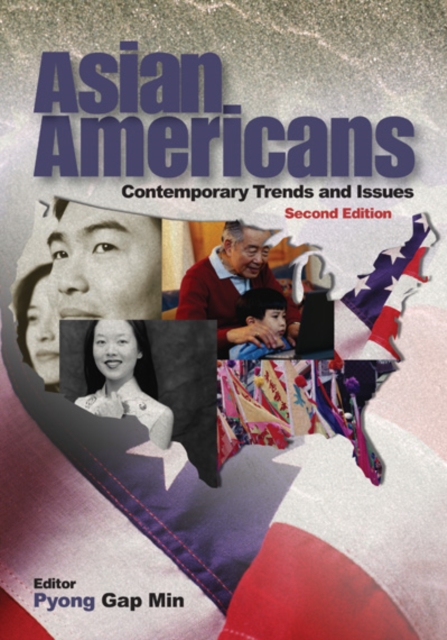
Asian Americans : contemporary trends and issues
Offering a broad overview of the Asian American experience, Asian Americans provides an accessible resource for all students interested in the expanding and important Asian American population. While historical information is provided for each group, the main focus is on the variables and issues that impact Asian American life today. The scholars who author the chapters look at topics such as labor force participation and economic status, educational achievements, intermarriage, intergroup relations, and settlement patterns. Photo essays help to enhance the presentations.
eBook