
Catalogue Search | MBRL


Are you sure you want to remove the book from the shelf?

{{itemTitle}}
384
result(s) for
"RICHARD L. HASEN"
Sort by:

Plutocrats united : campaign money, the Supreme Court, and the distortion of American elections
\"Campaign financing is one of today's most divisive political issues. The left asserts that the electoral process is rife with corruption. The right protests that the real aim of campaign limits is to suppress political activity and protect incumbents. Meanwhile, money flows freely on both sides. In Plutocrats United, Richard Hasen argues that both left and right avoid the key issue of the new Citizens United era: balancing political inequality with free speech. The Supreme Court has long held that corruption and its appearance are the only reasons to constitutionally restrict campaign funds. Progressives often agree but have a much broader view of corruption. Hasen argues for a new focus and way forward: if the government is to ensure robust political debate, the Supreme Court should allow limits on money in politics to prevent those with great economic power from distorting the political process\"--Jacket.
Book

Cheap speech : how disinformation poisons our politics--and how to cure it
An informed and practical road map for controlling disinformation, embracing free speech, saving American elections, and protecting democracy \"A fresh, persuasive and deeply disturbing overview of the baleful and dangerous impact on the nation of widely disseminated false speech on social media. Richard Hasen, the country's leading expert about election law, has written this book with flair and clarity.\"-Floyd Abrams, author of The Soul of the First Amendment What can be done consistent with the First Amendment to ensure that American voters can make informed election decisions and hold free elections amid a flood of virally spread disinformation and the collapse of local news reporting? How should American society counter the actions of people like former President Donald J. Trump, who used social media to convince millions of his followers to doubt the integrity of U.S. elections and helped foment a violent insurrection? What can we do to minimize disinformation campaigns aimed at suppressing voter turnout? With piercing insight into the current debates over free speech, censorship, and Big Tech's responsibilities, Richard L. Hasen proposes legal and social measures to restore Americans' access to reliable information on which democracy depends. In an era when quack COVID treatments and bizarre QAnon theories have entered mainstream, this book explains how to assure both freedom of ideas and a commitment to truth.
eBook

The justice of contradictions : Antonin Scalia and the politics of disruption
\"Engaging but caustic and openly ideological, Antonin Scalia was among the most influential justices ever to serve on the United States Supreme Court. In this fascinating new book, legal scholar Richard L. Hasen assesses Scalia's complex legacy as a conservative legal thinker and disruptive public intellectual. The left saw Scalia as an unscrupulous foe who amplified his judicial role with scathing dissents and outrageous public comments. The right viewed him as a rare principled justice committed to neutral tools of constitutional and statutory interpretation. Hasen provides a more nuanced perspective, demonstrating how Scalia was crucial to reshaping jurisprudence on issues from abortion to gun rights to separation of powers. A jumble of contradictions, Scalia promised neutral tools to legitimize the Supreme Court, but his jurisprudence and confrontational style moved the Court to the right, alienated potential allies, and helped to delegitimize the institution he was trying to save.\" -- Publisher's website.
Book

Lobbying, Rent-seeking, and the Constitution
Politicians across the political spectrum, from Barack Obama to Sarah Palin and Rand Paul, routinely castigate lobbyists for engaging in supposedly corrupt activities or having unequal access to elected officials. Since attaining office President Obama has imposed unprecedented new lobbying regulations, and he is not alone: both Congress and state and local legislative bodies have done so in recent years. At the same time, federal courts, relying upon the Supreme Court's new campaign finance decision in Citizens United v. FEC, have begun striking down lobbying regulations, including important regulations that limit campaign finance activities of lobbyists and impose a waiting period before legislators or legislative staffers may work as lobbyists. Two courts have held such laws could not be sustained on anticorruption grounds, and they are unlikely to be sustained on political equality grounds either. This Article advances an alternative rationale which could support some, though not all, of the recent wave of new lobbying regulations: the state's interest in promoting national economic welfare. Lobbyists threaten national economic welfare in two ways. First, lobbyists facilitate rent-seeking activities. Rentseeking occurs when individuals or groups devote resources to capturing government transfers, rather than putting them to a productive use, and lobbyists are often the key actors securing such benefits. Second, lobbyists tend to lobby for legislation that is itself an inefficient use of government resources. Part I of this Article provides an overview of the current state of lobbying regulation and lobbying jurisprudence. Part II proposes a new national economic welfare rationale for lobbying regulation. It begins by describing the political science literature on how lobbying works, as well as current statistics on the extent of lobbying on the federal level and the costs of lobbyist-driven rent-seeking on the national economy. Some of the new and proposed lobbying regulations, such as antibundling provisions and anti-revolving-door provisions, could decrease the total amount of interest group rent-seeking. The state's national economic welfare interest must be balanced against the First Amendment costs of lobbying regulation in infringing on the right to speak and petition the government. I defend this interest as an important (even potentially compelling) state interest that justifies at least some new lobbying regulations against constitutional challenge. Part III turns to objections and extensions of the argument. I respond to objections on both ends and means. On ends I consider the circumstances in which the promotion of national economic welfare can trump First Amendment rights. On means, I consider whether there is sufficient proof that lobbying regulations are sufficiently tailored to a reduction in rent-seeking and whether, because of the \"hydraulic\" nature of money in politics, attempts to regulate lobbying so as to decrease rent-seeking will be easy to evade. Under extensions, I consider whether the national economic welfare rationale could be used to justify the reenactment, as suggested by Justice Stevens, of the ban on spending corporate treasury funds in candidate elections, as well as the recent SEC \"pay-to-play\" rule for investment advisers.
Journal Article

\CITIZENS UNITED\ AND THE ILLUSION OF COHERENCE
The self-congratulatory tone of the majority and concurring opinions in last term's controversial Supreme Court blockbuster, Citizens United v. Federal Election Commission, extended beyond the trumpeting of an absolutist vision of the First Amendment that allows corporations to spend unlimited sums independently to support or oppose candidates for office. The triumphalism extended to the majority's view that it had imposed coherence on the unwieldy body of campaign finance jurisprudence by excising an \"outlier\" 1990 opinion, Austin v. Michigan Chamber of Commerce, which had upheld such corporate limits, and parts of a 2003 opinion, McConnell v. FEC, extending Austin to unions and to a broader set of election-related television and radio broadcasts. The majority saw itself as returning the Court to the fountainhead of this jurisprudence, the Court's 1976 opinion in Buckley v. Valeo. Citizens United indisputably harmonized campaign finance law on the question of the constitutionality of spending limits on corporations, even if its view of Austin as an \"outlier\" remains contested. But the Court in doing so amplified and solidified other significant, incoherent aspects of its campaign finance jurisprudence. Part I of this Article situates Citizens United in the campaign finance jurisprudence that preceded it and describes in detail the key opinions in the case. Part II explains how the Court's analysis in Citizens United is likely to lead to new incoherence in the Court's campaign finance jurisprudence, because it is unlikely that the Court will follow the new case to its extreme, for example to allow spending by foreign nationals to influence candidate elections, to treat spending in judicial elections the same way as spending for other races, or to strike down reasonable limits on campaign contributions made directly to condidates. Part III suggests that incoherence is likely to be an enduring feature of the Court's campaign finance jurisprudence, because consistent application of a coherent approach could well be politically unpalatable for majority of the Justices on the Court. It also considers the challenge such incoherence poses for lawyers arguing campaign finance cases in the Supreme Court and lower courts.
Journal Article
Election Law's Path in the Roberts Court's First Decade: A Sharp Right Turn but with Speed Bumps and Surprising Twists
The first decade of election law cases at the Supreme Court under the leadership of Chief Justice Roberts brought election law down a strongly conservative path in cases involving issues from campaign finance to voting rights to election administration. Nonetheless, the Roberts Court, while dominated by a majority of five conservative Justices until the recent death of Justice Antonin Scalia, had not gone as far right as it could have or as some had predicted. This Essay describes the path of election law jurisprudence in the Roberts Court and then considers two questions. First, what explains why the Court, while shifting in a strongly conservative direction, has not moved more extremely to the right? Second, what options has the Court left for election reformers who are unhappy with the strongly conservative, although not maximally conservative, status quo? On the first question, a combination of factors appears to explain the trajectory and speed of the Roberts Court's election law decisions. The Roberts Court has been fundamentally conservative, but for jurisprudential, temperamental, or strategic reasons, Justices who have held the balance of power appear to prefer incrementalism to radical change. Mandatory appellate jurisdiction appeared the best way to force the Roberts Court s hand, and it often (but not always) led to a conservative result. Nearly half of the Roberts Court's election cases came on mandatory jurisdiction. Finally, the five conservative Justices were not monolithic in their views and were capable of surprise. On the second question, the Court has left very limited space for reform in certain areas, such as campaign finance. Where the Court has greatly constrained choice, only minor improvements are possible absent a change in the Supreme Court's personnel. In these areas, the problem is not that reformers have a \"romanticized\" vision of democracy; it is that the structural impediments erected by the Court have hobbled meaningful reform efforts. In contrast, in areas in which the Court has mostly left room for decentralized election law approaches, such as in the arena of election administration, election fights are becoming both legal and political. Much of the space for reform efforts depends upon the future composition of the Court Part I briefly describes the path of election law in the Roberts era across key election law areas including campaign finance, voting rights, and election administration. Part II explains why the Roberts Court has been deeply conservative but not consistently maximalist Part III considers the space for election reform in the Roberts Court era and beyond
Journal Article
The Democracy Canon
In the heat of the 2008 election season-following the new tradition of the 2000 and 2004 elections-candidates, political parties, and others filed new lawsuits practically every day over election law issues. The issues ranged from candidate ballot access to the allocation of voting machines by precinct to the accuracy of state voter registration databases. In mid-September 2008, two Ohio controversies garnered national attention. In one case, Republicans filed suit to block first-time Ohio voters from registering to vote and casting an early in-person absentee ballot at the same time during an apparent five-day statutory overlap between the dates for voter registration and for early voting. In another case, Republicans sued the Democratic Ohio Secretary of State, Jennifer Brunner, for her refusal to accept absentee ballot requests submitted by voters who filled out a form sent to them by the McCain campaign unless the voter had checked a box confirming the voter was qualified to vote. The box, mistakenly added by the McCain campaign, was not required under Ohio law.
Journal Article
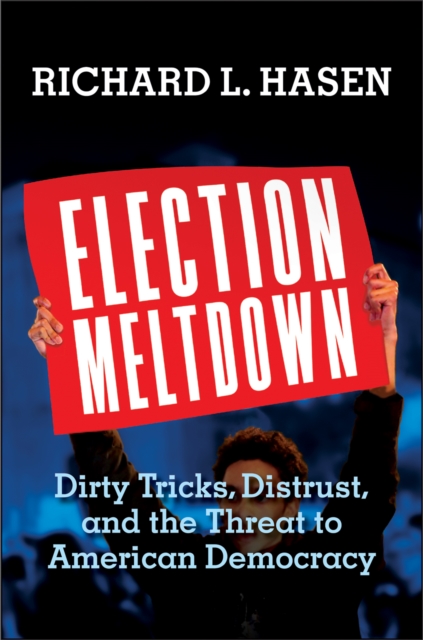
Election Meltdown
From the nation's leading expert, an indispensable analysis of key threats to the integrity of the 2020 American presidential election As the 2020 presidential campaign begins to take shape, there is widespread distrust of the fairness and accuracy of American elections. In this timely and accessible book, Richard L. Hasen uses riveting stories illustrating four factors increasing the mistrust. Voter suppression has escalated as a Republican tool aimed to depress turnout of likely Democratic voters, fueling suspicion. Pockets of incompetence in election administration, often in large cities controlled by Democrats, have created an opening to claims of unfairness. Old-fashioned and new-fangled dirty tricks, including foreign and domestic misinformation campaigns via social media, threaten electoral integrity. Inflammatory rhetoric about \"stolen\" elections supercharges distrust among hardcore partisans. Taking into account how each of these threats has manifested in recent years-most notably in the 2016 and 2018 elections-Hasen offers concrete steps that need to be taken to restore trust in American elections before the democratic process is completely undermined.
eBook
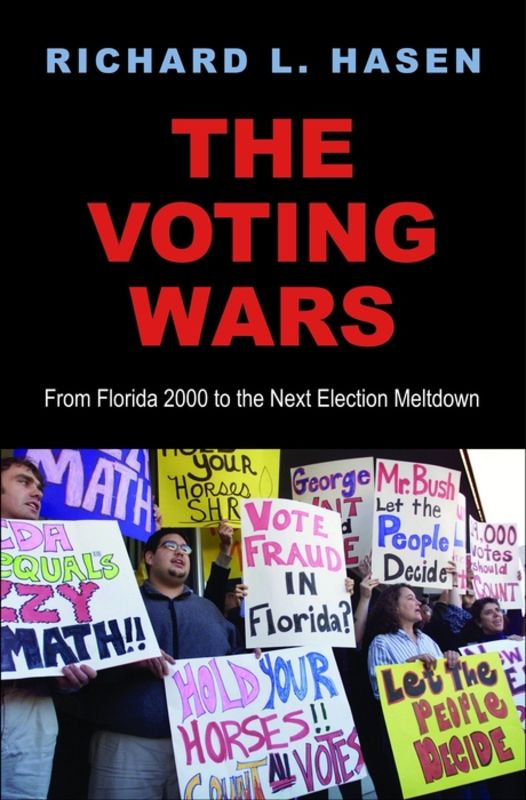
The voting wars : from Florida 2000 to the next election meltdown
In 2000, just a few hundred votes out of millions cast in the state of Florida separated Republican presidential candidate George W. Bush from his Democratic opponent, Al Gore. The outcome of the election rested on Florida's 25 electoral votes, and legal wrangling continued for 36 days. Then, abruptly, one of the most controversial Supreme Court decisions in U.S. history, Bush v. Gore, cut short the battle. Since the Florida debacle we have witnessed a partisan war over election rules. Election litigation has skyrocketed, and election time brings out inevitable accusations by political partisans of voter fraud and voter suppression. These allegations have shaken public confidence, as campaigns deploy \"armies of lawyers\" and the partisan press revs up when elections are expected to be close and the stakes are high.Richard L. Hasen, a respected authority on election law, chronicles and analyzes the battles over election rules from 2000 to the present. From a nonpartisan standpoint he explores the rising number of election-related lawsuits and charges of voter fraud as well as the decline of public confidence in fair results. He explains why future election disputes will be worse than previous ones-more acrimonious, more distorted by unsubstantiated allegations, and amplified by social media. No reader will fail to conclude with Hasen that election reform is an urgent priority, one that demands the attention of conscientious citizens and their elected representatives.Also available: The Fraudulent Fraud Squad, an e-excerpt from The Voting WarsReleased February 2012 9780300187489 $1.99
eBook

The Supreme Court and election law : judging equality from Baker v. Carr to Bush v. Gore
In the first comprehensive study of election law since the Supreme Court decided Bush v. Gore , Richard L. Hasen rethinks the Court’s role in regulating elections. Drawing on the case files of the Warren, Burger, and Rehnquist courts, Hasen roots the Court’s intervention in political process cases to the landmark 1962 case, Baker v. Carr. The case opened the courts to a variety of election law disputes, to the point that the courts now control and direct major aspects of the American electoral process.
The Supreme Court does have a crucial role to play in protecting a socially constructed “core” of political equality principles, contends Hasen, but it should leave contested questions of political equality to the political process itself. Under this standard, many of the Court’s most important election law cases from Baker to Bush have been wrongly decided.
eBook