
Catalogue Search | MBRL


Are you sure you want to remove the book from the shelf?

{{itemTitle}}
13
result(s) for
"Radasanu, Andrea"
Sort by:
In search of humanity
This collection of essays, offered in honor of the distinguished career of prominent political philosophy professor Clifford Orwin, brings together internationally renowned scholars to provide a wide context and discuss various aspects of the virtue of \"humanity\" through the history of political philosophy.
eBook


Montesquieu on Ancient Greek Foreign Relations: Toward National Self-Interest and International Peace
Montesquieu famously claims that modernity ushered in gentle mores and peaceful relations among countries. Consulting Montesquieu's teaching on Greek foreign policy, both republican and imperial, elucidates the character of these peaceful mores. Montesquieu weaves a modernization tale from primitive ancient Greece to modern commercial states, all to teach the reader to overcome any lingering attachment to glory and to adopt the rational standards of national interest and self-preservation. This account provides important insights on the relationship between realism and idealism in Montesquieu's international relations teaching and helps scholars to rethink how these categories are construed.
Journal Article
Montesquieu’s Machiavellian Account of Civil Religion
Niccolò Machiavelli’s influence on Charles de Montesquieu’s work has been acknowledged in various ways and by many interpreters. Most famously, Montesquieu comments that Europe had begun to be cured of Machiavellianism, seemingly putting himself at odds with Machiavelli and his legacy.¹ In this case, Machiavellianism refers to the unbridled avarice of princes who would use their political power tyrannically to enrich themselves. Montesquieu stands against Machiavellianism on the side of limited governmental power and the protections of individual liberties and possessions. But the manner in which the tyrannical power of princes was curbed is not free of Machiavelli’s influence; that
Book Chapter

MONTESQUIEU ON MODERATION, MONARCHY AND REFORM
Montesquieu's respect for moderation is almost universally acknowledged, but not very well understood. In recent scholarship, his moderation has been interpreted as inclusive and pluralistic with a view to the range of regimes that are hospitable to liberty. This paper challenges
this currently dominant interpretation of Montesquieu by revisiting his understanding of moderation. On reflection, he does not simply discourage radical change, he even provides advice as to when and how such change is to be enacted. French absolute monarchy requires fundamental change, not
least because monarchy as such is not sufficiently accommodating to liberty. While the English commercial republic is better suited to liberty than French monarchy, there is no doubt that monarchy is more attractive than commercial republicanism. Montesquieu offers a profound and perhaps unsettling
account of the possible incompatibility of honour, generosity and greatness of spirit, on the one hand, and safety and liberty, on the other.
Journal Article
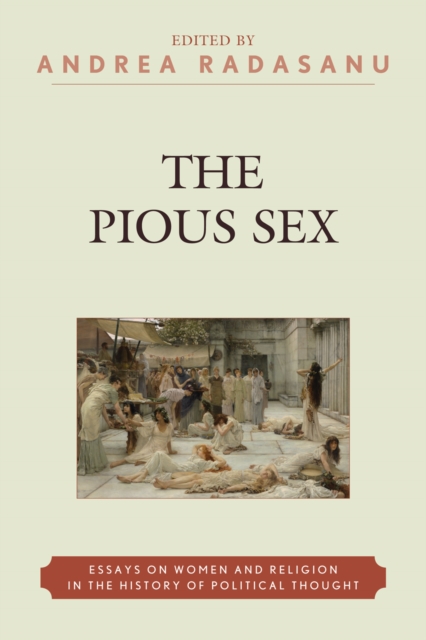
The pious sex
The Pious Sex strives to enlighten the reader with respect to the relationship between women and religion. The notion that there is a special relationship between women and piety may call to mind the worst of the prejudices associated with women over the ages: the characterization of women as superstitious and inherently irrational creatures who must be kept firmly in hand by the patriarchal establishment. The suggestion that there is a special relationship between women and piety conjures up the most oppressive picture of womanly virtue. The contributors of this volume revisit the claim that women constitute the pious sex and investigate the implications of such a designation. This collection of original essays examines the relationship between women and religion in the history of political thought broadly conceived. This theme is a remarkably revealing lens through which to view the Western philosophical and poetical traditions that have culminated in secular and egalitarian modern society. The essays also give highly analytical accounts of the manifold and intricate relationships between religion, family, and public life in the history of political thought, and the various ways in which these relationships have manifested themselves in pagan, Jewish, Christian, and post-Christian settings.
eBook

Civil Religion in Modern Political Philosophy
Inspired by Machiavelli, modern philosophers held that the
tension between the goals of biblical piety and the goals of
political life needed to be resolved in favor of the political, and
they attempted to recast and delimit traditional Christian teaching
to serve and stabilize political life accordingly. This volume
examines the arguments of those thinkers who worked to remake
Christianity into a civil religion in the early modern and modern
periods.
Beginning with Machiavelli and continuing through to Alexis de
Tocqueville, the essays in this collection explain in detail the
ways in which these philosophers used religious and secular writing
to build a civil religion in the West. Early chapters examine
topics such as Machiavelli's comparisons of Christianity with Roman
religion, Francis Bacon's cherry-picking of Christian doctrines in
the service of scientific innovation, and Spinoza's attempt to
replace long-held superstitions with newer, \"progressive\" ones.
Other essays probe the scripture-based, anti-Christian argument
that religion must be subordinate to politics espoused by
Jean-Jacques Rousseau and David Hume, both of whom championed
reason over divine authority. Crucially, the book also includes a
study of civil religion in America, with chapters on John Locke,
Montesquieu, and the American Founders illuminating the
relationships among religious and civil history, acts, and
authority. The last chapter is an examination of Tocqueville's
account of civil religion and the American regime.
Detailed, thought-provoking, and based on the careful study of
original texts, this survey of religion and politics in the West
will appeal to scholars in the history of political philosophy,
political theory, and American political thought.
eBook
Enlightenment and secularism
Enlightenment and Secularism is a collection of twenty eight essays that seek to understand the connection between the European Enlightenment and the emergence of secular societies, as well as the character or nature of those societies. The contributors are drawn from a variety of disciplines including History, Sociology, Political Science, and Literature. Most of the essays focus on a single text from the Enlightenment, borrowing or secularizing the format of a sermon on a text, and are designed to be of particular use to those teaching and studying the history of the Enlightenment within a liberal arts curriculum.
eBook

Civic education and the future of American citizenship
The Founders of this nation believed that the government they were creating required a civically educated populace. Such an education aimed to cultivate enlightened, informed, and vigilant citizens who could perpetuate and improve the nation. Unfortunately, America’s contemporary youth seem to lack adequate opportunities, if not also the ability or will, to critically examine the foundations of this nation. An even larger problem is an increasing ambivalence toward education in general. Stepping into this void is a diverse group of educators, intellectuals, and businesspeople, brought together in Civic Education and the Future of American Citizenship to grapple with the issue of civic illiteracy and its consequences. The essays, edited by Elizabeth Kaufer Busch and Jonathan W. White, force us to not only reexamine the goals of civic education in America but also those of liberal education more broadly.
eBook

Modern appeals to history and tradition: Montesquieu and Burke
Many contemporary critics of liberalism have objected to this doctrine's unhistorical understanding of individual autonomy and liberty. In order to assess the merit of these criticisms it would be profitable to return to the early and seminal attempts of Montesquieu and Burke to ground individual liberty in particular histories and traditions. Montesquieu has at various times been labeled a liberal or a conservative, while Burke's reputation is that of a staunch conservative. Yet recently both have been mined for their seemingly capacious notions of liberty. Both of them make careful and nuanced arguments regarding the conditions for liberty, and both have flexible notions of liberty, which include aspects of the ancien régime and of the liberal democratic regimes that eventually followed. Upon careful scrutiny, however, it is difficult to conclude that either of these political thinkers offers a convincing account of embedded liberalism, at once sensitive to historical difference and careful to offer a principled standard for liberty. Montesquieu's purportedly moderate liberalism proves to be no more capacious than that of Hobbes and Locke, while Burke's spirited attempt to salvage respect for tradition coupled with his attack on reason results in unwitting historicism. Efforts to promote moderation and statesmanship on modern liberal grounds are problematic. Montesquieu and Burke agree that political life is for the sake of comfortable self-preservation, and argue that pre-rational affection is crucial for achieving this goal. Our history and traditions help form our sensibilities in such a way as to make possible regulated liberty. Although Montesquieu and Burke offer rich accounts of political life, they both fall short of providing plausible alternatives to the individualistic and universalistic liberalism of Hobbes and Locke. Montesquieu's attempt to account for the irrational historical and social forces that form political character blurs the line between nature and history, and thus makes more difficult the application of a natural standard by which to judge our political affections and commitments. For Burke, nature and history become so confounded as to make impossible standards of liberty or goodness by nature.
Dissertation