
Catalogue Search | MBRL


Are you sure you want to remove the book from the shelf?

{{itemTitle}}
42
result(s) for
"Radburn, Nicholas"
Sort by:

Guinea Factors, Slave Sales, and the Profits of the Transatlantic Slave Trade in Late Eighteenth-Century Jamaica: The Case of John Tailyour
In 1783 Scottish native John Tailyour arrived in Jamaica, where he hoped to make his fortune after a string of failed business ventures in North America. Fifteen years later he retired as a rich man. His newfound wealth came in large part from his career as a “Guinea factor,” a merchant who sold captive Africans from newly arrived slave ships. During his years as a Guinea factor, Tailyour sold 17,295 Africans into slavery through a traumatizing process that channeled captives to different buyers according to their age, sex, and health. Tailyour's history reveals the important ways that Guinea factors shaped the transatlantic slave trade within the Americas and, in doing so, powerfully conditioned the lives of the Africans they sold into slavery. The rapidity with which Tailyour built his fortune also suggests that the fabled profits of the slave trade were available for men who sold slaves in the Americas rather than investing directly in slave ships. Tailyour's case thus encourages future historians to look beyond the notorious Middle Passage and focus on the slave trade within the Americas.
Journal Article
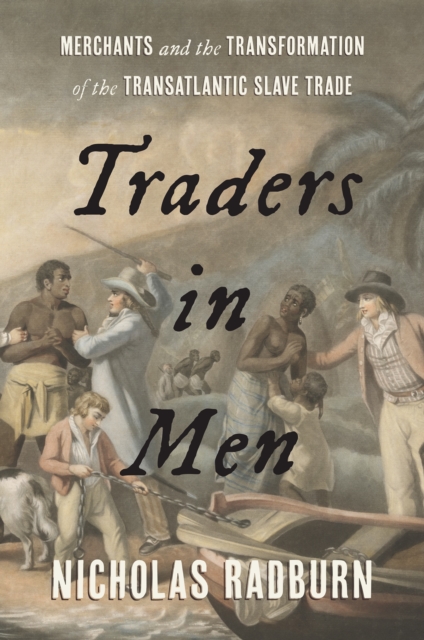
Traders in Men
BA sweeping new history that reveals how British, African, and American merchants developed the transatlantic slave trade/BBR / BR /B\"This is a landmark study given its clear status as easily the best researched and most comprehensive book on the British slave trade to date.\"-David Eltis, coauthor of IAtlas of the Transatlantic Slave Trade/I/BBR / BR /B\"A masterful account of one of the most brutal moments in the history of capitalist modernity. Radburn brilliantly details all aspects of the process of commodification of human beings in the Liverpool slave trade, vividly depicting the long journeys endured by Africans in Africa, across the Atlantic, and in the Americas.\"-Leonardo Marques, Universidade Federal Fluminense/BBR / BR / During the eighteenth century, Britain's slave trade exploded in size. Formerly a small and geographically constricted business, the trade had, by the eve of the American Revolution, grown into a transatlantic system through which fifty thousand men, women, and children were enslaved every year.BR / BR / In this wide-ranging history, Nicholas Radburn explains how thousands of merchants collectively transformed the slave trade by devising highly efficient but violent new business methods. African brokers developed commercial infrastructure that facilitated the enslavement and sale of millions of people. Britons invented shipping methods that quelled enslaved people's constant resistance on the Middle Passage. And American slave traders formulated brutal techniques through which shiploads of people could be quickly sold to colonial buyers. Truly Atlantic-wide in its vision, this study shows how the slave trade dragged millions of people into its terrible vortex and became one of the most important phenomena in world history.
eBook


The British Gunpowder Industry and the Transatlantic Slave Trade
How did Atlantic slavery stimulate British industry? This article answers that question through a study of five firms that supplied gunpowder to the slave trade. It first demonstrates that the Atlantic slavery trade certainly expanded Britain's explosives industry during the eighteenth century. British merchant capitalists established five plants in the proximity of Bristol and Liverpool to meet African demand, provincializing the gunpowder industry for the first time. The slave trade also inflated the gunpowder industry's volume, with twelve percent of all powder going to Africa before abolition. This article next reveals that supplying the slave trade was likely a lucrative pursuit for British manufacturers, with investors in the five mills earning profits that exceeded those of slaving. The boost given to the explosives industry faded considerably as abolition neared, however, and so this article concludes that Atlantic slavery's stimulus was likely of limited importance for driving the later Industrial Revolution.
Journal Article


Keeping “the wheel in motion”: Trans-Atlantic Credit Terms, Slave Prices, and the Geography of Slavery in the British Americas, 1755–1807
This article uses a new dataset of 330 slaving voyages to examine terms of credit issued for British American slave sales between 1755 and 1807. It shows that credit terms consistently varied between American colonies, and that slave ship captains considered these differences when electing where to land enslaved Africans. Our dataset also shows that credit terms were highly erratic, especially in the last quarter of the century, contributing to both surges and collapses in the slave trade to individual colonies, and in the trade as a whole. Four such instances are examined in detail to show that instability in credit terms played an important and hitherto unacknowledged role in the volume and direction of Britain's trans-Atlantic slave trade in the second one-half of the eighteenth century.
Journal Article
