Catalogue Search | MBRL


Are you sure you want to remove the book from the shelf?

{{itemTitle}}
12
result(s) for
"Rafter, Nicole Hahn, 1939-"
Sort by:


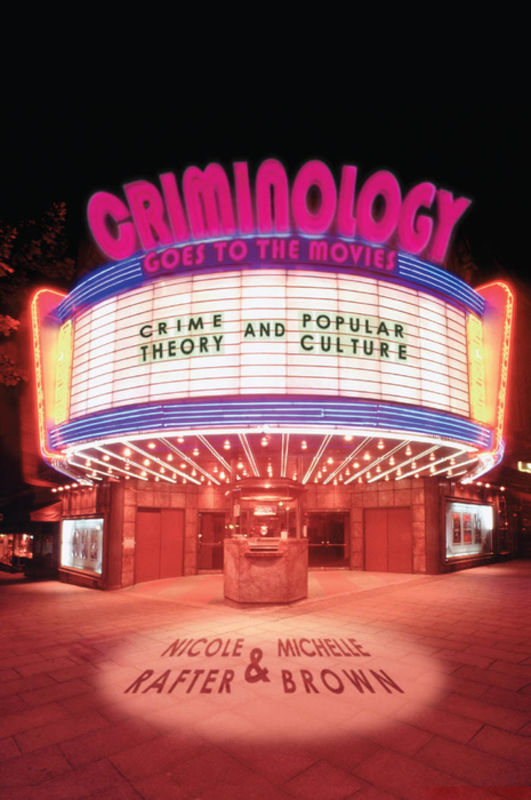
Criminology Goes to the Movies
From a look at classics like Psycho and Double Indemnity to recent films like Traffic and Thelma & Louise, Nicole Rafter and Michelle Brown show that criminological theory is produced not only in the academy, through scholarly research, but also in popular culture, through film. Criminology Goes to the Movies connects with ways in which students are already thinking criminologically through engagements with popular culture, encouraging them to use the everyday world as a vehicle for theorizing and understanding both crime and perceptions of criminality. The first work to bring a systematic and sophisticated criminological perspective to bear on crime films, Rafter and Brown’s book provides a fresh way of looking at cinema, using the concepts and analytical tools of criminology to uncover previously unnoticed meanings in film, ultimately making the study of criminological theory more engaging and effective for students while simultaneously demonstrating how theories of crime circulate in our mass-mediated worlds. The result is an illuminating new way of seeing movies and a delightful way of learning about criminology.
eBook



لقطات وطلقات في المرآة : أفلام الجريمة والمجتمع
يقدم كتاب لقطات وطلقات في المرآة أفلام الجريمة والمجتمع دراسة تحليلية لأكثر من ثلاثمائة فيلم أمريكي من أفلام العنف والجريمة عبر مراحل مختلفة من تاريخ السينما في محاولة للإجابة عن سؤال هل هذه النوعية من الأفلام تعكس فقط مفاهيمنا عن الجريمة والمجرمين والعدالة والقانون أم أنها تعيد تشكيل هذه المفاهيم ذاتها ؟ ويتكون من ثمانية فصول تقع تحت عناوين تاريخ أفلام الجريمة لماذا أصبحوا أشرارا ؟ وأفلام القتلة والسفاحين وأفلام رجال الشرطة والمخبرين وأفلام القانون الجنائي وأفلام السجن والإعدام وأبطال أفلام الجريمة وأفلام الألتباس الأخلاقي.
BOOK

Criminal man
Cesare Lombroso is widely considered the founder of criminology. His theory of the \"born\" criminal dominated European and American thinking about the causes of criminal behavior during the late nineteenth century and the early twentieth. This volume offers English-language readers the first critical, scholarly translation of Lombroso's Criminal Man, one of the most famous criminological treatises ever written. The text laid the groundwork for subsequent biological theories of crime, including contemporary genetic explanations.
Originally published in 1876, Criminal Man went through five editions during Lombroso's lifetime. In each edition Lombroso expanded on his ideas about innate criminality and refined his method for categorizing criminal behavior. In this new translation, Mary Gibson and Nicole Hahn Rafter bring together for the first time excerpts from all five editions in order to represent the development of Lombroso's thought and his positivistic approach to understanding criminal behavior.
In Criminal Man, Lombroso used modern Darwinian evolutionary theories to \"prove\" the inferiority of criminals to \"honest\" people, of women to men, and of blacks to whites, thereby reinforcing the prevailing politics of sexual and racial hierarchy. He was particularly interested in the physical attributes of criminals—the size of their skulls, the shape of their noses—but he also studied the criminals' various forms of self-expression, such as letters, graffiti, drawings, and tattoos. This volume includes more than forty of Lombroso's illustrations of the criminal body along with several photographs of his personal collection. Designed to be useful for scholars and to introduce students to Lombroso's thought, the volume also includes an extensive introduction, notes, appendices, a glossary, and an index.
eBook


The Criminal Brain, Second Edition
What is the relationship between criminality and biology? Nineteenth-century phrenologists insisted that criminality was innate, inherent in the offender's brain matter. While they were eventually repudiated as pseudo-scientists, today the pendulum has swung back. Both criminologists and biologists have begun to speak of a tantalizing but disturbing possibility: that criminality may be inherited as a set of genetic deficits that place one at risk to commit theft, violence, or acts of sexual deviance. But what do these new theories really assert? Are they as dangerous as their forerunners, which the Nazis and other eugenicists used to sterilize, incarcerate, and even execute thousands of supposed \"born\" criminals? How can we prepare for a future in which leaders may propose crime-control programs based on biology?In this second edition ofThe Criminal Brain, Nicole Rafter, Chad Posick, and Michael Rocque describe early biological theories of crime and provide a lively, up-to-date overview of the newest research in biosocial criminology. New chapters introduce the theories of the latter part of the 20th century; apply and critically assess current biosocial and evolutionary theories, the developments in neuro-imaging, and recent progressions in fields such as epigenetics; and finally, provide a vision for the future of criminology and crime policy from a biosocial perspective. The book is a careful, critical examination of each research approach and conclusion. Both compiling and analyzing the body of scholarship devoted to understanding the criminal brain, this volume serves as a condensed, accessible, and contemporary exploration of biological theories of crime and their everyday relevance.
eBook