
Catalogue Search | MBRL


Are you sure you want to remove the book from the shelf?

{{itemTitle}}
271
result(s) for
"Raleigh, Donald J"
Sort by:


Russia's sputnik generation : Soviet baby boomers talk about their lives
Russia's Sputnik Generation presents the life stories of eight 1967 graduates of School No. 42 in the Russian city of Saratov. Born in 1949/50, these four men and four women belong to the first generation conceived during the Soviet Union's return to \"normality\" following World War II. Well educated, articulate, and loosely networked even today, they were first-graders the year the USSR launched Sputnik, and grew up in a country that increasingly distanced itself from the excesses of Stalinism. Reaching middle age during the Gorbachev Revolution, they negotiated the transition to a Russian-style market economy and remain active, productive members of society in Russia and the diaspora. In candid interviews with Donald J. Raleigh, these Soviet \"baby boomers\" talk about the historical times in which they grew up, but also about their everyday experiences -- their family backgrounds; childhood pastimes; favorite books, movies, and music; and influential people in their lives. These personal testimonies shed valuable light on Soviet childhood and adolescence, on the reasons and course of perestroika, and on the wrenching transition that has taken place since the collapse of the Soviet Union in 1991.
eBook
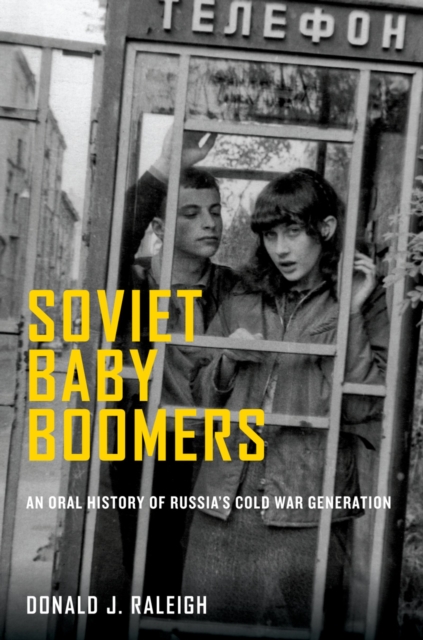
Soviet Baby Boomers
Soviet Baby Boomers traces the collapse of the Soviet Union and the transformation of Russia into a modern, highly literate, urban society through the life stories of the country's first post-World War II, Cold War generation. It is based on interviews with sixty 1967 graduates of two \"magnet\" secondary schools that offered intensive instruction in English, one in Moscow and one in Saratov. Illuminating a critical generation of people who had remained largely faceless up until now, the book reveals what it meant to \"live Soviet\" during the twilight of the Soviet empire.
eBook


Doing Local History, or From Social History to Oral History: Some Autobiographical Reflections on Studying Russia's Saratov Region
The author of this article, an early practitioner of local history in the field, takes an autobiographical approach in tracing his evolving views on, and the practice of, local history. The piece outlines how the changes that have come to local history since the early 1970s reflect broader transformations in the historical profession and intellectual life, as well as in the sociohistorical context. It discusses the emergence of local history in the field of Russian studies at the time that social history and social science models invigorated the writing of history, and how the genre remained in its infancy until Russia's opening and the opening of its archives, when it fell under the influence of sister disciplines and of the cultural turn. Until the late 1990s, the dearth of distinguished works of local history written by Russian scholars constrained the research agendas of foreign scholars because the latter could not enter into dialogue with scholarship by Russia-based historians. This has changed as Russian historians have rejoined the larger historical community and as they have made efforts at distinguishing the more popular genre of kraevedenie from professional and academic work on local history that welcomes interdisciplinary currents.
Journal Article

Une province russe dans la tourmente de la guerre civile (Saratov, 1914-1922)
Malgré l’importance majeure de la guerre civile en Russie, l’historiographie du sujet reste, jusqu’à ce jour, singulièrement restreinte. Fondée sur des archives encore inexploitées, la présente étude, concentrée sur la région de Saratov, s’attache à démontrer comment le traumatisme social prolongé des années 1914-1922 exerça une influence capitale sur les événements ultérieurs de l’histoire soviétique, interdisant au bolchevisme de recourir à des alternatives réelles. Après avoir considéré l’impact de la guerre et de la révolution, l’auteur se propose d’analyser quatre aspects qui, en dehors des paramètres d’actions militaires directes,résument les expériences essentielles de la guerre civile : le problème du localisme, la culture politique et la corruption, les stratégies politiques des bolcheviks en milieu rural et l’explosion du mécontentement ouvrier en mars 1921. Selon l’auteur, un grand nombre de formes de gouvernement traditionnellement attribuées à l’ère stalinienne avaient déjà été esquissées, pratiquées et même implantées en profondeur durant la période de 1914-1922. Ces formes de gouvernement reflètent des éléments connus de la culture politique russe, mais révèlent également des configurations nouvelles, façonnées par les idéologies, les circonstances, les personnages et le hasard, et forgées au brasier de la guerre civile. A Russian province in the fire of Civil War (Saratov, 1914-1922) Despite the importance of the Russian Civil War, the historiography on the topic remains remarkably underdeveloped. Focusing on the Saratov region and drawing on heretofore untapped archival sources, this essay shows how the sustained social trauma of the 1914-1922 period constrained and enabled later Soviet history by closing Bolshevism to real alternatives. After considering the impact of war and revolution, the author analyzes four issues that encapsulate essential civil war experiences outside the parameters of direct military engagements: the problem of localism, political culture and corruption, Bolshevik policies in the countryside, and the explosion of workers’ discontent in March 1921. Raleigh argues that many of the features of the Soviet system we associate with the Stalin era were already adumbrated, practiced, and even embedded during the 1914-1922 period. They reflected familiar elements of Russian political culture, but also new forms shaped by ideology, circumstances, situations, people, chance, and forged in the fire of Civil War.
Journal Article


Doing Soviet History: The Impact of the Archival Revolution
The opening of official archives in Russia has changed how Soviet history is practiced in critical ways. Although initially the agenda of Russian historians differed from those in the West, this is less and less the case as they rejoin the larger world community of historians.
Journal Article

