
Catalogue Search | MBRL


Are you sure you want to remove the book from the shelf?

{{itemTitle}}
19
result(s) for
"Rantisi, Norma M."
Sort by:


Market/Place
Markets are seemingly omnipresent features of our economic landscape, and yet they do not exhibit a singular, essential or universal form. What are we to make of the fact that markets are never self-contained and self-regulating, but instead are tangled up and co-produced with all manner of governmental, social, and political processes? Furthermore, how are we to explain the persistent and often unruly “geographies\" of markets, the causes and consequences of which remain elusive? From a variety of theoretical and disciplinary perspectives, this collection of original essays probes the question of how to think about markets spatially, and how to make sense of the geographies of marketization. In the process, Market/Place opens new frontiers for the emergent field of critical market studies, problematizing the “geography of markets\" as an issue not only for self-identifying economic geographers, but as a demanding, interdisciplinary question.
eBook
Exploring the role of industry intermediaries in the construction of ‘Local Pipelines’
The fur garment cluster in Montreal, Canada has been undergoing a gradual process of transformation in the last two decades, marked by the increasing incorporation of fashion design as a competitive strategy. This article explores the role played by a trade association intermediary, the Fur Council of Canada, to promote this design-led form of development. In particular, it examines a series of initiatives undertaken by the Fur Council in collaboration with other actors to promote greater links, or ‘local pipelines’, between the fashion and fur industries. Drawing primarily on semi-structured interviews, the article draws particular attention to efforts to reduce the cognitive distance between potential pipeline actors as a basis for pipeline construction.
Journal Article

The Competitive Foundations of Localized Learning and Innovation: The Case of Women's Garment Production in New York City
This article considers the relevance of the \"local\" for firm learning in New York City's Garment District. By documenting the design innovation process in the district's women's wear industry and the ways in which designers draw on the district's specialized services and institutions to assist in the process, the article examines how a localized agglomeration or \"cluster\" facilitates the development of shared conventions and practices. It also shows how the district confers benefits on firms in indirect ways. Since apparel manufacturers operate in a U.S. regulatory framework that inhibits cooperation, the Garment District's support institutions serve as production intermediaries, providing firms with a means to monitor and observe rival firms' performances and solutions. As such, the case of the Garment District poses interesting challenges to the prevailing conceptions of the \"local\" as a site for cooperation and suggests the need to rethink the relevance of competition for learning and innovation.
Journal Article

Spaces of Vernacular Creativity
Creativity has become part of the language of regeneration experts, urban planners and government policy makers attempting to revive the economic and cultural life of cities in the 21 st century. Concepts such as the creative class, the creative industries and bohemian cultural clusters have come to dominate thinking about how creativity can contribute to urban renewal. Spaces of Vernacular Creativity offers a critical perspective on the instrumental use of arts and creative practices for the purposes of urban regeneration or civic boosterism.
Several important contributions are brought into one volume to examine the geography of locally embedded forms of arts and creative practice. There has been an explosion of interest in both academic and policy circles in the notion of creativity, and its role in economic development and urban regeneration. This book argues for a rethinking of what constitutes creativity, foregrounding non-economic values and practices, and the often marginal and everyday spaces in which creativity takes shape. Drawing on a range of geographic contexts including the U.S., Europe, Canada and Australia, the book explores a diverse array of creative practices ranging from art, music, and design to community gardening and anticapitalist resistance. The book examines working class, ethnic and non-elite forms of creativity, and a variety of creative spaces, including rural areas, suburbs and abandoned areas of the city. The authors argue for a broader and more inclusive conception of what constitutes creative practice, advocating for an approach that foregrounds economies of generosity, conviviality and activism. The book also explores the complexities and nuances that connect the local and the global and finally, the book provides a space for valuing alternative, marginal and displaced knowledges.
Spaces of Vernacular Creativity provides an important contribution to the debates on the creative class and on the role of value of creative knowledge and skills. The book aims to contribute to contemporary academic debates regarding the development of post-industrial economies and the cognitive cultural economy. It will appeal to a wide range of disciplines including, geography, applied art, planning, cultural studies, sociology and urban studies, plus specialised programmes on creativity and cultural industries at Undergraduate and Postgraduate levels.
Tim Edensor teaches Cultural Geography at MMU. He is author of Tourists at the Taj (1998), National Identity, Popular Culture and Everyday Life (2002) and Industrial Ruins: Space, Aesthetics and Materiality (2005). He is currently researching landscapes of illumination, geographies of rhythm and urban materiality.
Deborah Leslie is an Associate Professor of Geography at the University of Toronto. She is interested in the role of cultural industries in urban economic development, and has done research on a range of industries including design, fashion, art, furniture, advertising and more recently the circus. She has related research interests in the creative city initiatives and urban governance, and in the geography of commodity chains. She is author of a number of publications relating to these topics.
Steve Millington is a Senior Lecturer in Human Geography at Manchester Metropolitan University. His research interests include landscapes of illumination, vernacular creativity and geographies of play. He is co-author of Cosmopolitan Urbanism (2006) and has recently published journal articles in Global Networks and Sociology .
Norma M. Rantisi is an Associate Professor in the Department of Geography, Planning & Environment at Concordia University (Canada). She is author and co-author of numerous articles on the themes of fashion design, the cultural economy and policies governing design in urban settings. She has co-edited two special journal issues: one for Environment and Planning A on the creative economy and one for The Journal of Economic Geography on relational economic geography.
1. Introduction: Rethinking Creativity: Critiquing the Creative Class Thesis (Tim Edensor, Deborah Leslie, Steve Millington and Norma M. Rantisi) Part 1: Governing and Practising Creativity 2. Creative Spaces and the Art of Urban Living (Graeme Evans) 3. Creativity by Design? The Role of Informal Spaces in Creative Production (Rantisi and Leslie) 4. Art goes AWOL (Malcolm Miles) Part 2: Decentering Creativity 5. Creative Suburbs: Cultural ‘Popcorn’ Pioneering in Multi-purpose Spaces (Alison Bain) 6. Beyond Bohemia: Geographies of Everyday Creativity for Musicians in Toronto (Brian J. Hracs) 7. Mapping Vernacular Creativity: the Extent and Diversity of Rural Festivals in Australia (Chris Gibson, Chris Brennan-Horley and Jim Walmsley) 8. Imagining the Spatialities of Music Production: The Co-constitution of Creative Clusters and Networks (Bas Van Heur) 9. Remediating Vernacular Creativity: Photography and Cultural Citizenship in the Flickr Photosharing Network (Jean Burgess) Part 3: Everyday Spaces of Creativity 10. Creativity, Space and Performance: Community Gardening (David Crouch) 11. Growing Places: Community Gardening, Ordinary Creativities and Place-based Regeneration in a Northern English City (Paul Milbourne) 12. Creative Destruction and Critical Creativity: Recent Episodes in the Social Life of Gnomes (Tracey J. Potts) 13. Christmas Lights Displays and the Creative Production of Spaces of Generosity (Edensor and Millington) Part 4: Alternative Creativities 14. Challenge, Change, and Space in Vernacular Cultural Practice (Ann Markusen) 15. The Politics of Creative Performance in Public Space: Towards a Critical Geography of Toronto Case Studies (Heather E. McLean) 16. Creativity Unbound: Cultivating the Generative Power of Non-economic Neighbourhood Spaces (Ava Bromberg)
eBook
Circus in Action: Exploring the Role of a Translation Zone in the Cirque du Soleil's Creative Practices
This article explores the process of knowledge production and creativity in the circus. In particular, it examines how the Cirque du Soleil has been able to forge an innovative and novel tradition of circus arts by drawing upon knowledge and competencies from the related fields of sport, circus, dance, and theater. Using the notion of translation developed in actor network theory, we trace how a variety of actors and entities, including both human and nonhuman actants, are enrolled in the creation of a contemporary circus performance. We explore how power and agency are distributed in the networks that foster creativity in the circus, highlighting their inherently unstable and precarious nature, and how the Cirque has created an open and unbounded space that accommodates fluid exchanges between actants (what we call a translation zone).
Journal Article

Creativity and Place in the Evolution of a Cultural Industry: the Case of Cirque du Soleil
The Cirque du Soleil, based in Montreal, is known internationally for its innovative form of circus production. Although a transnational company recruiting talent from around the world, it is argued that the Cirque's ability to innovate is underpinned by its historical and geographical situatedness in Montreal. Drawing on evolutionary economics, the paper examines the place-specific and path-dependent trajectory which has informed the emergence of the Cirque, focusing on how a series of latent synergies—including a vibrant tradition of street performance in Quebec, the lack of established circus conventions, and the strength of related cultural sectors in Montreal—gave rise to the Cirque. In addition, the paper explores the purposive role of the state in actualising some of these latent synergies.
Journal Article

Branding the design metropole: the case of Montréal, Canada
As part of a broader process of inter-urban competition, city governments have increasingly sought to 'position' themselves as centres of creativity. In these branding initiatives, culture is viewed as a tool of urban regeneration and economic development. Our paper examines the case of Commerce Design Montréal, an annual design competition run by the City of Montréal, which aims to brand Montréal as a centre of design. Commerce Design Montréal is an example of a 'fast' policy initiated by the state, but carried out by business owners and citizens. As such, it represents a downloading of the responsibility for economic development to the private or individual scale and adopts only a partial view of the varied actors and uses that are implicated in the design process. The paper considers the opportunities and challenges that this model presents for promoting design as a form of urban regeneration in a neo-liberal context.
Journal Article
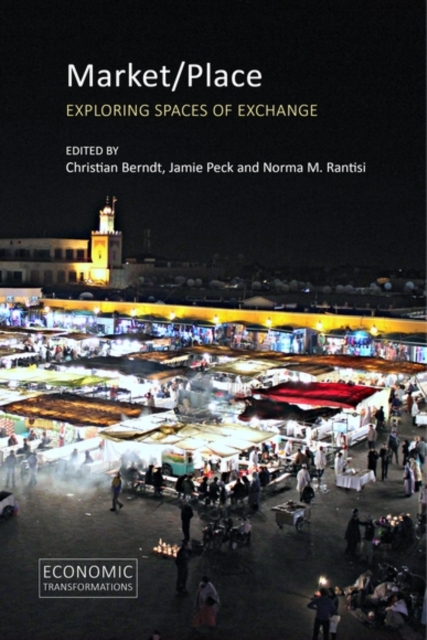
Market/place
The term \"market\" originally portrayed a public space for economic transactions but the term has since evolved into an abstract and disputed idea. Despite modern markets seemingly omnipresent nature, their specific geographies have undergone relatively little analysis. This collection of new essays rediscovers the physical space that markets inhabit and explore how the impact of political, social and economic factors determine the shape of a particular market space. The essays present new research from the fields of geography, economics, political economy and planning and provide valuable case study material to show how markets are contested, constructed and placed. Rather than separate markets from the surrounding society and state, these essays connect markets to their wider context and showcase how economic geography can combine with other disciplines to throw new light on spaces of exchange.
eBook
Circus in Action: Exploring the Role of a Translation Zone in the C irque du S oleil's Creative Practices
This article explores the process of knowledge production and creativity in the circus. In particular, it examines how the C irque du Soleil has been able to forge an innovative and novel tradition of circus arts by drawing upon knowledge and competencies from the related fields of sport, circus, dance, and theater. Using the notion of translation developed in actor network theory, we trace how a variety of actors and entities, including both human and nonhuman actants, are enrolled in the creation of a contemporary circus performance. We explore how power and agency are distributed in the networks that foster creativity in the circus, highlighting their inherently unstable and precarious nature, and how the C irque has created an open and unbounded space that accommodates fluid exchanges between actants (what we call a translation zone).
Journal Article