
Catalogue Search | MBRL


Are you sure you want to remove the book from the shelf?

{{itemTitle}}
23
result(s) for
"Rascaroli, Laura"
Sort by:


The Essay Film: Problems, Definitions, Textual Commitments
According to Giannetti, for instance, \"an essay is neither fiction nor fact, but a personal investigation involving both the passion and intellect of the author. According to Adorno, \"the essay's innermost formal law is heresy\"5; for Lukács, the essay must manufacture the conditions of its own existence: \"the essay has to create from within itself all the preconditions for the effectiveness and solidity of its vision. \"20 In 1948, in the context of his key reflection on the cinema's ability to express ideas, Astruc had already mentioned Eisenstein's project of illustrating Marx's Capital, but did not regard it as an example of the new type of cinema he announced.21 Noël Burch, writing on the essay film in 1961, also mentioned another early, unrealized project, Jacques Feyder's idea of a film based on Montaigne's essays.22 The first contribution explicitly devoted to the essay film is probably Hans Richter's \"Der Filmessay, Eine neue Form des Dokumentarfilms,\" which was published on 24 April 1940 in Nationalzeitung.23 In his article, Richter (himself often listed as an author of essay films) announces a new type of intellectual but also emotional cinema, able to provide \"images for mental notions\" and to \"portray a concept.\" Pierre Sorlin recalls how already a 1940 law of the Vichy government boosted the production of nonfiction in France, with an increase from 400 documentaries made during the German occupation to 4,000 made between 1945 and 1955.37 Catherine Lupton observes that France experienced a decade in which short filmmaking flourished after the introduction in 1955 of a new system of grants which, together with the work of such sympathetic producers as Anatole Dauman (Argos Films) and Pierre Braunberger (Les Films de la Pléiade), favored the debuts of many young directors in a situation of increased creative freedom.38 Bazin himself, in his above-mentioned piece on Marker, stressed how short filmmaking was at the time \"the liveliest fringe of French cinema.
Journal Article


Amateur filmmaking : the home movie, the archive, the web
\"With the advent of digital filmmaking and critical recognition of the relevance of self expression, first-person narratives, and personal practices of memorialization, interest in the amateur moving image has never been stronger. Bringing together key scholars in the field, and revealing the rich variety of amateur filmmaking--from home movies of Imperial India and film diaries of life in contemporary China, to the work of leading auteurs such as Joseph Morder and Peter Forgacs--Amateur Filmmaking highlights the importance of amateur cinema as a core object of critical interest across an array of disciplines. With contributions on the role of the archive, on YouTube, and on the impact of new technologies on amateur filmmaking, these essays offer the first comprehensive examination of this growing field\"-- Provided by publisher.
Book
Burning Passions, Flammable Decade: Cinema, Avant-Garde, Self, and Society in \Fire in the Water\ (1977)
Both become somehow trapped in their own form of vision- in the course of the narrative, it becomes increasingly evident that the man's project of producing a summa of his own work and a reading of the previous de cade through images is an impossible task; and the woman becomes literally entrapped in her progressively dark communion with nature, at the risk of losing her life.8 Furthermore, as is obvious, the two characters are not true to life, but are evidently meta phorical; they are alchemical symbols in a film infused with the four elements of earth, air, fire, and water; Jungian archetypes of male Anima and female Animus and, ultimately, two sides of the creator of the film himself, who is the true subject of the film- a split self in search of his own unity. [...]Peter Whitehead is the (in)visible persona that operates the alchemical merger of the two souls of the film.9 Fire in the Water does not work only according to binaries and dualisms; circularity and repetition are also structuring presences, as is immediately suggested by the Brechtian quote that opens the film- the idea that civilizations are destined to disappear is suggestive of the cycles of history. Whitehead's position here is not participative and celebratory but historical and critical; indeed, his alter ego (or, better, half of his alter ego), the filmmaker in the film, is presented to us not while directing and shooting, but while editing and manipulating images. [...]the filmmaker is at a remove from his own images, as well as from the events he has filmed. Some of the earlier footage incorporated into Fire in the Water, for instance, is taken from a film of When I Was Young, an Eric Burdon and The Animals single, shot by Whitehead on commission in 1967 for Top of the Pops; the film includes images of The Animals playing in a studio, as well as shots of warplanes taken from a discarded film can containing 16 mm footage from The Battle for Britain that Whitehead found by chance in a dumpster in Soho, and images of a documentary on Hitler that he filmed impromptu from the TV screen.15 By intercutting the found footage and the musicians' per formance, Whitehead was pushing the limits of the medium's generic conventions- he was creating that new, hybrid genre that is the pop promo, as well as prefiguring a novel form in between promotion and art, the music video; he was also emphasizing and facilitating the potential of the rock per for mance to move well beyond the stage and the record and to generate a strong visual impact on pop u lar culture and certainly on society. The same applies to po liti cal events captured impromptu by Whitehead's documentary/ participative lens, including images of demonstrations both in favor of and against the Vietnam War, of Robert Kennedy talking to a crowd, of the memorial ser vice for Martin Luther King Jr., of the arsons of the black quarters of Newark, New Jersey, and of the violent repression of the student protests at Columbia University.
Journal Article

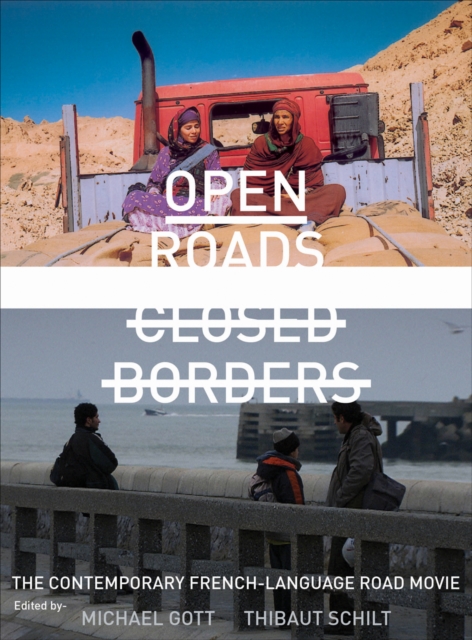
Open roads, closed borders
Open Roads, Closed Borders is the first collection of essays about French-language road movies, a particularly rich yet critically neglected cinematic category. These films, the contributors argue, offer important perspectives on contemporary French ideas about national identity, France's former colonies, Europe and the rest of the world. Taken together, the essays illustrate how travel and road motifs have enabled directors of various national origins and backgrounds to reimagine space and move beyond simple oppositions such as Islam and secularism, local and global, home and away, France and Africa and East and West.
eBook
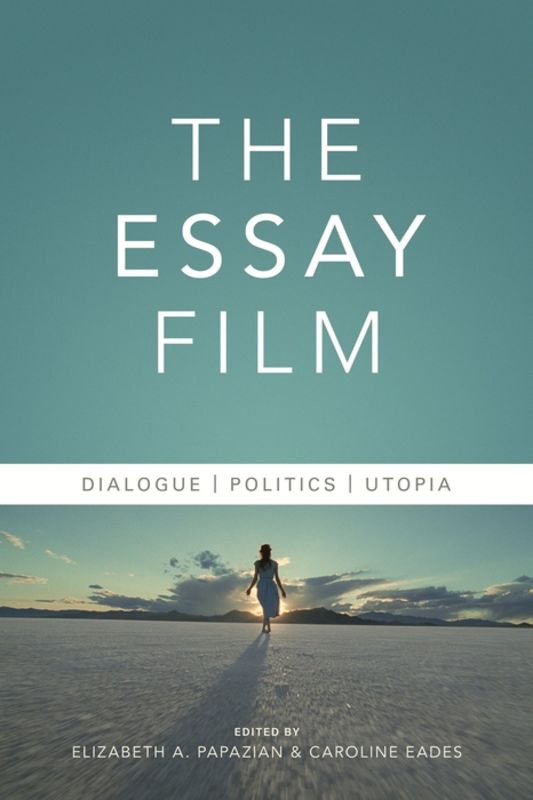
The essay film
With its increasing presence in a continuously evolving media environment, the essay film as a visual form raises new questions about the construction of the subject, its relationship to the world, and the aesthetic possibilities of cinema. In this volume, authors specializing in various national cinemas (Cuban, French, German, Israeli, Italian, Lebanese, Polish, Russian, American) and critical approaches (historical, aesthetic, postcolonial, feminist, philosophical) explore the essay film and its consequences for the theory of cinema while building on and challenging existing theories. Taking.
eBook