
Catalogue Search | MBRL


Are you sure you want to remove the book from the shelf?

{{itemTitle}}
575
result(s) for
"Rausser, Gordon C"
Sort by:

Political power and economic policy : theory, analysis, and empirical applications
\"This book analyzes the links between political economics, governance structures and the distribution of political power in economic policy making. The book theoretically explains and empirically quantifies these interactions. The analysis includes both public good policies and redistributive policies. Part I of the book presents the conceptual foundations of political-economic bargaining and interest group analysis. After presenting the underlying theory, Part II of the book examines ideology, prescription and political power coefficients; Part III analyzes a number of specific structures; and Part IV presents a framework for political econometrics with a number of empirical applications and testable hypotheses. In all four parts of the book, four analytical dimensions of public policy are distinguished: governance structures, political economy, mechanism design and incidence\"--Provided by publisher.
Book

Commodity Storage and the Market Effects of Biofuel Policies
Legislation passed in 2007 by the U.S. Congress increased by about 1.3 billion bushels the net amount of corn required to be processed annually into ethanol for motor-fuel use. We estimate that corn prices were about 30% higher from 2006 to 2014 than they would have been without this demand increase. We develop a partially identified structural vector autoregression model. Our identification strategy is unique in the literature because it enables us to estimate the effects of transitory shocks, such as weather, separately from the effects of persistent shocks, such as the increased ethanol mandate. Moreover, by only partially identifying our model, we show how to generate robust conclusions without strong identifying assumptions.
Journal Article
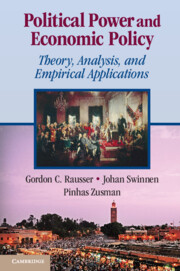
Political Power and Economic Policy
This book analyzes the links between political economics, governance structures and the distribution of political power in economic policy making. The book theoretically explains and empirically quantifies these interactions. The analysis includes both public good policies and redistributive policies. Part I of the book presents the conceptual foundations of political-economic bargaining and interest group analysis. After presenting the underlying theory, Part II of the book examines ideology, prescription and political power coefficients; Part III analyzes a number of specific structures; and Part IV presents a framework for political econometrics with a number of empirical applications and testable hypotheses. In all four parts of the book, four analytical dimensions of public policy are distinguished: governance structures, political economy, mechanism design and incidence.
eBook

Valuing Research leads: Bioprospecting and the Conservation of Genetic Resources
Bioprospecting has been touted as a source of finance for biodiversity conservation. Recent work has suggested that the bioprospecting value of the “marginal unit” of genetic resources is likely to be vanishingly small, creating essentially no conservation incentive. This result is shown to flow specifically from a stylized description of the research process as one of brute‐force testing, unaided by an organizing scientific framework. Scientific models channel research effort toward leads for which the expected productivity of discoveries is highest. Leads of unusual promise then command information rents, associated with their role in reducing the costs of search. When genetic materials are abundant, information rents are virtually unaffected by increases in the profitability of product discovery and decline as technology improvements lower search costs. Numerical simulation results suggest that, under plausible conditions, the bioprospecting value of certain genetic resources could be large enough to support market‐based conservation of biodiversity.
Journal Article

Ownership and Control in Mexico’s Community Forestry Sector
Ownership and control are rarely synonymous. This article examines the factors motivating Mexican agrarian communities with forests to participate and invest in timber production activities, an opportunity that has opened in the past 20 years due to changes in Mexican forestry policy. We propose that contractual difficulties with downstream production services and buyers led community members to forward integrate into the wood production industry to enjoy greater benefits from production. An incomplete contracting model frames our analysis while original community‐level data from Oaxaca, Mexico, serves as the basis for empirical quantification. Using measures of specificity of investments, uncertainty, multiple uses of the forest, and managerial and labor expertise, it is found that communities with higher levels of human, social, and resource capital endowments are more likely to integrate forward into timber‐processing activities.
Journal Article

Commodity Booms and Busts
Periodically, the global economy experiences great commodity booms and busts, characterized by a broad and sharp comovement of commodity prices. There have been two such episodes since the Korean War. The first event peaked in 1974 and the second in 2008, 34 years apart. Both created major economic and political shocks, including fallen governments and human suffering due to high food prices. Each occurrence raised serious concerns over food and energy security and led to more government intervention in the commodity markets. Although there is no simple explanation for what causes such complex events, they do share similar characteristics. We find at the core of these cycles a set of contemporaneous supply and demand surprises that coincided with low inventories and that were magnified by macroeconomic shocks and policy responses. In the next few decades, the world faces the prospect of continued increases in the demand for commodities and greater uncertainty about supply. However, because market participants are likely to respond by increasing inventory holdings and investing in new technologies, we see no reason to expect an increase in the frequency of dramatic commodity booms and busts.
Journal Article

Rational exaggeration and counter-exaggeration in information aggregation games
We study an information aggregation game in which each of a finite collection of \"senders\" receives a private signal and submits a report to the center, who then makes a decision based on the average of these reports. The integration of three features distinguishes our framework from the related literature: players' reports are aggregated by a mechanistic averaging rule, their strategy sets are intervals rather than binary choices, and they are ex ante heterogeneous. In this setting, players engage in a \"tug-of-war,\" as they exaggerate and counter-exaggerate in order to manipulate the center's decision. While incentives to exaggerate have been studied extensively, the phenomenon of counter-exaggeration is less well understood. Our main results are as follows. First, the cycle of counter-exaggeration can be broken only by the imposition of exogenous bounds on the space of admissible sender reports. Second, in the unique pure-strategy equilibrium, all but at most one player is constrained with positive probability by one of the report bounds. Our third and fourth results hold for a class of \"anchored\" games. We show that if the report space is strictly contained in the signal space, then welfare is increasing in the size of the report space, but if the containment relation is reversed, welfare is independent of the size of the space. Finally, the equilibrium performance of our heterogeneous players can be unambiguously ranked: a player's equilibrium payoff is inversely related to the probability that her exaggeration will be thwarted by the report bounds.
Journal Article
The Role of Patent Rights in Mergers: Consolidation in Plant Biotechnology
Few empirical studies have addressed the impact of the patent system on industry structure. Using firm-level patent data for firms in plant biotechnology, we develop a measure of patent enforceability. Duration models show that patent statistics are useful predictors of the timing of consolidation and that patent enforceability is an important factor influencing the likelihood of consolidation. Acquisitions in plant biotechnology may be motivated by the enforcement of patent rights when firms have overlapping technologies; some merger activity may be explained by attempts to avoid mutually blocking technology, as exemplified by the case of Roundup Ready corn.
Journal Article
Interactions Between Incentive Instruments: Contracts and Quality in Processing Tomatoes
Contracting and other forms of vertical coordination are important parts of the supply chains for many agricultural products. Often the buyer cares about multiple product attributes affected by a grower's actions. Using data that are insulated from common methodological problems, we test whether or not price incentives for two processing tomato quality attributes exhibit complementarity in improving delivered quality. Price incentives for the two attributes are substitutes for the provision of one and complements for the other. This finding has consequences for the profit-maximizing choice of incentive instruments for processors, and contributes to the literature regarding tests for complementarities.
Journal Article