
Catalogue Search | MBRL


Are you sure you want to remove the book from the shelf?

{{itemTitle}}
17
result(s) for
"Ravetz, Amanda"
Sort by:


Drawing with a camera? Ethnographic film and transformative anthropology
Drawing has emerged as a recent focus of anthropological attention. Writers such as Ingold and Taussig have argued for its significance as a special kind of knowledge practice, linking it to a broader re-imagining of the anthropological project itself. Underpinning their approach is an opposition between the pencil and the camera, between 'making' and 'taking', between restrictive and generative modes of inquiry. This essay challenges this assumption, arguing that these elements in drawing and filmmaking exist in a dialectical rather than a polarized relationship. It highlights particular insights that follow from a dialogue between written and film-based anthropologies and links them to broader debates within the discipline - for example, debates about ways of knowing, skilled practice, improvisation and the imagination, and anthropology as a form of image-making practice. Le dessin est un objet d'étude anthropologique d'apparition récente. Ingold et Taussig ont mis en lumière son importance comme pratique de connaissance d'un genre particulier, le liant à une ré-imagination plus large du projet anthropologique lui-même. Leur approche s'appuie sur une opposition entre crayon et caméra, entre « faire » et « prendre », entre modes d'acquisition d'informations restrictifs et génératifs. Notre article remet en cause cette hypothèse en avançant que ces éléments du dessin et du film se situent dans une relation dialectique plutôt que polarisée. Il éclaire des idées particulières nées d'un dialogue entre l'anthropologie écrite et filmée et fait le lien entre ces activités et des débats plus larges au sein de la discipline, par exemple à propos des modes de connaissance, des savoir-faire, de l'improvisation et de l'imagination, ou encore de l'anthropologie comme forme de pratique de la création d'images.
Journal Article

On Reverie, Collaboration, and Recovery
This is a meditation on reverie and collaboration in the context of recovery: recovery from substance misuse, but also in its much broader sense, recovering the connection between thinking and feeling. It highlights tensions that can be encountered when feeling constrained by perceptions of disciplinary norms, as well as the rewards of working through thought processes in connection with visual expression. Several narrative moments of my own journey are presented, emphasizing the depth of time it can take to realize ways of becoming writers, artists, anthropologists, people. Coming to know is a long-term commitment, with previous experiences feeding into present and future collaborations. A desire to combine anthropological and artistic thinking and imagination is expressed, and images and words are brought together to ask how this desire can infuse research with and into recovery. At the heart of the essay I recount an arts and health project, Wonderland: the art of becoming human in which trust and vulnerability, together with solidarity and gratitude, helped with the digestion of experiences of addiction and recovery. Reverie and collaboration are conceptualized less as a set of techniques and more as a call to disciplines to intersect at crucial points, or, inspired by intimations of \"things in themselves,\" to suspend categorical boundaries.
Journal Article
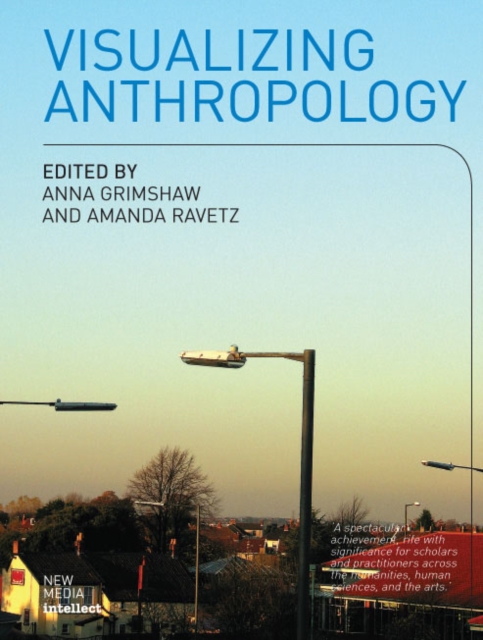
Visualizing anthropology
Questions of vision and knowledge are central to debates about the world in which we live. Developing new analytical approaches toward ways of seeing is a key challenge facing those working across a wide range of disciplines. This text maps experiments in the forms and techniques of visual enquiry.
eBook

Visualizing Anthropology
Questions of vision and knowledge are central to debates about the world in which we live. Developing new analytical approaches toward ways of seeing is a key challenge facing those working across a wide range of disciplines. How can visuality be understood on its own terms rather than by means of established textual frameworks? Visualizing Anthropology takes up this challenge. Bringing together a range of perspectives anchored in practice, the book maps experiments in the forms and techniques of visual enquiry. The origins of this collection lie in visual anthropology. Although the field has greatly expanded and diversified, many of the key debates continue to be focused around the textual concerns of the mainstream discipline. In seeking to establish a more genuinely visual anthropology, the editors have sought to forge links with other kinds of image-based projects. Ethnography is the shared space of practice. Understood not as a specialized method but as cultural critique, the book explores new collaborative possibilities linked to image-based work.
eBook

Flowerman
I am engaged in a project about reverie, using poetics and storytelling as my method. Where does one person’s reverie start and another’s end? What uses might anthropology have for reverie? Taking the form of a braided narrative, Flowerman, meshes my voice with others to explore the entanglements of reverie, its fundamental inter-subjectivity. But rather than call this autobiography or autoethnography, I regard it as a form of inter-subjective practice-led research, aimed at shared understanding. To speak of practice-led research is to evoke the precepts of artistic research as much as those of anthropology. Artistic research does not imagine a separation between knowledge production, and making processes. The insights yielded here through making, and reflection on making, are folded back into the practices of storytelling.
Journal Article
Rethinking observational cinema
Observational cinema' has long been central to debates in visual anthropology. Although initially hailed as a radical breakthrough in ethnographic filmmaking, the genre was subsequently criticized as naively empiricist and lacking in reflexive sophistication. In this article, we make a new case for observational cinema. It grows out of a renewed attention to practice. We argue that observational work be understood not as preliminary to anthropological proper but as a distinctive form of anthropology in its own right. /// Le \"cinéma d'observation\" est depuis longtemps un sujet de controverse dans l'anthropologie visuelle. Salué à ses débuts comme une révolution dans l'acquisition d'images ethnographiques, le genre a été critiqué par la suite comme entaché d'un empirisme naïf et dépourvu d'élaboration reflexive. Les auteures plaident ici pour le cinéma d'observation, à partir d'une attention renouvelée pour cette pratique. Elles demandent que le travail d'observation soit considéré non pas comme un préliminaire au travail anthropologique proprement dit, mais comme une forme distincte d'anthropologie à part entière.
Journal Article
