
Catalogue Search | MBRL


Are you sure you want to remove the book from the shelf?

{{itemTitle}}
264
result(s) for
"Rawson, Claude"
Sort by:

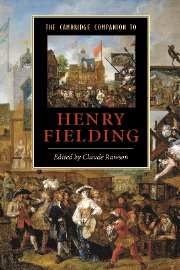
The Cambridge Companion to Henry Fielding
Now best known for three great novels - Tom Jones, Joseph Andrews and Amelia - Henry Fielding (1707–1754) was one of the most controversial figures of his time. Prominent first as a playwright, then as a novelist and political journalist, and finally as a justice of peace, Fielding made a substantial contribution to eighteenth-century culture, and was hugely influential in the development of the novel as a form, both in Britain and more widely in Europe. This collection of specially-commissioned essays by leading scholars describes and analyses the many facets of Fielding's work in theatre, fiction, journalism and politics. In addition it assesses his unique contribution to the rise of the novel as the dominant literary form, the development of the law, and the political and literary culture of eighteenth-century Britain. Including a Chronology and Guide to Further Reading, this volume offers a comprehensive account of Fielding's life and work.
eBook

The Cambridge companion to English poets
\"This volume provides lively and authoritative introductions to twenty-nine of the most important British and Irish poets from Geoffrey Chaucer to Philip Larkin. The list includes, among others, Shakespeare, Donne, Milton, Wordsworth, Browning, Yeats and T. S. Eliot, and represents the tradition of English poetry at its best. Each contributor offers a new assessment of a single poet's achievement and importance, with readings of the most important poems. The essays, written by leading experts, are personal responses, written in clear, vivid language, free of academic jargon, and aim to inform, arouse interest, and deepen understanding\"-- Provided by publisher.
BOOK
Dryden, Pope, Johnson, Malone
Great Shakespeareans offers a systematic account of those figures who have had the greatest influence on the interpretation, understanding and cultural reception of Shakespeare, both nationally and internationally. In this volume, leading scholars assess the contribution of Alexander Pope, John Dryden, Samuel Johnson and Edmond Malone to the afterlife and reception of Shakespeare and his plays. Each substantial contribution assesses the double impact of Shakespeare on the figure covered and of the figure on the understanding, interpretation and appreciation of Shakespeare, provide a sketch of their subject's intellectual and professional biography and an account of the wider cultural context, including comparison with other figures or works within the same field.
eBook

Swift's angers
\"Jonathan Swift's angers were all too real, though Swift was temperamentally equivocal about their display. Even in his most brilliant satire, A Tale of a Tub, the aggressive vitality of the narrative is designed, for all the intensity of its sting, never to lose its cool. Yet Swift's angers are partly self-implicating, since his own temperament was close to the things he attacked, and behind his angers are deep self-divisions. Though he regarded himself as 'English' and despised the Irish 'natives' over whom the English ruled, Swift became the hero of an Irish independence he would not have desired. In this magisterial account, Claude Rawson, widely considered the leading Swift scholar of our time, brings together recent work, as well as classic earlier discussions extensively revised, offering fresh insights into Swift's bleak view of human nature, his brilliant wit, and the indignations and self-divisions of his writings and political activism\"-- Provided by publisher.
BOOK
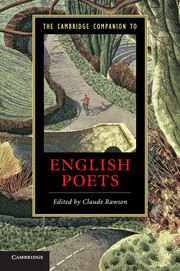
The Cambridge Companion to English Poets
This volume provides lively and authoritative introductions to twenty-nine of the most important British and Irish poets from Geoffrey Chaucer to Philip Larkin. The list includes, among others, Shakespeare, Donne, Milton, Wordsworth, Browning, Yeats and T. S. Eliot, and represents the tradition of English poetry at its best. Each contributor offers a new assessment of a single poet's achievement and importance, with readings of the most important poems. The essays, written by leading experts, are personal responses, written in clear, vivid language, free of academic jargon, and aim to inform, arouse interest, and deepen understanding.
eBook

Dryden, Pope, Johnson, Malone
Great Shakespeareans offers a systematic account of those figures who have had the greatest influence on the interpretation, understanding and cultural reception of Shakespeare, both nationally and internationally. In this volume, leading scholars assess the contribution of Alexander Pope, John Dryden, Samuel Johnson and Edmond Malone to the afterlife and reception of Shakespeare and his plays. Each substantial contribution assesses the double impact of Shakespeare on the figure covered and of the figure on the understanding, interpretation and appreciation of Shakespeare, provide a sketch of their subject’s intellectual and professional biography and an account of the wider cultural context, including comparison with other figures or works within the same field.
eBook

Gulliver, Travel, and Empire
In his article \"Gulliver, Travel, and Empire\" Claude Rawson analyzes Jonathan Swift's Gulliver's Travels as a central document of European intellectual history. Rawson focuses on the relationship between ethnicity and human identity asking what constitutes humanity and how individual groups qualify (or not) for human status. Posing as a \"parody\" of travel books, Rawson's article is both a series of voyages and an ethnically widening arc of moral exploration as Swift's Book Four at once expresses an ambivalent perception of the Irish under English rule and extends to what Swift/Gulliver calls \"all Savage Nations\" and ultimately takes in what Swift described in a letter as \"that Animal called Man.\"
Journal Article

Recent Studies in the Restoration and Eighteenth Century
An assessment of recent scholarly work treating the literature of the Restoration and Eighteenth Century and some general observations on the state of the profession. A full bibliography and price list of the works received by SEL for consideration follow.
Journal Article

WAR AND THE EPIC MANIA IN ENGLAND AND FRANCE: MILTON, BOILEAU, PRIOR AND ENGLISH MOCK-HEROIC
The final version of Paradise Lost and the first version of Boileau's Lutrin appeared within a few days of each other in July 1674, one of the unsung coincidences of literary history. Both mark a turning point in the literary history of grand styles and of anti-war feeling in Europe. The last great classical epic, and the first poem in a high mock-heroic genre, share an avoidance of the central epic theme of military carnage, which Milton disavowed explicitly and Boileau and his English mock-heroic followers replaced with non-deadly combats. Milton's anti-militarism was not shared by Boileau, however, perhaps reflecting national differences, and the genre of the mock-heroic poem, in the sense in which Boileau may be thought to have invented it, became a mainly English phenomenon (in the hands of Garth, Swift and Pope), not practised at the highest level by French poets. The article concludes with a discussion of the poetic and patriotic confrontations of Boileau by Matthew Prior.
Journal Article