
Catalogue Search | MBRL


Are you sure you want to remove the book from the shelf?

{{itemTitle}}
38
result(s) for
"Ray, Sarah Jaquette"
Sort by:


ecological other
With roots in eugenics and other social-control programs, modern
American environmentalism is not always as progressive as we would
like to think. In The Ecological Other , Sarah Jaquette Ray
examines the ways in which environmentalism can create social
injustice through discourses of the body. Ray investigates three
categories of ecological otherness: people with disabilities,
immigrants, and Native Americans. Extending recent work in
environmental justice ecocriticism, Ray argues that the expression
of environmental disgust toward certain kinds of bodies draws
problematic lines between ecological \"subjects\"-those who are good
for and belong in nature-and ecological \"others\"-those who are
threats to or out of place in nature. Ultimately, The
Ecological Other urges us to be more critical of how we use
nature as a tool of social control and to be careful about the ways
in which we construct our arguments to ensure its protection. The
book challenges long-standing assumptions in environmentalism and
will be of interest to those in environmental literature and
history, American studies, disability studies, and Native American
studies, as well as anyone concerned with issues of environmental
justice.
eBook

Critical norths : space, nature, theory
\"For millennia, \"the North\" has held a powerful sway in Western culture. Long seen through contradictions--empty of life yet full of promise, populated by indigenous communities yet ripe for conquest, pristine yet marked by a long human history--it has moved to the foreground of contemporary life as the most dramatic stage for the reality of climate change. This book brings together scholars from a range of disciplines to ask key questions about the North and how we've conceived it--and how conceiving of it in those terms has caused us to fail the region's human and nonhuman life. Engaging questions of space, place, indigeneity, identity, nature, the environment, justice, narrative, history, and more, it offers a crucial starting point for an essential rethinking of both the idea and the reality of the North\"-- Provided by publisher.
BOOK

Disability Studies and the Environmental Humanities
Although scholars in the environmental humanities have been exploring the dichotomy between \"wild\" and \"built\" environments for several years, few have focused on the field of disability studies, a discipline that enlists the contingency between environments and bodies as a foundation of its scholarship. On the other hand, scholars in disability studies have demonstrated the ways in which the built environment privileges some bodies and minds over others, yet they have rarely examined the ways in which toxic environments engender chronic illness and disability or how environmental illnesses disrupt dominant paradigms for scrutinizing \"disability.\"Designed as a reader for undergraduate and graduate courses,Disability Studies and the Environmental Humanitiesemploys interdisciplinary perspectives to examine such issues as slow violence, imperialism, race, toxicity, eco-sickness, the body in environmental justice, ableism, and other topics. With a historical scope spanning the seventeenth century to the present, this collection not only presents the foundational documents informing this intersection of fields but also showcases the most current work, making it an indispensable reference.
eBook

Disability studies and the environmental humanities : toward an eco-crip theory
\"Although scholars in the environmental humanities have been exploring the dichotomy between \"wild\" and \"built\" environments for several years, few have focused on the field of disability studies, a discipline that enlists the contingency between environments and bodies as a foundation of its scholarship. On the other hand, scholars in disability studies have demonstrated the ways in which the built environment privileges some bodies and minds over others, yet they have rarely examined the ways in which toxic environments engender chronic illness and disability or how environmental illnesses disrupt dominant paradigms for scrutinizing disability\"--amazon.com
Book
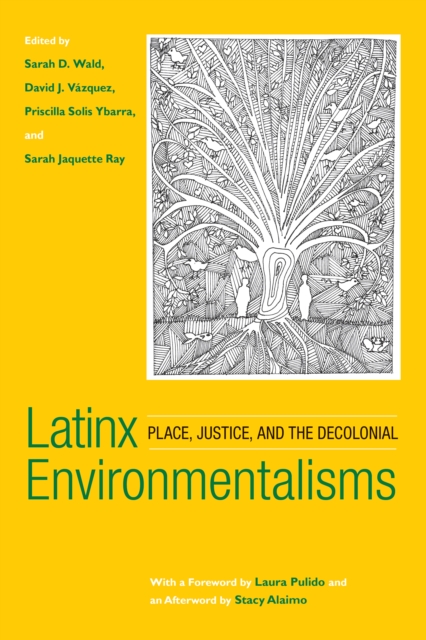
Latinx Environmentalisms
The whiteness of mainstream environmentalism often fails to account for the richness and variety of Latinx environmental thought. Building on insights of environmental justice scholarship as well as critical race and ethnic studies, the editors and contributors to Latinx Environmentalisms map the ways Latinx cultural texts integrate environmental concerns with questions of social and political justice.
Original interviews with creative writers, including Cherríe Moraga, Helena María Viramontes, and Héctor Tobar, as well as new essays by noted scholars of Latinx literature and culture, show how Latinx authors and cultural producers express environmental concerns in their work. These chapters, which focus on film, visual art, and literature—and engage in fields such as disability studies, animal studies, and queer studies—emphasize the role of racial capitalism in shaping human relationships to the more-than-human world and reveal a vibrant tradition of Latinx decolonial environmentalism.
Latinx Environmentalisms accounts for the ways Latinx cultures are environmental, but often do not assume the mantle of \"environmentalism.\"
eBook


Can a Green University Serve Underrepresented Students?: Reconciling Sustainability and Diversity at HSU
In a speech delivered as part of the Sustainable Future Speaker Series on Nov. 12, 2015, Sarah Jaquette Ray, faculty at Humboldt State University (HSU), talked about the potential of a green university to serve underrepresented students and reconciling sustainability and diversity at HSU. She discussed the two goals of the social and environmental responsibility, of sustainability and diversity, to use language from its recent Strategic Plan which seem to exist in happy harmony. She argued that HSU's green university failed to account for the ways in which its very green-ness works against social justice, impacting underrepresented students to thrive.
Journal Article