
Catalogue Search | MBRL


Are you sure you want to remove the book from the shelf?

{{itemTitle}}
78
result(s) for
"Reich, Rob"
Sort by:


Philanthropy and Caring for the Needs of Strangers
People have been giving away their money, property, and time to others for millennia. What's novel about the contemporary practice of philanthropy is the availability of tax incentives to give money away. Such incentives are built into tax systems in nearly all developed and many developing democracies. In this sense, philanthropy is not an invention of the state but ought to be viewed today as an artifact of the state. This paper specifies and assesses three possible justifications for the existence of tax incentives for charitable giving, identifies a distinctive role for philanthropy in democracies, and argues for a fundamental redesign of the current legal framework governing philanthropy. Empirically, giving to assist the needy and care for strangers is an uncommon form of giving in the United States. Normatively, it is but one potential justification for philanthropy.
Journal Article
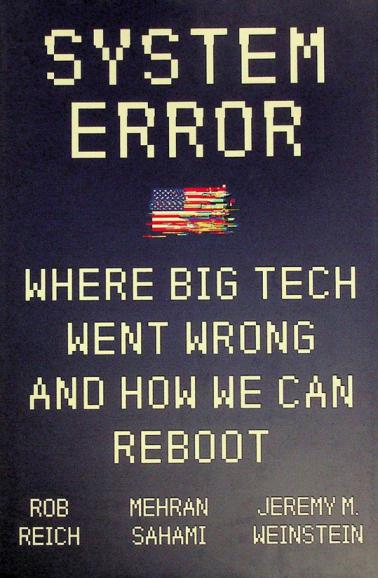
System error : where big tech went wrong and how we can reboot
A forward-thinking manifesto from three Stanford professors--experts who have worked at ground zero of the tech revolution for decades--which reveals how big tech's obsession with optimization and efficiency has sacrificed fundamental human values and outlines steps we can take to change course, renew our democracy, and save ourselves.
Book

Repugnant to the Whole Idea of Democracy? On the Role of Foundations in Democratic Societies
This article focuses on a particular and peculiar philanthropic entity: the private foundation. Analogues of the contemporary philanthropic foundation can be found in antiquity, when endowments funded the creation and sustenance of public monuments and educational institutions, including Plato's Academy. However, the modern grant-making foundation in which private assets are set aside in a perpetual, donor-directed, tax-advantaged endowment with a fraction of the assets distributed annually for a public purpose is a recent institutional form, distinctly American, and no older than the early 20th century. By definition, it is a plutocratic entity representing the legal permission--indeed, tax-subsidized invitation--for large wealth to play a consequential role in public life. What could confer legitimacy on such an entity in a democratic society?
Journal Article

Philanthropy and Caring for the Needs of Strangers
It is often said that Americans are the world's most generous citizens. The claim is based upon the large amount of money given away every year by Americans, approximately $315 billion in 2012, a figure that, except during recessions, has risen more or less constantly for the past 40 years. Philanthropy appears to be more about the pursuit of one's own projects, a mechanism for the expression of one's values or preferences rather than a mechanism for redistribution or relief for the poor. Social scientists have studied the empirical landscape of charity in the US with some care, but relatively little has been written about fundamental normative questions concerning the purpose of charitable giving in democratic societies. It is useful to recall that the practice of philanthropy is ancient. What is novel about the contemporary practice of philanthropy is the availability of tax incentives. Adapted from the source document.
Journal Article

Trust, Transparency, and Replication in Political Science
Striving better to uncover causal effects, political science is amid a revolution in micro-empirical research designs and experimental methods. This methodological development—although quite promising in delivering new findings and discovering the mechanisms that underlie previously known associations—raises new and unnerving ethical issues that have yet to be confronted by our profession. We believe that addressing these issues proactively by generating strong, internal norms of disciplinary regulation is preferable to reactive measures, which often come in the wake of public exposés and can lead to externally imposed regulations or centrally imposed internal policing.
Journal Article

ON REGULATING HOMESCHOOLING: A REPLY TO GLANZER
I welcome Perry Glanzer's thoughtful essay, which discusses my 2002 book Bridging Liberalism and Multiculturalism in American Education and criticizes portions of my analysis there of homeschooling. Glanzer provides a helpful and fair gloss of some of the main theoretical claims I make in the book concerning the nature of the interests at stake in educating children and the importance of educating for autonomy.
Journal Article