
Catalogue Search | MBRL


Are you sure you want to remove the book from the shelf?

{{itemTitle}}
147
result(s) for
"Reiss, Benjamin"
Sort by:

Wild nights : how taming sleep created our restless world
\"Humans have slept since the dawn of our species. And yet the way humans sleep across history has changed dramatically, most disastrously in our own modern era. For the last two centuries sleep, the industrialized West has reduced sleep to one narrow definition: hours of unbroken slumber, in a private chamber, alone or with at most one additional partner. And this artificial cultural definition is now spreading around the world. We've gained much from this sleeping revolution--privacy and security and independence--but along the way added a whole new host of problems: the explosion of sleep disorders, sleep anxieties, and life-style diseases connected to exhaustion and sleeplessness; the devastating rise in addiction to both sleeping pills and caffeine; the nightmarish nightly-battles faced by parents enforcing artificial 'bed times' for children. Our modern world may be founded on taming sleep; and yet our collective exhaustion reveals the extraordinary costs we've all paid\"-- Provided by publisher.
Book

From Wonder to Anger: Rethinking The Showman and the Slave Through Standpoint Theory
Wonder exalts its object. Can it also degrade? This question was a central interpretive tension guiding the author’s archival research and analysis when he set out to write his first book almost 30 years ago, about a 19th-century woman who was simultaneously degraded—for her race, her disability, her old age, and her enslavement—and lionized for the stories she had to tell and for the symbolism of her very existence. The author reflects on how his fascination with the story he was recovering in the archives reflected his “positionality,” or the ways in which his social identity shaped his understanding. A reading of a recent collection of poems by Bettina Judd reimagining the same story helped clarify both what his own standpoint allowed him to see, and what he missed.
Journal Article

Keywords for disability studies
\"Keywords for Disability Studies aims to broaden and define the conceptual framework of disability studies for readers and practitioners in the field and beyond. The volume engages some of the most pressing debates of our time, such as prenatal testing, euthanasia, accessibility in public transportation and the workplace, post-traumatic stress, and questions about the beginning and end of life.\"--Front cover flap.
Book
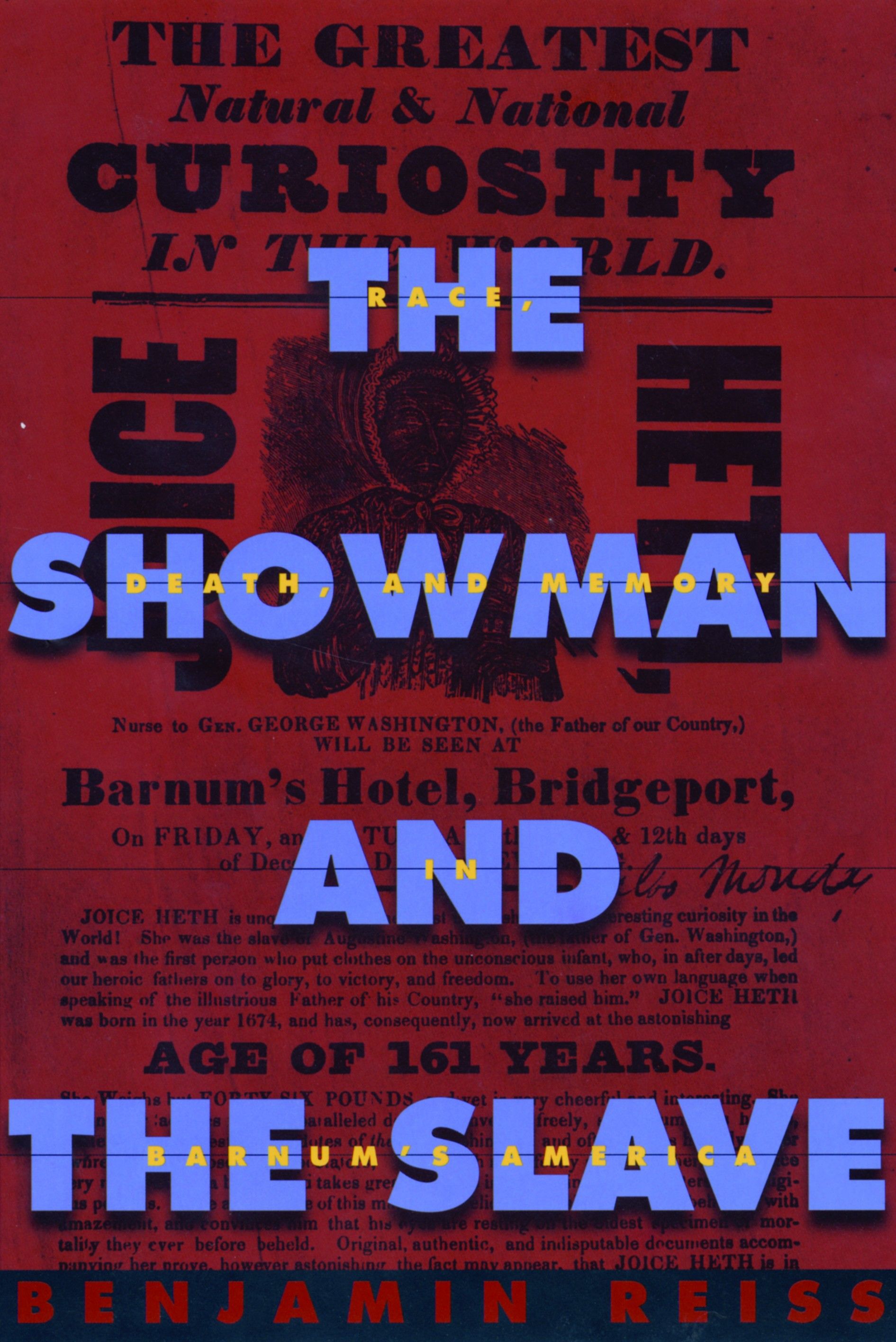

The Showman and the Slave
Reiss uses P. T. Barnum's Joice Heth hoax to examine the contours of race relations in the antebellum North. Barnum's first exhibit as a showman, Heth was an elderly enslaved woman said to be the 161-year-old former nurse of the infant George Washington. Seizing upon the novelty, the newly emerging commercial press turned her act--and especially her death--into one of the first media spectacles in American history.
eBook

The showman and the slave : race, death, and memory in Barnum's America
Reiss uses P. T. Barnum's Joice Heth hoax to examine the race relations in the antebellum North. Barnum's first exhibit as a showman, Heth was an enslaved woman said to be the 161-year-old former nurse of the infant George Washington. The newly emerging commercial press turned her act into one of the first media spectacles in American history.
eBook


Reviews
Reason - A Black Cat\" all circle around the problem of automatic responses to external stimuli, responses that in the extreme undercut the foundational democratic assumption that humans are capable of governing themselves. Yet Stowe's depiction of a highly charismatic, religiously inspired rebel slave both accepts the diagnostic framework of nervous disorder and suggests that his neurological predisposition toward trance states can indeed be a vehicle for genuine clairvoyance and prophecy. More intriguing are Murison's claims that the new cognitive approaches share with historicist approaches a desire to ground subjective literary readings in hard-and-fast evidence; she favors instead a \"surface\" reading for cultural pattern that does not count as \"evidence\" of something else.
Journal Article