
Catalogue Search | MBRL


Are you sure you want to remove the book from the shelf?

{{itemTitle}}
6
result(s) for
"Rhode, Paul Webb"
Sort by:


Biological Innovation without Intellectual Property Rights: Cottonseed Markets in the Antebellum American South
The Antebellum American South experienced rapid biological innovation centered around an active market for new cotton seed varieties, despite the absence of intellectual property rights. Contemporaries complained new seed was initially offered at high prices, which subsequently collapsed. Using local newspaper evidence, this paper documents this market’s operation. It then rationalizes the price movements given the potential of improved seed to multiply at finite rates. The initial prices were sufficiently high to provide meaningful incentives to innovate. This study also identifies information problems affecting the cotton seed market, leading observers to claim too many new varieties were released, not too few.
Journal Article
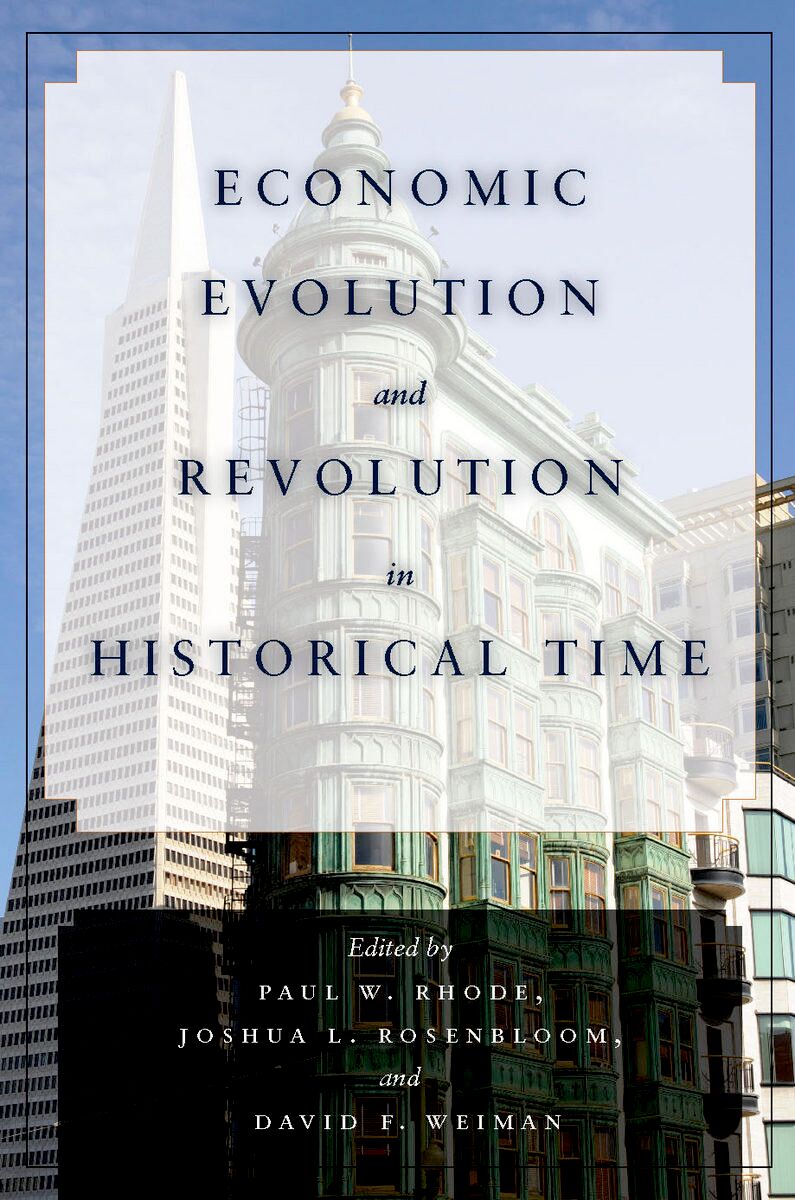
Economic Evolution and Revolution in Historical Time
This book challenges the static, ahistorical models on which Economics continues to rely. These models presume that markets operate on a \"frictionless\" plane where abstract forces play out independent of their institutional and spatial contexts, and of the influences of the past. In reality, at any point in time exogenous factors are themselves outcomes of complex historical processes. They are shaped by institutional and spatial contexts, which are \"carriers of history,\" including past economic dynamics and market outcomes. To examine the connections between gradual, evolutionary change and more dramatic, revolutionary shifts the text takes on a wide array of historically salient economic questions—ranging from how formative, European encounters reconfigured the political economies of indigenous populations in Africa, the Americas, and Australia to how the rise and fall of the New Deal order reconfigured labor market institutions and outcomes in the twentieth century United States. These explorations are joined by a common focus on formative institutions, spatial structures, and market processes. Through historically informed economic analyses, contributors recognize the myriad interdependencies among these three frames, as well as their distinct logics and temporal rhythms.
eBook

Economic Evolution and Revolution in Historical Time
This book challenges the static, ahistorical models on which Economics continues to rely. These models presume that markets operate on a \"frictionless\" plane where abstract forces play out independent of their institutional and spatial contexts, and of the influences of the past. In reality, at any point in time exogenous factors are themselves outcomes of complex historical processes. They are shaped by institutional and spatial contexts, which are \"carriers of history,\" including past economic dynamics and market outcomes. To examine the connections between gradual, evolutionary change and more dramatic, revolutionary shifts the text takes on a wide array of historically salient economic questions-ranging from how formative, European encounters reconfigured the political economies of indigenous populations in Africa, the Americas, and Australia to how the rise and fall of the New Deal order reconfigured labor market institutions and outcomes in the twentieth century United States. These explorations are joined by a common focus on formative institutions, spatial structures, and market processes. Through historically informed economic analyses, contributors recognize the myriad interdependencies among these three frames, as well as their distinct logics and temporal rhythms
Book
Learning, Capital Accumulation, and the Transformation of California Agriculture
Between 1890 and 1914, California agriculture rapidly shifted from extensive to intensive crops, emerging as one of the world's major suppliers of Mediterranean products. Based on an analysis of new data on price and quantity movements, this article calls into question the traditional emphasis on changes in transportation, water, and labor market conditions as explanations for California's transformation. It argues that increases in fruit supply outpaced increases in demand and that declining farm interest rates and biological learning played crucial, if relatively neglected, roles in the intensification process.
Journal Article

Growth in a high-wage economy: California's industrial development, 1900-1960
Since 1900, California has been transformed from a small, slow-growing, peripheral economy to a dynamic center of high-technology and manufacturing. If treated as a separate nation, California would rank today as the eighth largest economy in the world. This study explores this transformation of this high-wage economy. It examines the sources of slow growth in the nineteenth century and the revitalization of growth in the twentieth, the state's emergence as the nation's \"Second Industrial Belt,\" and its rise as a world leader in high-technology. This work is comprised of three major essays. The first examines the re-acceleration of income and population growth beginning around 1900. It argues the state experienced a scale-dependent process of expansion based on import-substitution. The essay includes a theoretical model of this growth process, capturing the positive interaction between local market size and local production. The second essay explores detailed case studies of the tire and automobile industries in California, industries which were central to the state's emergence as the \"Industrial Belt\" of the West. These case studies indicate that regional market size was an important determinant of the timing of entry and level of production in these two industries, thus providing micro-level support for the growth process considered in the first essay. The third essay presents a case study of the state's vital aircraft industry. This essay re-interprets the forces leading to the localization of this export activity in the state. It asserts a vigorous home market and path-breaking innovative efforts of local firms were the key factors, but also notes the important role of accident in the location choice. The work concludes with a comparison the California experience of high-wage industrialization with that of the nation as a whole.
Dissertation