
Catalogue Search | MBRL


Are you sure you want to remove the book from the shelf?

{{itemTitle}}
3
result(s) for
"Rickles, Dean, author"
Sort by:

A brief history of string theory : from dual models to M-theory
This book offers a lively survey of the forty-year history of string theory, focusing on how what has been called both a 'theory of everything' and a 'theory of nothing' came to exist, and how it came to occupy its present position in physics.
Book
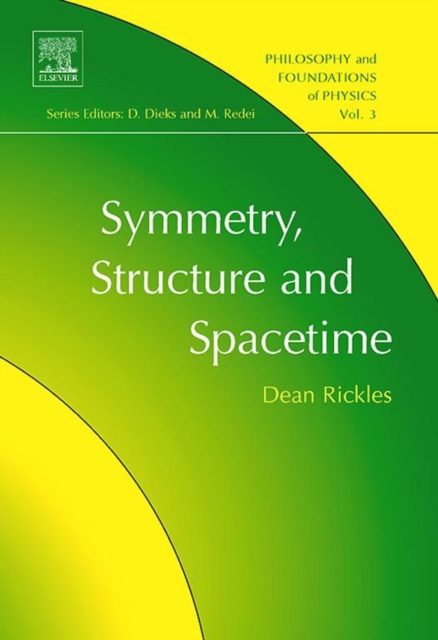
Symmetry, structure, and spacetime
In this book Rickles considers several interpretative difficulties raised by gauge-type symmetries (those that correspond to no change in physical state).The ubiquity of such symmetries in modern physics renders them an urgent topic in philosophy of physics.
eBook

Life is short : an appropriately brief guide to making it more meaningful
\"This brief book attempts to provide a 21st-century version of Seneca's classic essay, On the Shortness of Life. Like Seneca, Rickles seeks to motivate readers to meditate on how they use their time and offer some reasons why they mismanage this precious resource. Drawing on new developments in the understanding of time, the self, and human agency, in philosophy, psychology, neuroscience, and physics, Rickles's basic aim is to highlight the essential nature of the limit provided by death and the ways in which this fact gives life its meaning. The book will also point to a number of solutions (and potential pitfalls in these) aimed at using time more wisely. Throughout the book the focus is on a pair of competing personality styles that are found to be at the root of many of the problems Seneca unearthed, and can be associated with philosophical stances on personal identity and theories of time. These styles, commonly referred to in psychology as \"Puer\" and \"Senex\" are, respectively, the childish, present-focused type and the rational, future-focused, type. These styles relate in a fundamental way to how an individual reacts to being limited, whether by death or decision. The book will also deal with themes such as the concept of immortality; \"diseases of time,\" such as the hyperbolic discounting leading us to devalue our futures; and strategies for using the short life well. The book concludes by showing that it is not life that has ultimate meaning but death, and this ultimate limit is where life derives whatever meaning it will have\"-- Provided by publisher.
Book