
Catalogue Search | MBRL


Are you sure you want to remove the book from the shelf?

{{itemTitle}}
73
result(s) for
"Rispoli, Matthew"
Sort by:

Probing entanglement in a many-body–localized system
An interacting quantum system that is subject to disorder may cease to thermalize owing to localization of its constituents, thereby marking the breakdown of thermodynamics. The key to understanding this phenomenon lies in the system’s entanglement, which is experimentally challenging to measure. We realize such a many-body–localized system in a disordered Bose-Hubbard chain and characterize its entanglement properties through particle fluctuations and correlations. We observe that the particles become localized, suppressing transport and preventing the thermalization of subsystems. Notably, we measure the development of nonlocal correlations, whose evolution is consistent with a logarithmic growth of entanglement entropy, the hallmark of many-body localization. Our work experimentally establishes many-body localization as a qualitatively distinct phenomenon from localization in noninteracting, disordered systems.
Journal Article
Quantum thermalization through entanglement in an isolated many-body system
Statistical mechanics relies on the maximization of entropy in a system at thermal equilibrium. However, an isolated quantum many-body system initialized in a pure state remains pure during Schrödinger evolution, and in this sense it has static, zero entropy. We experimentally studied the emergence of statistical mechanics in a quantum state and observed the fundamental role of quantum entanglement in facilitating this emergence. Microscopy of an evolving quantum system indicates that the full quantum state remains pure, whereas thermalization occurs on a local scale. We directly measured entanglement entropy, which assumes the role of the thermal entropy in thermalization. The entanglement creates local entropy that validates the use of statistical physics for local observables. Our measurements are consistent with the eigenstate thermalization hypothesis.
Journal Article

Microscopy of the interacting Harper–Hofstadter model in the two-body limit
The combination of interparticle interactions and a synthetic gauge field leads to chirality in the propagation dynamics of particles in a ladder-like lattice.
Gauging two-body interactions
Simulating topological band structures, the corresponding edge states, and the quantum Hall effect with neutral atoms requires the introduction of artificial gauge fields. Although challenging, various groups have recently demonstrated artificial gauge fields in ultracold neutral-atom systems. However, up to now, these simulations have been limited to single-particle effects, meaning that many fascinating condensed-matter phenomena, such as the fractional quantum Hall effect, could not be studied. Here, the authors subject a two-dimensional Bose–Einstein condensate of rubidium-87 atoms to an artificial gauge field and use a quantum gas microscope to investigate how two-body interactions affect the chiral dynamics. If extended to many-body interactions, this strategy could enable the simulation of the interplay between many-body interactions and topology in condensed-matter physics.
The interplay between magnetic fields and interacting particles can lead to exotic phases of matter that exhibit topological order and high degrees of spatial entanglement
1
. Although these phases were discovered in a solid-state setting
2
,
3
, recent innovations in systems of ultracold neutral atoms—uncharged atoms that do not naturally experience a Lorentz force—allow the synthesis of artificial magnetic, or gauge, fields
4
,
5
,
6
,
7
,
8
,
9
,
10
. This experimental platform holds promise for exploring exotic physics in fractional quantum Hall systems, owing to the microscopic control and precision that is achievable in cold-atom systems
11
,
12
. However, so far these experiments have mostly explored the regime of weak interactions, which precludes access to correlated many-body states
4
,
13
,
14
,
15
,
16
,
17
. Here, through microscopic atomic control and detection, we demonstrate the controlled incorporation of strong interactions into a two-body system with a chiral band structure. We observe and explain the way in which interparticle interactions induce chirality in the propagation dynamics of particles in a ladder-like, real-space lattice governed by the interacting Harper–Hofstadter model, which describes lattice-confined, coherently mobile particles in the presence of a magnetic field
18
. We use a bottom-up strategy to prepare interacting chiral quantum states, thus circumventing the challenges of a top-down approach that begins with a many-body system, the size of which can hinder the preparation of controlled states. Our experimental platform combines all of the necessary components for investigating highly entangled topological states, and our observations provide a benchmark for future experiments in the fractional quantum Hall regime.
Journal Article
Strongly correlated quantum walks in optical lattices
Full control over the dynamics of interacting, indistinguishable quantum particles is an important prerequisite for the experimental study of strongly correlated quantum matter and the implementation of high-fidelity quantum information processing. We demonstrate such control over the quantum walk—the quantum mechanical analog of the classical random walk—in the regime where dynamics are dominated by interparticle interactions. Using interacting bosonic atoms in an optical lattice, we directly observed fundamental effects such as the emergence of correlations in two-particle quantum walks, as well as strongly correlated Bloch oscillations in tilted optical lattices. Our approach can be scaled to larger systems, greatly extending the class of problems accessible via quantum walks.
Journal Article

Quantum Virtual Cooling
We propose a quantum-information-based scheme to reduce the temperature of quantum many-body systems and access regimes beyond the current capability of conventional cooling techniques. We show that collective measurements on multiple copies of a system at finite temperature can simulate measurements of the same system at a lower temperature. This idea is illustrated for the example of ultracold atoms in optical lattices, where controlled tunnel coupling and quantum gas microscopy can be naturally combined to realize the required collective measurements to access a lower, virtual temperature. Our protocol is experimentally implemented for a Bose-Hubbard model on up to 12 sites, and we successfully extract expectation values of observables at half the temperature of the physical system. Additionally, we present related techniques that enable the extraction of zero-temperature states directly.
Journal Article

Early Speech Rate Development: A Longitudinal Study
Purpose: Our knowledge of speech rate development remains inadequate because of limited longitudinal data and lack of data from children under age 3;0 (years;months). The purpose of this longitudinal study was to test the pattern of speech rate development between ages 2;0 and 3;0. Method: Speech rate was assessed at 4 time points between ages 2;0 and 3;0. The analysis employed multilevel models to characterize the development of speech rate (syllables per second), phonemes per second (PPS), length of active declarative sentences, and mean length of utterance. Results: The results indicate a significant linear increase in speech rate, PPS, length of active declarative sentences, and mean length of utterance occurring over the 1-year period. Male and female children differed in speech rate, PPS, and utterance length, suggesting sex is a potential factor in early speech rate development. Conclusions: Our findings indicate that the speech motor system develops rapidly during the period when grammar emerges. Speech rate has the potential to be an important metric for understanding typical speech development and speech disorders.
Journal Article
Changing the Subject: The Place of Revisions in Grammatical Development
Purpose: This article focuses on toddlers' revisions of the sentence subject and tests the hypothesis that subject diversity (i.e., the number of different subjects produced) increases the probability of subject revision. Method: One-hour language samples were collected from 61 children (32 girls) at 27 months. Spontaneously produced, active declarative sentences (ADSs) were analyzed for subject diversity and the presence of subject revision and repetition. The number of different words produced, mean length of utterance, tense/agreement productivity score, and the number of ADSs were also measured. Results: Regression analyses were performed with revision and repetition as the dependent variables. Subject diversity significantly predicted the probability of revision, whereas the number of ADSs predicted the probability of repetition. Conclusion: The results support the hypothesis that subject diversity increases the probability of subject revision. It is proposed that lexical diversity within specific syntactic positions is the primary mechanism whereby revision rates increase with grammatical development. The results underscore the need to differentiate repetition from revision in the classification of disfluencies.
Journal Article
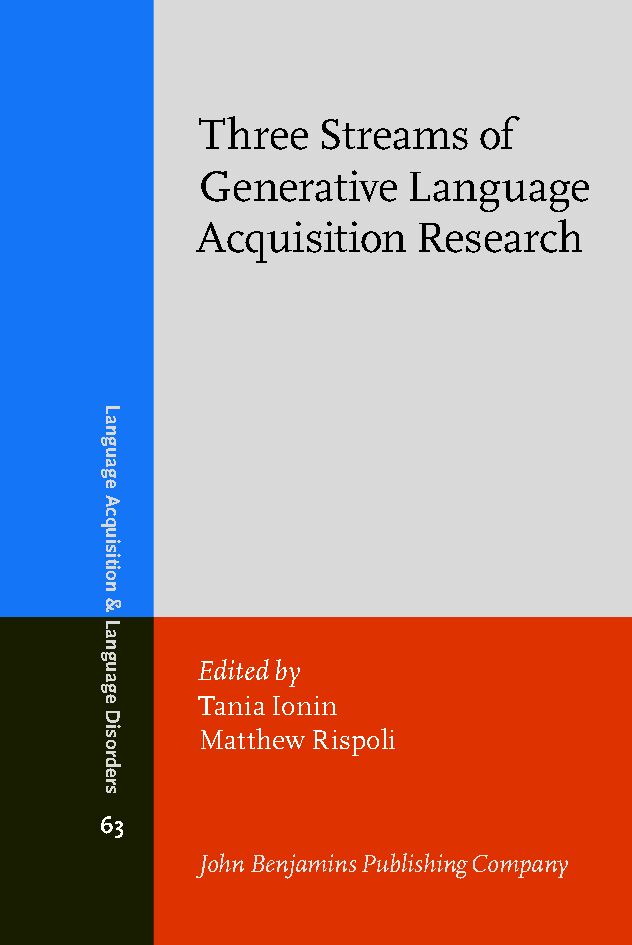
Three streams of generative language acquisition research : selected papers from the 7th meeting of Generative Approaches to Language Acquisition - North America, University of Illinois at Urbana-Champaign
This edited volume contains a representative sample of papers presented at the 7th meeting of the Generative Approaches to Language Acquisition - North America (GALANA-7) conference. The book features three streams of research (Variation in Input, First Language Acquisition, and Second Language Acquisition), each of which investigates the nature of language acquisition from the generative perspective. A unique feature of the GALANA-7 conference, and of this volume, is the bringing together of research on generative language acquisition and research on the role that cross-dialectal input variation plays in acquisition. This volume should be of interest to scholars and students of first language acquisition, second language acquisition, and input variation.
eBook
Quantum critical behaviour at the many-body localization transition
Phase transitions are driven by collective fluctuations of a system’s constituents that emerge at a critical point
1
. This mechanism has been extensively explored for classical and quantum systems in equilibrium, whose critical behaviour is described by the general theory of phase transitions. Recently, however, fundamentally distinct phase transitions have been discovered for out-of-equilibrium quantum systems, which can exhibit critical behaviour that defies this description and is not well understood
1
. A paradigmatic example is the many-body localization (MBL) transition, which marks the breakdown of thermalization in an isolated quantum many-body system as its disorder increases beyond a critical value
2
–
11
. Characterizing quantum critical behaviour in an MBL system requires probing its entanglement over space and time
4
,
5
,
7
, which has proved experimentally challenging owing to stringent requirements on quantum state preparation and system isolation. Here we observe quantum critical behaviour at the MBL transition in a disordered Bose–Hubbard system and characterize its entanglement via its multi-point quantum correlations. We observe the emergence of strong correlations, accompanied by the onset of anomalous diffusive transport throughout the system, and verify their critical nature by measuring their dependence on the system size. The correlations extend to high orders in the quantum critical regime and appear to form via a sparse network of many-body resonances that spans the entire system
12
,
13
. Our results connect the macroscopic phenomenology of the transition to the system’s microscopic structure of quantum correlations, and they provide an essential step towards understanding criticality and universality in non-equilibrium systems
1
,
7
,
13
.
Quantum critical behaviour at the many-body localization transition in a disordered Bose–Hubbard system of bosonic rubidium atoms in an optical lattice is observed, connecting the macroscopic phenomenology of the transition to the system’s microscopic quantum correlations.
Journal Article

Probing the onset of quantum avalanches in a many-body localized system
Strongly correlated systems can exhibit unexpected phenomena when brought in a state far from equilibrium. An example is many-body localization, which prevents generic interacting systems from reaching thermal equilibrium even at long times1,2. The stability of the many-body localized phase has been predicted to be hindered by the presence of small thermal inclusions that act as a bath, leading to the delocalization of the entire system through an avalanche propagation mechanism3–8. Here we study the dynamics of a thermal inclusion of variable size when it is coupled to a many-body localized system. We find evidence for accelerated transport of thermal inclusion into the localized region. We monitor how the avalanche spreads through the localized system and thermalizes it site by site by measuring the site-resolved entropy over time. Furthermore, we isolate the strongly correlated bath-induced dynamics with multipoint correlations between the bath and the system. Our results have implications on the robustness of many-body localized systems and their critical behaviour.The presence of small thermal regions in a many-body localized system could lead to its delocalization. An experiment with cold atoms now monitors the delocalization induced by the coupling of a many-body localized region with a thermal bath.
Journal Article