
Catalogue Search | MBRL


Are you sure you want to remove the book from the shelf?

{{itemTitle}}
154
result(s) for
"Robert D Bullard"
Sort by:

Just Sustainabilities
Environmental activists and academics alike are realizing that a sustainable society must be a just one. Environmental degradation is almost always linked to questions of human equality and quality of life. Throughout the world, those segments of the population that have the least political power and are the most marginalized are selectively victimized by environmental crises. This book argues that social and environmental justice within and between nations should be an integral part of the policies and agreements that promote sustainable development. The book addresses the links between environmental quality and human equality and between sustainability and environmental justice.
eBook

Pesticides and environmental injustice in the USA: root causes, current regulatory reinforcement and a path forward
Many environmental pollutants are known to have disproportionate effects on Black, Indigenous and People of Color (BIPOC) as well as communities of low-income and wealth. The reasons for these disproportionate effects are complex and involve hundreds of years of systematic oppression kept in place through structural racism and classism in the USA. Here we analyze the available literature and existing datasets to determine the extent to which disparities in exposure and harm exist for one of the most widespread pollutants in the world – pesticides. Our objective was to identify and discuss not only the historical injustices that have led to these disparities, but also the current laws, policies and regulatory practices that perpetuate them to this day with the ultimate goal of proposing achievable solutions. Disparities in exposures and harms from pesticides are widespread, impacting BIPOC and low-income communities in both rural and urban settings and occurring throughout the entire lifecycle of the pesticide from production to end-use. These disparities are being perpetuated by current laws and regulations through 1) a pesticide safety double standard, 2) inadequate worker protections, and 3) export of dangerous pesticides to developing countries. Racial, ethnic and income disparities are also maintained through policies and regulatory practices that 4) fail to implement environmental justice Executive Orders, 5) fail to account for unintended pesticide use or provide adequate training and support, 6) fail to effectively monitor and follow-up with vulnerable communities post-approval, and 7) fail to implement essential protections for children. Here we’ve identified federal laws, regulations, policies, and practices that allow for disparities in pesticide exposure and harm to remain entrenched in everyday life for environmental justice communities. This is not simply a pesticides issue, but a broader public health and civil rights issue. The true fix is to shift the USA to a more just system based on the Precautionary Principle to prevent harmful pollution exposure to everyone, regardless of skin tone or income. However, there are actions that can be taken within our existing framework in the short term to make our unjust regulatory system work better for everyone.
Journal Article
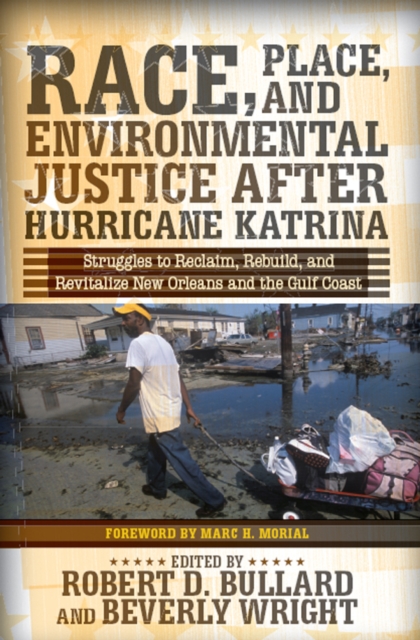
Race, Place, and Environmental Justice After Hurricane Katrina
On August 29, 2005, Hurricane Katrina made landfall near New Orleans leaving death and destruction across the Louisiana, Mississippi, and Alabama Gulf Coast counties. The lethargic and inept emergency response that followed exposed institutional flaws, poor planning, and false assumptions that are built into the emergency response and homeland security plans and programs. Questions linger: What went wrong? Can it happen again? Is our government equipped to plan for, mitigate, respond to, and recover from natural and manmade disasters? Can the public trust government response to be fair? Does race matter? Racial disparities exist in disaster response, cleanup, rebuilding, reconstruction, and recovery. Race plays out in natural disaster survivors' ability to rebuild, replace infrastructure, obtain loans, and locate temporary and permanent housing. Generally, low-income and people of color disaster victims spend more time in temporary housing, shelters, trailers, mobile homes, and hotels - and are more vulnerable to permanent displacement. Some 'temporary' homes have not proved to be that temporary. In exploring the geography of vulnerability, this book asks why some communities get left behind economically, spatially, and physically before and after disasters strike.
eBook

The Black metropolis in the twenty-first century
This book brings together key essays that seek to make visible and expand our understanding of the role of government (policies, programs, and investments) in shaping cities and metropolitan regions; the costs and consequences of uneven urban and regional growth patterns; suburban sprawl and public health, transportation, and economic development; and the enduring connection of place, space, and race in the era of increased globalization. Whether intended or unintended, many government policies (housing, transportation, land use, environmental, economic development, education, etc.) have aided and in some cases subsidized suburban sprawl, job flight, and spatial mismatch; concentrated urban poverty; and heightened racial and economic disparities. Written mostly by African American scholars, the book captures the dynamism of these meetings, describing the challenges facing cities, suburbs, and metropolitan regions as they seek to address continuing and emerging patterns of racial polarization in the twenty-first century. The book clearly shows that the United States entered the new millennium as one of the wealthiest and the most powerful nations on earth. Yet amid this prosperity, our nation is faced with some of the same challenges that confronted it at the beginning of the twentieth century, including rising inequality in income, wealth, and opportunity; economic restructuring; immigration pressures and ethnic tension; and a widening gap between 'haves' and 'have-nots.' Clearly, race matters. Place also matters. Where we live impacts the quality of our lives and chances for the 'good life.'
eBook

Environmental health and racial equity in the United States : building environmentally just, sustainable, and livable communities
From the \"Father of Environmental Justice\" comes, Environmental Health and Racial Equity, a first-rate account of events, individuals, and organizations that have shaped the environmental justice movement over the past two decades. The struggles chronicled are both instructive and inspirational to anyone who wants to make a difference.
eBook

Differential Vulnerabilities: Environmental and Economic Inequality and Government Response to Unnatural Disasters
This paper uses an environmental justice framework to examine government response to weather-related disasters dating back some eight decades. It places the 2005 Hurricane Katrina disaster in socio-historical context of past emergencies with an emphasis on race and class dynamics and social vulnerability. Key questions explored include: What went wrong? Can it happen again? Is government equipped to plan for, mitigate against, respond to, and recover from natural and manmade disasters? Can the public trust government response to be fair? Why are so many African Americans \"locked out\" of New Orleans' post-Katrina rebuilding, reconstruction, and recovery? Adapted from the source document.
Journal Article
Growing smarter : achieving livable communities, environmental justice, and regional equity
Experts from academic, government, and nonprofit organisations offer an environmental justice perspective on Smart Growth, discussing equitable solutions to suburban sprawl and urban decay.
eBook
Environmental Justice
Environmental Justice: Key Issues is the first textbook to offer a comprehensive and accessible overview of environmental justice, one of the most dynamic fields in environmental politics scholarship.
The rapidly growing body of research in this area has brought about a proliferation of approaches; as such, the breadth and depth of the field can sometimes be a barrier for aspiring environmental justice students and scholars. This book therefore is unique for its accessible style and innovative approach to exploring environmental justice. Written by leading international experts from a variety of professional, geographic, ethnic, and disciplinary backgrounds, its chapters combine authoritative commentary with real-life cases. Organised into four parts—approaches, issues, actors and future directions—the chapters help the reader to understand the foundations of the field, including the principal concepts, debates, and historical milestones. This volume also features sections with learning outcomes, follow-up questions, references for further reading and vivid photographs to make it a useful teaching and learning tool.
Environmental Justice: Key Issues is the ideal toolkit for junior researchers, graduate students, upper-level undergraduates, and anyone in need of a comprehensive introductory textbook on environmental justice.
eBook

Environmental Justice: It's More Than Waste Facility Siting
In a reply comment on the article by Tracy Yandle & Dudley Burton on historical hazardous waste landfill siting patterns in TX (1996 [see abstract 9718271]), it is argued that the authors fail to provide either an adequate conceptual analysis of environmental justice or an accurate sociocultural context for their study. Seven erroneous assumptions are identified that severely limit their conclusions: (1) environmental justice is limited to waste facility siting; (2) ignoring some facilities & communities will not affect study results; (3) all census tracts are similar in terms of population density & proximity of the population to the facilities; (4) census tracts represent homogeneous communities; (5) all hazardous waste landfills are essentially the same; (6) environmental justice & environmental racism are the same; & (7) principles of environmental justice do not apply to poor white communities. Noting the effect of each faulty assumption, it is concluded that Yandle & Burton have failed to appreciate the full scope of environmental justice, invalidating the conclusions drawn from their statistical analysis. 11 References. S. Barrera
Journal Article
