
Catalogue Search | MBRL


Are you sure you want to remove the book from the shelf?

{{itemTitle}}
326
result(s) for
"Robert S. Birchard"
Sort by:
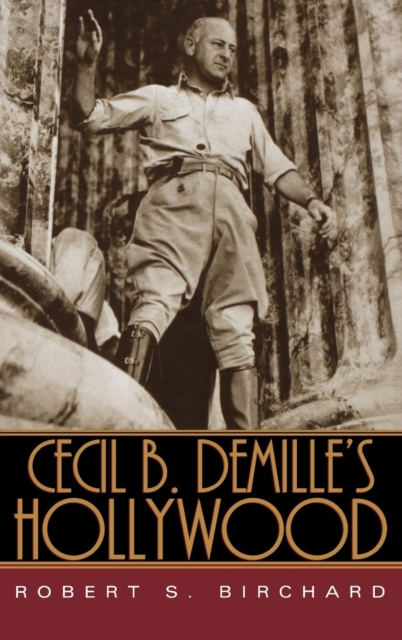
Cecil B. DeMille's Hollywood
\" \"\"Far and away the best film book published so far this year.\"\"--National Board of Review Cecil B. DeMille was the most successful filmmaker in early Hollywood history. Cecil B. DeMille's Hollywood is a detailed and definitive chronicle of the screen work that changed the course of film history and a fascinating look at how movies were actually made in Hollywood's Golden Age. Drawing extensively on DeMille's personal archives and other primary sources, Robert S. Birchard offers a revealing portrait of DeMille the filmmaker that goes behind studio gates and beyond DeMille's legendary persona. In his forty-five-year career DeMille's box-office record was unsurpassed, and his swaggering style established the public image for movie directors. DeMille had a profound impact on the way movies tell stories and brought greater attention to the elements of decor, lighting, and cinematography. Best remembered today for screen spectacles such as The Ten Commandments and Samson and Delilah, DeMille also created Westerns, realistic \"chamber dramas,\" and a series of daring and highly influential social comedies. He set the standard for Hollywood filmmakers and demanded absolute devotion to his creative vision from his writers, artists, actors, and technicians.
eBook

Nitrate Machos vs. Nitrate Nellies: Buccaneer Days at the UCLA Film and Television Archive
Birchard discusses his experiences in the early years of the University of California, Los Angeles (UCLA) Film and Television Archive, starting in the late 1960s and early 70s. He profiles faculty member Bob Epstein, who was integral to shaping the archive. Birchard also comments on the storage of the archives, the collection, the archive's relationship with Paramount Pictures, the preservation program, and other related topics.
Journal Article

Conversations with Irvin V. Willat
Provides a transcript of several interviews with film director Irvin V. Willat compiled from two sessions which occurred on 9 June and 20 November 1971. Introduces the transcript with a brief biographical profile of the now deceased director. States that his personality \"jumps off the page.\" Focuses on Willat's passion for the movies, the observation of detail, the way he worked, and his attitudes about people and events.
Journal Article


Union Pacific
FollowingThe BuccaneerDeMille planned to make a film dealing with the history of Canada’s Hudson Bay Company and, true to his earlier word to Jesse Lasky Jr., he assigned the young screenwriter to conduct research and outline a story for the film. The idea was abandoned when DeMille discovered that 20th Century-Fox had a similar project in preparation.¹
Industry trade magazine publisher Martin Quigley suggested a film based on the building of the transcontinental railroad, and DeMille was not dissuaded when he learned that Warner Bros. had already registered the titleUnion Pacificwith the Motion Picture Producers and
Book Chapter
The Dream Girl
Cecil B. DeMille drastically cut back his production schedule in 1916. In part because of the prestige he gained with the Geraldine Farrar pictures and as a reward for his contributions to the success of the Lasky Feature Play Company, DeMille was given the opportunity to make larger-scale, special productions outside the quota of Paramount program pictures. During the year he concentrated his efforts on his first “big picture,”Joan the Woman,and directed only three other films. The third of his programmers for the year,The Dream Girlwas made very cheaply and cannot have been of much interest
Book Chapter